
 CA
 NZ
 UK
 AU
 IND

 US

 Share
 X (Formerly Twitter)
 Whatsapp
 Facebook
 LinkedIn
 Telegram
 Email This Article
 Copy Link
 Summarize with AI
 Chat GPT
 Perplexity
Key Highlghts
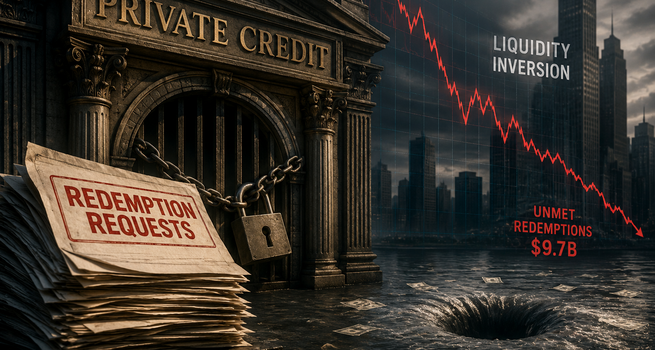
- The Liquidity Inversion: A staggering -$15.6 billion in quarterly redemptions was requested by investors in Q2 2026, marking a massive 500% surge in exit demands over three consecutive quarters.
- The Exit Gate Clogs: Only 38% of withdrawal requests were successfully fulfilled, down from 53% in Q1. This structural backlog has left a record $9.7 billion in unmet redemptions marooned within the sector.
- Flaginals Under Pressure: The industry's largest managers bore the brunt of the squeeze. Blue Owl faced exit requests for 19% of its outstanding shares, closely followed by Apollo at 16% and Ares at 14%.
- Fundraising Dries Up: The structural bottleneck was severely compounded by a -75% collapse in monthly capital inflows since January, with May pulling in just ~$500 million—the lowest intake in 18 months.
- Arbitrage and Illiquidity: The rush for the exit is being aggressively driven by a widening valuation gap, as publicly traded peers trade at sharp discounts while non-traded vehicles artificially maintain stable book values.
For half a decade, private credit was heralded as the undisputed king of alternative investments. Following the regional banking scares of the early 2020s, non-bank lenders rapidly filled the void, vacuuming up retail and institutional capital to build an asset class that surpassed $2 trillion globally by 2025. Yield-hungry investors piled into semi-liquid vehicles—most notably non-traded Business Development Companies (BDCs)—enticed by high floating-rate returns and the promise of a stable, insulated exit path via quarterly redemption windows.
But by mid-2026, the structural architecture underpinning this massive capital migration hit a historic wall.
Data compiled by alt-investment tracking authority Robert A. Stanger & Co. reveals that a profound liquidity inversion has fundamentally altered the private credit landscape. In the second quarter of 2026, investors requested an unprecedented -$15.6 billion in redemptions from non-traded BDCs. This marks the third consecutive quarterly increase in withdrawal demands, representing an astronomical +$13 billion escalation (a 500% surge) from the baseline trends seen late last year.
Worse still, the mechanism designed to provide orderly exits is clogging. Just 38% of those redemption requests were met in Q2 2026, down sharply from 53% in the first quarter. This structural bottleneck has left $9.7 billion in unmet redemptions, creating the largest backlog of unfulfilled retail liquidity requests in the history of the private credit market. Coupled with a devastating -75% collapse in monthly capital inflows since January, the multi-trillion-dollar private credit complex faces its most severe operational test to date.
The Anatomy of the Inversion
To understand how the private credit market arrived at this hairpin turn, one must examine the delicate mechanics of the non-traded, perpetual-life BDC structure. Unlike publicly listed BDCs, which trade daily on stock exchanges at fluctuating premiums or discounts to their Net Asset Value (NAV), non-traded BDCs offer shares directly to wealth-channel clients at a fixed NAV.
To prevent forced liquidations of the illiquid corporate loans that comprise their portfolios, these funds feature built-in guardrails: they typically limit quarterly share repurchases (tenders) to 5% of total outstanding net assets.
For years, this 5% cap was an abstract security feature because redemption requests hovered at a negligible 1% to 2% per quarter. Inflows from new retail investors vastly exceeded outflows, providing managers with a constant stream of fresh cash to fund new mid-market corporate loans and easily satisfy exiting shareholders.
By late 2025 and early 2026, however, that dynamic inverted completely.
As detailed in The Stanger Report, the first quarter of 2026 marked the first time in the sector’s history that gross capital outflows structurally outpaced inflows. Publicly registered non-listed BDCs raised just $4.9 billion in fresh capital in Q1, while sponsors were hit with a massive wave of redemptions. By Q2 2026, the mismatch widened into a chasm. The total redemption requests scaled to -$15.6 billion, while monthly capital inflows slowed to a trickle, dropping from multi-billion-dollar monthly clips down to just ~$500 million in May 2026—the smallest intake in over 18 months.
Gated and Prorated: Major Managers Under Pressure
The consequences of this liquidity mismatch have manifested as severe proration across the industry's flagship platforms. When a fund receives redemption requests equal to 15% or 20% of its outstanding assets but maintains a strict 5% repurchase limit, it is legally required to fulfill those requests on a pro-rata basis. Investors seeking to exit are being handed fractional liquidity, while the rest of their capital is effectively locked behind the fund's gates.
The pressure is highly concentrated among the industry's mega-cap asset managers, with several prominent credit shops hitting their structural limits:
Blue Owl Capital
Blue Owl's flagship retail vehicle, Blue Owl Credit Income Corp. (OCIC), emerged as the most heavily impacted vehicle in the Q2 cycle. Investors filed redemption requests representing a staggering 19% of the fund's total shares outstanding. Adhering to its structural risk limits, the fund was unable to absorb the wave, leaving 14% of its outstanding shares unmet—the highest unfulfilled redemption rate among its large peers.
Apollo Global Management
Apollo experienced a similar wealth-channel bottleneck. Repurchase requests for its core non-traded credit vehicle hit 16% of outstanding shares. Because Apollo strictly enforced its quarterly tender caps to protect portfolio integrity, 11% of total investor requests went unmet, leaving billions of dollars of wealth-management allocations stuck in queues.
Ares Management
Ares, a pioneer in the private debt ecosystem, was not immune to the sector-wide rebalancing. Tenders against its core strategic income platform climbed to 14% of shares outstanding, forcing the manager to prorate distributions and leaving 9% unmet.
Summary of Q2 2026 Top BDC Redemption Stress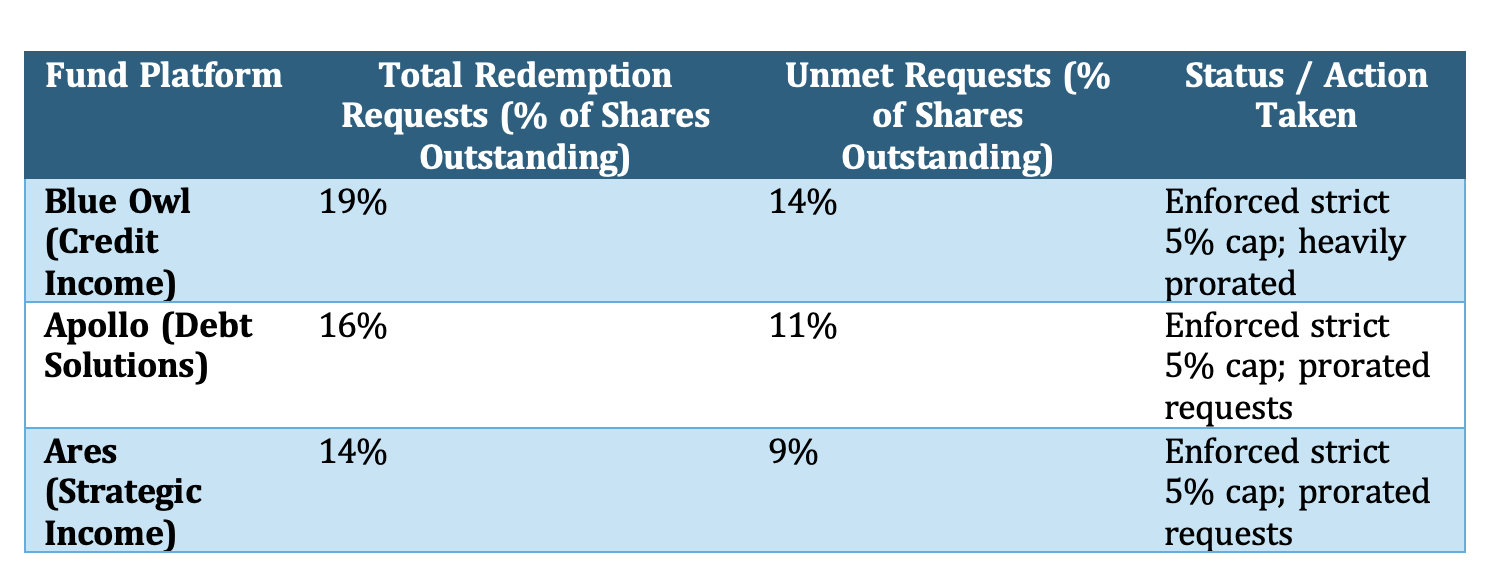
What is Driving the Exit? The Core Catalysts
This sudden, aggressive rush for the exit is not a randomized market event; it is driven by a convergence of macroeconomic shifts, deteriorating loan portfolios, and structural valuation arbitrage.
1. The Asset Allocation Rotation: The Rise of "HALO"
According to industry analysis from Robert A. Stanger & Co., the massive spike in redemptions is partially a reflection of institutional and high-net-worth investors rebalancing their portfolios. In 2023 and 2024, private credit was the primary beneficiary of the Federal Reserve's "higher for longer" interest rate environment, as floating-rate corporate debt generated double-digit yields.
By 2026, however, investors began proactively rotating capital out of pure corporate credit and shifting toward HALO strategies (Hard Assets with Low Obsolescence), including core infrastructure and real estate assets, which have experienced a parallel fundraising boom.
2. Rising Portfolio Friction: Non-Accruals and PIK Income
Underneath the asset allocation shift lies a more troubling driver: a steady, undeniable rise in borrower stress. Data from private credit research firm Octus highlights that aggregate BDC non-accruals (loans where borrowers have defaulted or stopped making interest payments) jumped dramatically by 40% sequentially moving into 2026, climbing from $7.12 billion to $9.98 billion.
Simultaneously, the use of Payment-in-Kind (PIK) income has trended upward, averaging over 4.5% in the non-traded sector. PIK allows stressed mid-market corporate borrowers to pay their interest obligations using additional debt rather than cash. While this gives struggling companies breathing room, it means BDCs are reporting accounting income that is not backed by actual cash flow, sparking fears among advisors that underlying dividend yields may become unsustainable.
3. Net Asset Value (NAV) Arbitrage
Perhaps the most direct catalyst for retail liquidations is the valuation mismatch between private and public markets. Throughout late 2025 and 2026, publicly traded BDCs began trading at significant discounts to their NAV—frequently between 15% to 25% below book value—as public equity investors priced in corporate defaults and macroeconomic headwinds.
In contrast, non-traded BDCs continued to value their private loan portfolios at or near 100 cents on the dollar, keeping their stated NAVs remarkably stable. This created an immediate arbitrage opportunity for sophisticated wealth advisors. If an investor can redeem their shares at a stated 100% NAV from a non-traded fund, but the broader public market implies that the "real" underlying credit value is worth only 80% of NAV, the rational fiduciary choice is to pull capital out before the manager is forced to mark the portfolio down.
Systemic Failure or Structure Working as Designed?
The critical question now confronting Wall Street, the Federal Reserve, and the wealth management channel is whether this $9.7 billion backlog represents an existential crisis for private credit or a validation of its structural design.
In its May 2026 Financial Stability Report, the Federal Reserve specifically evaluated the mounting redemption pressure on non-traded BDCs, characterizing the systemic risk to the broader financial architecture as "limited and manageable." The central bank's constructive view is shared by industry executives like Kevin T. Gannon, Chairman and CEO of Robert A. Stanger & Co., who argues that the current proration wave proves the semi-liquid fund model is functioning exactly as it was intended:
"What we're watching is a rotation, not a retreat... The semi-liquid structure allows investors to rebalance on defined terms, protecting the investors who want to stay without forcing distressed asset sales inside the fund. That's the mechanism working exactly as intended."
This perspective underscores a fundamental truth about alternative assets: mismatched liquidity is a feature, not a bug. If these multi-billion-dollar funds operated with daily liquidity features like standard mutual funds or ETFs, a sudden -$15.6 billion redemption wave would force managers to panic-sell their illiquid senior secured corporate loans at deep discounts, destroying the fund's performance and triggering a localized credit meltdown. By strictly enforcing 5% caps and prorating withdrawals, managers insulate the underlying portfolio, ensuring that corporate borrowers are not disrupted and remaining investors are protected from a run on the fund.
The Road Ahead for Private Credit
While the structural guardrails are successfully preventing catastrophic fire sales, the current liquidity trap will have profound operational consequences for the private credit landscape through the remainder of 2026 and into 2027.
- Increased Reliance on Leverage and Credit Facilities: With new capital inflows down -75% to just $500 million monthly, BDC managers can no longer rely on fresh investor capital to fund their operations. To meet the $5.9 billion in quarterly redemptions they do honor, alongside funding existing loan commitments, firms will be forced to draw heavily down on their corporate credit lines and increase portfolio leverage closer to regulatory caps.
- A Hard Brake on New Loan Originations: Because a significant portion of available cash flow must now be reserved to fund quarterly redemption tenders and service debt facilities, private credit platforms will have substantially less dry powder to deploy into the market. This capital contraction will dramatically slow down new mid-market deal originations, forcing private equity sponsors to look elsewhere for debt financing.
- The Flight to Institutional Scale: The liquidity crunch will inevitably accelerate an industry-wide consolidation cycle. Mega-platforms with multi-asset capabilities, robust balance sheets, and dedicated workout teams can successfully manage a prolonged proration cycle. Smaller, sector-concentrated non-traded BDCs, however, will face severe pressure, likely forcing them to merge with larger public peers or halt originations entirely.
The private credit gold rush has officially ended, giving way to a sober, institutional era of liquidity management. The vehicles that promised to democratize access to private debt are holding the line, but the $9.7 billion in unmet redemptions serves as a stark reminder to the wealth channel that in the world of alternative investments, exiting is a luxury, not a guarantee.
FAQs


 Nov 17, 2026





 Please wait processing your request...