
 CA
 NZ
 UK
 AU
 IND

 US

 Share
 X (Formerly Twitter)
 Whatsapp
 Facebook
 LinkedIn
 Telegram
 Email This Article
 Copy Link
 Summarize with AI
 Chat GPT
 Perplexity
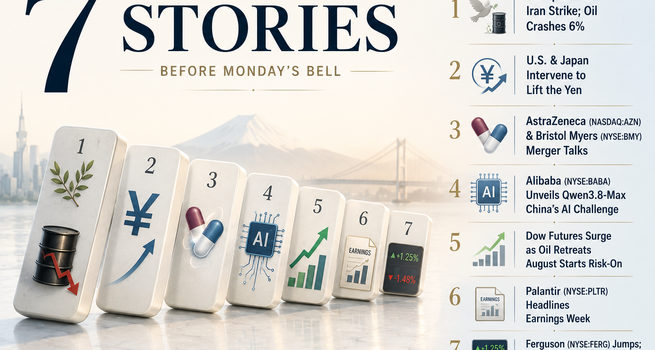
Trump cancelled what would have been the largest strike on Iran since World War II, sending oil crashing more than 6% and lifting futures on the first trading day of August. The U.S. Treasury confirmed a coordinated intervention with Japan to prop up the yen, the first joint move since last September's agreement, while a report that AstraZeneca and Bristol-Myers Squibb are in Merger talks sent the two stocks in opposite directions. Alibaba unveiled its most powerful AI model yet as Palantir leads a busy Monday of Earnings .
1. IRAN: Trump Cancels Planned Strike, Would Have Been Biggest Since WWII; Talks Set to Begin Monday Afternoon; Iran Denies Any Negotiations Planned; Oil Crashes 6%
Trump said he called off a planned strike on Iran after being asked to hold off by Saudi Arabia, the United Arab Emirates, Qatar, and Iran itself, adding that the perimeters of a deal had been agreed and that negotiations would begin Monday afternoon. He described a proposed agreement covering the immediate and complete reopening of the Strait of Hormuz and an end to Iran's nuclear threat as imminent, and said Saturday the planned operation would have been the biggest since World War II.
Iran's foreign ministry spokesperson Esmail Baghaei denied any immediate plan for talks with the U.S., saying Tehran is currently only in discussions with Oman over the strait; the IRGC-linked news agency separately dismissed Trump's proposal as a wish list, while Iran's acting defence minister called the U.S. statements part of a psychological warfare campaign but said all threats are taken seriously. Oil crashed on the news: WTI fell more than 6% to near $78 a barrel, and Brent lost more than 5% to near $82.99-83.39.
- The six percent single-session oil decline is one of the sharpest moves of this series, confirming how much war premium remained priced into crude even after weeks of intermittent ceasefire and escalation cycles.
- Iran's public denial of talks arriving within hours of Trump's announcement is the same pattern of diplomatic ambiguity that has characterised prior de-escalation attempts in this conflict, where U.S. optimism and Iranian statements have consistently diverged.
- Risk note: BMI raised its probability of renewed escalation to 35% from 25% even as this de-escalation news broke, and a UKMTO-reported explosion near a tanker close to Khasab, Oman, at the mouth of Hormuz, shows shipping risk persisting on the water regardless of the diplomatic headlines; a single miscalculation could reverse today's oil move within a session.
2. YEN: U.S. and Japan Confirm First Coordinated Intervention Since September Agreement; Yen Strengthens From ¥163.73 to ¥155-157.70; Questions Raised Over Use of Euros Instead of Dollars
Japan's Finance Ministry confirmed a coordinated yen-buying operation conducted with the U.S. Treasury on Friday, describing it as a rare joint move to stem sharp currency swings; the yen had hit 163.73 to the dollar Thursday before strengthening to a range of 155-157.70 by Monday. Treasury Secretary Scott Bessent confirmed the action, saying the U.S. will not hesitate to participate in further joint intervention, while Japan's finance minister Katayama Satsuki said the countries were ready to do more.
The intervention was carried out under the joint statement framework agreed in September 2025, and Japan separately announced plans to draw on the Federal Reserve's foreign and international monetary authorities repo Facility if needed. Reports that the U.S. funded its side of the operation with euros rather than dollars surprised markets, since coordinated interventions have traditionally been funded with dollar Assets .
- A joint intervention this explicit, confirmed publicly by both Treasury and Japan's Finance Ministry rather than left to speculation, signals both governments see the yen's weakness as having crossed a threshold requiring visible coordination rather than quiet market operations.
- The euro-funding detail is analytically significant beyond the headline move: if confirmed, it suggests U.S. officials structured the operation to avoid Japan needing to sell Treasuries to finance its side, a choice aimed at protecting Bond Market stability but one that outside analysts argue undercuts the intervention's credibility.
- Risk note: if the yen resumes its slide toward the four-decade lows seen before the intervention, the euro-funding structure becomes a live question for markets pricing whether this was a durable policy shift or a one-off gesture ahead of further Fed and BOJ divergence.
3. ASTRAZENECA/BRISTOL-MYERS: Shares Move in Opposite Directions After FT Reports Merger Talks; AstraZeneca Falls More Than 7%, Bristol-Myers Jumps More Than 3%
AstraZeneca ( Nasdaq :AZN) and Bristol-Myers Squibb (NYSE:BMY) shares moved in opposite directions Monday after the Financial Times reported the two pharmaceutical companies were in talks to merge; AstraZeneca fell more than 7% while Bristol-Myers jumped more than 3%. Neither company has publicly confirmed the report. The divergent stock reaction, one company falling and the other rising on the same reported deal, reflects the market's initial read on which side would bear dilution risk versus Acquisition premium in a combination of two large-cap pharmaceutical names.
- AstraZeneca's decline on merger speculation typically signals investors pricing it as the larger, acquiring party facing integration and financing risk, while Bristol-Myers' rise is consistent with the market treating it as the target commanding a premium.
- A combination of this scale would create one of the largest pharmaceutical companies globally by Market Capitalisation , with a portfolio spanning oncology, cardiovascular, and immunology franchises across both companies' current pipelines.
- Risk note: until either company confirms or denies the report, the stock moves reflect pure speculation; if talks are denied or Fail to materialise into a formal agreement, both stocks face a Reversal of today's opposing moves, with AstraZeneca likely to recover and Bristol-Myers likely to give back its gain.
4. ALIBABA: Unveils Qwen3.8-Max, 2.4 Trillion Parameters, Scores Comparable to Anthropic's Fable 5; Shares Rise 7%.
Alibaba (NYSE:BABA) unveiled Qwen3.8-Max, its most powerful AI model to date, with 2.4 trillion parameters and support for a context window of up to 1 million tokens, scheduled for official release next week. The company shared benchmark results showing the model delivering comparable or in some cases better scores than Anthropic's Fable 5, ranking second in the Vision Arena and fifth in the Text Arena.
Qwen3.8-Max can reportedly work autonomously on coding tasks for weeks with minimal human input; in one internal test it spent 16 days independently building and refining an AI coding tool. The release follows domestic rival Moonshot AI's Kimi K3, a 2.8 trillion parameter model that is currently China's largest. Alibaba's U.S.-listed shares rose 4-4.5% pre-market, while its Hong Kong-listed shares gained 7%.
- Benchmark Parity or outperformance against a leading U.S. frontier model is a materially different competitive claim than prior Chinese model releases in this series, most of which positioned themselves as capable but trailing rather than comparable at the frontier.
- The 16-day autonomous coding test is the most concrete demonstration yet in this series of extended agentic capability from a Chinese lab, a capability class that has so far been dominated by U.S. developer narratives.
- Risk note: benchmark scores self-reported by the model's own developer carry inherent selection bias; independent verification against Fable 5 and other frontier models will determine whether today's rally reflects a genuine capability shift or a well-marketed release.
5. FUTURES/MARKETS: Dow Futures Jump 557 Points on Iran News; 10-Year Yield Falls to 4.68%; Europe Higher, Asia Mixed as Kospi Gives Back Friday's Record Gain
U.S. Equity futures rose sharply on the Iran de-escalation news: Dow futures added 600 points, or nearly 1.2%, S& Amp ;P 500 futures advanced 0.6%, and Nasdaq-100 futures ticked up 0.2%. The 10-year Treasury Yield fell 6 basis points to 4.68% as Inflation worries eased slightly alongside the oil price collapse.
European markets traded higher, with Germany's DAX leading gains at 1.3%, France's CAC 40 up almost 1.1%, and the pan-European Stoxx 600 up 0.3%, while the UK's FTSE 100 dipped slightly. Asia-Pacific markets were mixed: South Korea's Kospi fell more than 5%, giving back gains from Friday's record session, Japan's Nikkei 225 slid 0.94%, Australia's ASX 200 rose 0.47%, and China's CSI 300 fell 0.98%. Monday marks the first trading day of August, with markets looking to stabilise after a volatile July.
- The muted Nasdaq-100 futures move against the sharper Dow and S&P gains suggests the rally is being driven primarily by the oil-sensitive and rate-sensitive parts of the market rather than by AI-linked technology names, a different composition than prior Iran de-escalation rallies in this series.
- The Kospi's more than 5% pullback after Friday's record day is a reminder that South Korean chip stocks, having led the prior session's gains, remain the most volatile single-country expression of both the AI trade and Middle East risk sentiment simultaneously.
- Risk note: investors are keeping enthusiasm in check given the pattern of prior false dawns in this conflict, meaning today's futures rally could prove as reversible as previous Iran-driven rebounds if negotiations stall as Iran's public statements already suggest they might.
6. EARNINGS SETUP: Palantir Consensus EPS $0.28 vs. $0.13 a Year Ago; Diamondback Energy Seen More Than Doubling; Vertex, ON Semiconductor Also Report Today
Palantir Technologies (NYSE:PLTR) reports after the close today with consensus EPS of $0.28, more than double the $0.13 posted a year ago. Diamondback Energy (NASDAQ:FANG) is expected to report $6.08 per share against $2.67 a year ago, and Ecopetrol (NYSE:EC) is expected at $0.83 versus $0.21, both reflecting the higher average oil price environment seen through the second quarter. Vertex Pharmaceuticals (NASDAQ:VRTX) is expected at $4.30 versus $4 a year ago, Williams Companies (NYSE:WMB) at $0.52 versus $0.46, ONEOK (NYSE:OKE) at $1.39 versus $1.34, TKO Group Holdings (NYSE:TKO) at $1.63 versus $1.17, and ON Semiconductor (NASDAQ:ON) at $0.72 versus $0.53. All names report after today's market close.
- Diamondback Energy and Ecopetrol's consensus estimates, both more than double their year-ago prints, are a direct earnings-season confirmation of the same war-driven oil pricing environment that boosted Chevron and Exxon's results last week, extending that theme into smaller pure-play producers.
- Palantir's expected profit more than doubling year on year keeps it in the same high-growth government and enterprise AI software category that has driven some of the sharpest re-ratings in this earnings season, making tonight's actual print a significant test of whether that growth rate is sustaining.
- Risk note: if today's Iran de-escalation proves durable and oil continues lower into the back half of the year, Diamondback and Ecopetrol's exceptional year on year comparisons this quarter are unlikely to repeat, making tonight's results a peak rather than a new baseline for energy sector earnings.
7. PRE-MARKET MOVERS: Ferguson +8% on S&P 500 Inclusion; eBay -3% on Downgrade; Circle -5% on Downgrade; Memory Stocks Broadly Lower; ArcelorMittal +2% on Deepened Microsoft Partnership
Ferguson Enterprises (NYSE:FERG) rose nearly 8% after S&P Dow Jones Indices announced Friday the stock will join the S&P 500, replacing Electronic Arts before Wednesday's opening bell. eBay (NASDAQ:EBAY) tumbled more than 3% after Wells Fargo downgraded the stock to underweight, citing the recently completed Depop acquisition weighing on fiscal 2027 earnings and likely higher Marketing spend against newly acquired competitors.
Circle Internet Group (NYSE:CRCL) declined 5% after Morgan Stanley downgraded it to underweight, citing tactical and structural headwinds including a weaker outlook for USDC Stablecoin circulation in 2027. Memory stocks were broadly lower to start the week following choppy trading last week: SanDisk (NASDAQ:SNDK) and Micron Technology (NASDAQ:MU) both fell more than 3%, while Seagate Technology (NASDAQ:STX) was off 2.5%. ArcelorMittal (NYSE:MT) rose more than 2% after announcing a deepened technology partnership with Microsoft (NASDAQ:MSFT), under which Azure will serve as the backbone for modernising the steelmaker's plant systems; Microsoft shares were also up 2%.
- Two separate downgrades on eBay and Circle in the same session, both citing 2027 structural headwinds rather than near-term results, shows Sell-Side analysts are increasingly willing to reprice stocks on multi-year outlook risk even when current-quarter numbers are not yet in question.
- The ArcelorMittal-Microsoft partnership extends Azure's enterprise cloud footprint into heavy industrial infrastructure, a sector Microsoft has flagged as a growth vector distinct from its AI-driven data centre narrative and complementary to the Azure strength already highlighted in story 5's market reaction.
- Risk note: memory stocks falling in sympathy at the start of the week, despite no new company-specific news, suggests the sector remains highly sensitive to sentiment carryover from prior sessions; a genuine negative catalyst from any single memory name this week could trigger a sharper sector-wide repricing than the current modest declines suggest.
Markets Intelligence Briefing is an informational and analytical publication. Nothing contained herein constitutes Investment advice, a recommendation to buy or sell any security, or a price target. All analysis is presented for informational purposes only. Investors should conduct their own Due Diligence before making any investment decision.

 Nov 27, 2026





 Please wait processing your request...