
 CA
 NZ
 UK
 AU
 IND

 US

 Share
 X (Formerly Twitter)
 Whatsapp
 Facebook
 LinkedIn
 Telegram
 Email This Article
 Copy Link
 Summarize with AI
 Chat GPT
 Perplexity

Key Highlights
- Two Sectors in Leading: Communication Services (XLC) and Technology (XLK) remain positioned in the Leading quadrant.
- One Sector in Weakening: Energy (XLE) remains the only sector in Weakening.
- Eight Sectors in Lagging: Financials, Industrials, Consumer Discretionary, Real Estate, Consumer Staples, Materials, Health Care and Utilities remain in Lagging.
- Leadership Remains Concentrated: Only XLC and XLK occupy the Leading quadrant.
- Energy Requires Monitoring: XLE remains above the horizontal axis but continues to show weakening relative momentum.
- Broad Lagging Group: Eight of the 11 US sectors remain in Lagging, indicating that momentum has not yet broadened across the market.
- Financials Remain Weak: XLF is positioned in Lagging following its previous deterioration from Weakening.
- Limited Momentum Improvement: No sector is currently positioned in the Improving quadrant.
The latest US sector momentum visualization for 16 September 2026 shows a concentrated momentum structure, with Communication Services (XLC) and Technology (XLK) positioned in Leading, Energy (XLE) in Weakening and eight sectors in Lagging. The chart continues to highlight a significant separation between the two leading sectors and the broader market, where most sectors remain below the central horizontal axis. The latest configuration suggests that relative momentum remains concentrated rather than broadly distributed across the US sector universe.
Momentum Breakdown by Quadrant
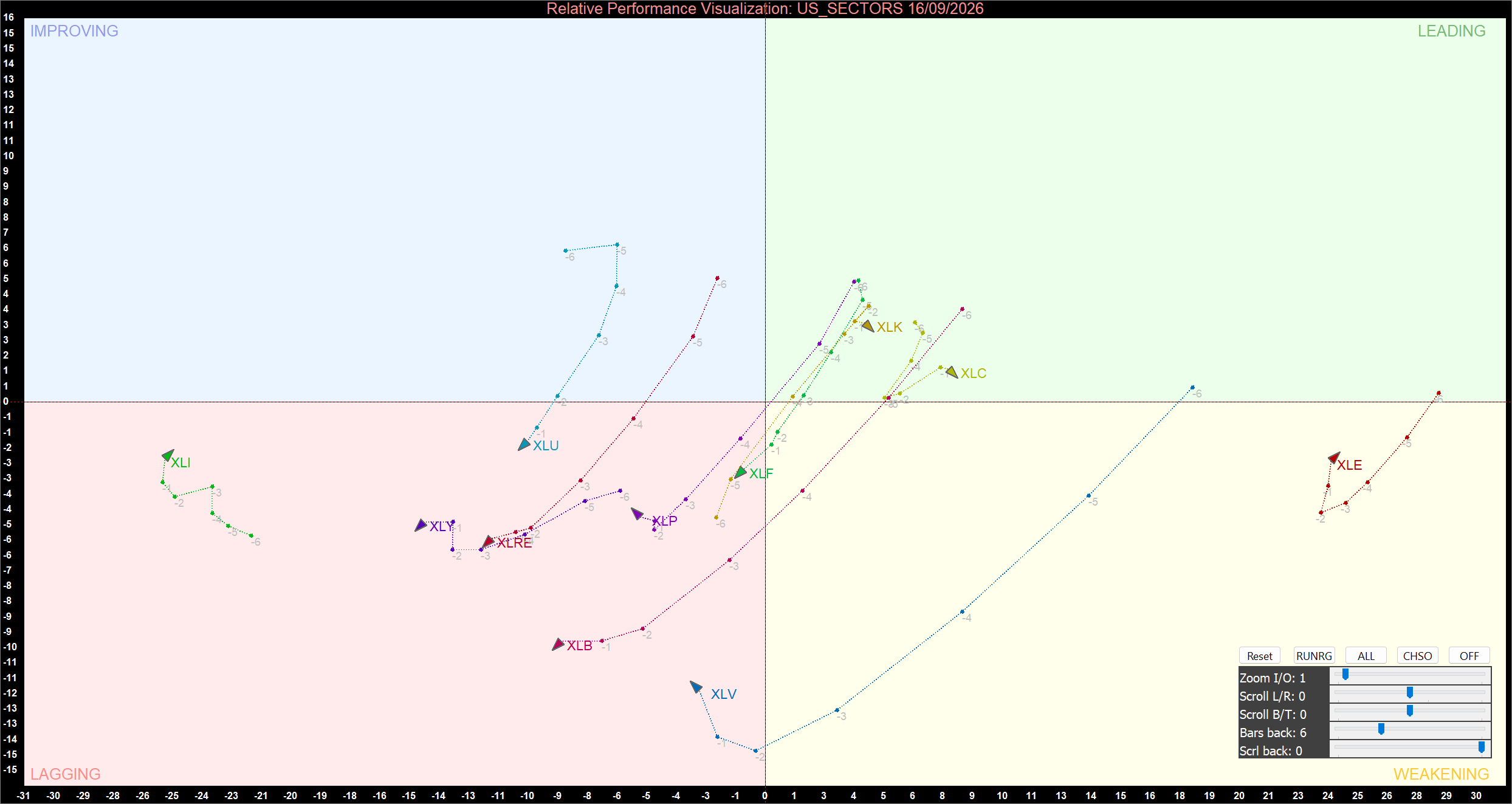
US Sector Relative Momentum Chart (at the closing price of 16/09/2026). Powered by: amibroker.com.
Leading: Communication Services and Technology
Communication Services (XLC) and Information Technology (XLK) remain the two sectors positioned in the Leading quadrant. Their locations above and to the right of the central axes indicate comparatively stronger relative strength and momentum than most other sectors in the universe.
The continued Leading classification suggests that both sectors retain relatively strong momentum. Their trajectories, however, remain important because a movement farther toward the upper-right would indicate continued improvement in both relative strength and momentum, while movement toward the centre could signal a gradual loss of momentum.
The current positioning also reinforces the distinction between daily performance and relative momentum. A sector can experience a short-term decline while remaining in Leading if its broader relative momentum remains stronger than that of other sectors.
Weakening: Energy
Energy (XLE) is the only sector currently positioned in the Weakening quadrant. Its position indicates that Energy continues to maintain relatively stronger positioning than the sectors in Lagging, although its momentum has deteriorated.
The current location places Energy between the Leading and Lagging groups. This makes its subsequent trajectory particularly important. A move back toward the upper-right would indicate improving relative momentum and could potentially strengthen its position. Conversely, continued movement toward the lower-left would increase the possibility of a transition into Lagging.
The chart therefore identifies Energy as a sector requiring close monitoring, particularly because it remains the only sector outside the Leading and Lagging groups.
Lagging: Eight Sectors
Eight sectors are currently positioned in Lagging: Financials (XLF), Industrials (XLI), Consumer Discretionary (XLY), Real Estate (XLRE), Consumer Staples (XLP), Materials (XLB), Health Care (XLV) and Utilities (XLU).
The large Lagging group demonstrates that weaker relative momentum remains widespread across the US sector universe. None of these sectors has moved into Improving, indicating that there has not yet been a sufficiently sustained improvement in relative momentum to shift their quadrant classification.
Financials remain particularly notable because XLF has already moved from Weakening into Lagging. Its position below the horizontal axis indicates that relative momentum remains weaker than that of the Leading sectors.
The other seven sectors also remain below the horizontal axis, although their individual trajectories differ. A sustained move toward the upper-right would be required for these sectors to demonstrate a meaningful improvement in relative momentum.
Leadership Remains Concentrated
The latest RRG configuration continues to show a narrow Leadership structure. Technology and Communication Services are the only sectors in Leading, while eight sectors remain in Lagging and Energy occupies Weakening.
This concentration indicates that stronger relative momentum has not yet spread broadly across the US sector universe. The absence of sectors in Improving is also notable, as it suggests that none of the Lagging sectors has yet demonstrated a sufficiently strong improvement to enter the transition phase between Lagging and Leading.
The trajectories of XLC and XLK will therefore remain important for determining whether current leadership persists. At the same time, XLE's direction will indicate whether Energy can recover its momentum or deteriorate further toward Lagging.
Strategic Summary
The latest US sector RRG presents a concentrated momentum environment, with Communication Services and Technology in Leading, Energy in Weakening and eight sectors in Lagging.
XLC and XLK continue to hold the strongest relative momentum positions, while XLE remains the key sector to monitor within the Weakening quadrant. Financials and the other Lagging sectors have yet to demonstrate sufficient improvement to move into a stronger quadrant.
Overall, the chart indicates that broad sector momentum improvement has yet to emerge. Future movement toward the upper-right of the RRG would provide evidence of improving relative strength and momentum, while continued movement toward the lower-left would reinforce weakening conditions. The key developments to monitor are whether XLC and XLK maintain their Leading positions, whether XLE can regain momentum, and whether the large Lagging group begins to move toward Improving.


 Nov 04, 2026





 Please wait processing your request...