
 CA
 NZ
 UK
 AU
 IND

 US

 Share
 X (Formerly Twitter)
 Whatsapp
 Facebook
 LinkedIn
 Telegram
 Email This Article
 Copy Link
 Summarize with AI
 Chat GPT
 Perplexity

Key Momentum Shifts
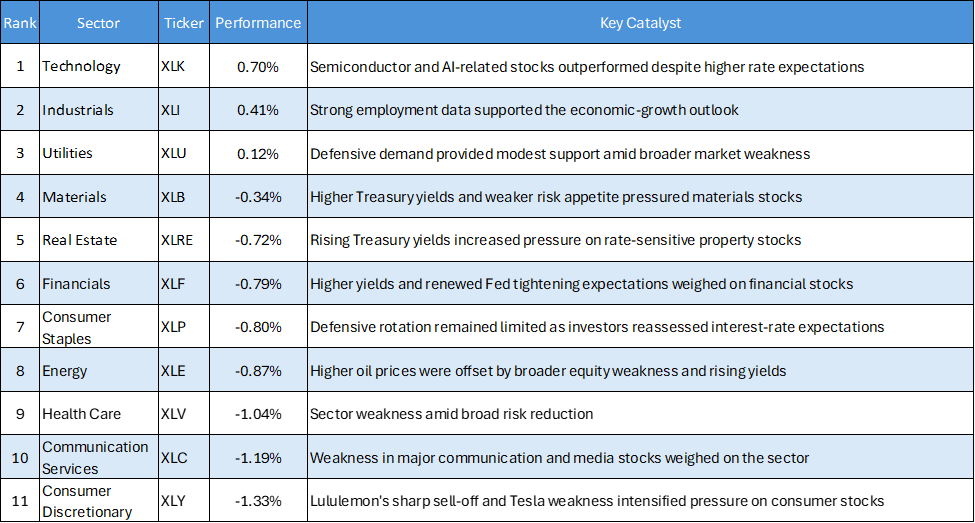
- Technology Leads Daily Performance: XLK gained 0.70%, making Technology the strongest-performing sector.
- Industrials Advance: XLI rose 0.41%, ranking second among the 11 sectors.
- Utilities Edge Higher: XLU gained 0.12%, providing modest support from the defensive segment.
- Materials Decline: XLB fell 0.34%, ending the session lower.
- Real Estate and Financials Weaken: XLRE declined 0.72%, while XLF fell 0.79%.
- Energy and Health Care Lag: XLE dropped 0.87%, while XLV declined 1.04%.
- Communication Services and Consumer Discretionary Underperform: XLC fell 1.19%, while XLY recorded the largest decline at 1.33%.
- Limited Positive Participation: Only three of the 11 sectors advanced, indicating significantly weaker breadth than the previous session.
The US sector performance data for 4 September 2026 shows a sharp deterioration in Market Breadth compared with the previous session. Technology and Industrials were the only meaningful areas of strength, while Consumer Discretionary, Communication Services and Health Care recorded notable declines. The pattern represents a clear shift from the broad-based gains seen on 3 September. The supplied reference article similarly assesses daily sector performance through relative strength and breadth.
The major catalyst was the stronger-than-expected August employment report, which increased expectations that the Federal Reserve could raise interest rates at its September meeting. Treasury yields moved higher and weighed on rate-sensitive and consumer-oriented sectors. At the same time, semiconductor and AI-related stocks provided support for Technology.
Performance Breakdown by Sector
Momentum Breakdown
Technology Leads While Most Sectors Decline
Technology (XLK) was the strongest-performing sector on 4 September, gaining 0.70%.
The outperformance was notable because the broader market declined following the stronger-than-expected US jobs report. Semiconductor stocks provided an important source of support, with the PHLX Semiconductor index rising around 2.7% and most of its constituents advancing. Memory and AI-related stocks including SanDisk, Seagate, Western Digital and Micron were among the strongest performers.
The resilience of Technology suggests that investors continued to favour selected AI and semiconductor exposures despite rising Treasury yields and increasing expectations for tighter Federal Reserve policy.
Industrials (XLI) also advanced 0.41%, making it the second-strongest sector. The gain suggests that investors continued to see support from the stronger economic backdrop indicated by the employment data.
Utilities Provide Limited Defensive Support
Utilities (XLU) gained 0.12%, making it the only other sector besides Technology and Industrials to finish higher.
The modest advance indicates some defensive Demand as investors responded to the stronger jobs report and higher interest-rate expectations. However, the small gain compared with the Technology rally indicates that investors were not making a wholesale shift into defensive assets.
Only three of the 11 sectors advanced, representing a significant deterioration in breadth from the previous session, when eight sectors recorded gains. The reference framework highlights broad participation as an important confirmation of sustained sector momentum.
Rate-Sensitive Sectors Come Under Pressure
Real Estate (XLRE) declined 0.72%, while Financials (XLF) fell 0.79%. Both sectors are sensitive to changes in interest rates and Treasury yields.
The stronger-than-expected August employment report showed that US employers added 162,000 jobs, well above expectations of roughly 55,000. The data increased the probability of a September Fed rate hike, with market pricing reportedly moving to around 58%. Treasury yields consequently moved higher.
This shift in rate expectations created a less favourable environment for rate-sensitive sectors, particularly Real Estate. The decline in Financials also suggests that investors were more concerned about the implications of tighter Monetary Policy than the positive signal from a stronger economy.
Energy, Health Care and Communication Services Lag
Energy (XLE) declined 0.87%, despite oil prices remaining elevated amid continuing geopolitical tensions. The sector's weakness reflected the broader deterioration in Equity sentiment rather than a collapse in energy prices. Oil remained an important inflationary Factor for markets, contributing to concerns about the Federal Reserve's policy outlook.
Health Care (XLV) fell 1.04%, while Communication Services (XLC) declined 1.19%. These declines indicate that selling pressure extended beyond rate-sensitive sectors.
Consumer Discretionary (XLY) was the weakest sector, falling 1.33%. Company-specific weakness was an important contributor. Lululemon plunged after cutting its full-year outlook, while Tesla declined 5.9% following a federal safety investigation into its Cybercab.
The weakness in Consumer Discretionary therefore reflected both the broader increase in borrowing-cost concerns and significant company-specific selling.
Strategic Summary
The US sector performance picture on 4 September 2026 was considerably weaker than the previous session, with only three of 11 sectors advancing. Technology was the standout performer at 0.70%, supported by strong semiconductor and AI-related stocks, while Industrials gained 0.41% and Utilities edged 0.12% higher.
In contrast, Consumer Discretionary fell 1.33%, Communication Services declined 1.19% and Health Care dropped 1.04%. Energy, Financials and Real Estate also remained under pressure.
The key market catalyst was the unexpectedly strong August jobs report, which increased expectations of a potential September Federal Reserve rate hike and pushed Treasury yields higher.
Overall, the session showed a narrowing of market leadership, with Technology providing the primary source of strength while most other sectors weakened. The key consideration for the next sessions is whether semiconductor and AI-related strength can broaden into other growth sectors, or whether higher yields and tighter Fed expectations will continue to pressure the wider equity market.


 Nov 04, 2026





 Please wait processing your request...