
 CA
 NZ
 UK
 AU
 IND

 US

 Share
 X (Formerly Twitter)
 Whatsapp
 Facebook
 LinkedIn
 Telegram
 Email This Article
 Copy Link
 Summarize with AI
 Chat GPT
 Perplexity

Key Highlights
- Communication Services Takes the Lead: Communication Services (XLC) surged 2.44%, emerging as the strongest-performing sector as investors rotated into media, internet, and digital platform companies.
- Financials Deliver Strong Gains: Financials (XLF) climbed 2.18%, supported by renewed confidence in banking, capital markets, and diversified financial businesses.
- Consumer and Defensive Sectors Remain Resilient: Consumer Discretionary (XLY), Health Care (XLV), Consumer Staples (XLP), and Real Estate (XLRE) all finished in positive territory, demonstrating broad market participation.
- Technology Experiences Significant Selling Pressure: Information Technology (XLK) fell 2.57%, making it the weakest-performing sector of the session as investors locked in profits following recent outperformance.
- Utilities and Industrials Also Underperform: Utilities (XLU) and Industrials (XLI) declined 1.26% and 1.01%, respectively, reflecting a rotation away from defensive yield sectors and selected cyclical industries.
The US equity market delivered a mixed but rotational session on July 1, 2026. Investors shifted capital away from Technology and Utilities while increasing exposure to Communication Services, Financials, and selected consumer-oriented sectors. The session reflected a broad reallocation of capital rather than a traditional risk-on or risk-off environment, as leadership rotated toward previously underperforming sectors while Technology experienced a period of consolidation.
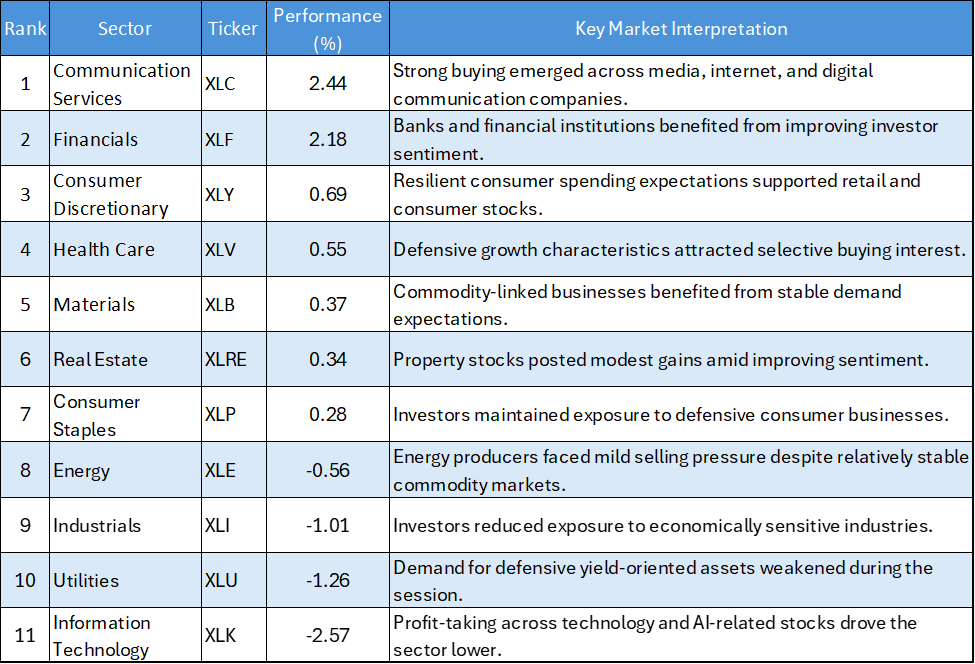
Daily US Sector Performance Summary
Key Market Themes
Communication Services Emerges as Market Leader
- Communication Services (XLC) delivered the strongest performance of the session, advancing 2.44%. The sector benefited from renewed investor demand for digital advertising, social media, streaming platforms, and communication infrastructure businesses.
- The strength suggests investors are becoming increasingly comfortable rotating capital toward sectors capable of delivering both growth and earnings resilience.
Financials Attract Institutional Capital
- Financials (XLF) rose 2.18%, making it the second-best-performing sector. Banks, asset managers, and diversified financial firms attracted strong buying interest as investors reassessed valuation opportunities within the sector.
- The outperformance of Financials may also reflect growing confidence in economic stability and credit market conditions.
Consumer Sectors Remain Constructive
- Consumer Discretionary (XLY) gained 0.69%, while Consumer Staples (XLP) added 0.28%. The positive performance across both cyclical and defensive consumer sectors suggests investors remain relatively confident regarding household spending trends.
- Health Care (XLV) also posted gains, reinforcing the balanced nature of sector participation throughout the session.
Technology Faces Profit-Taking
- Information Technology (XLK) recorded the largest decline of the day, falling 2.57%. After leading market performance in recent sessions, technology stocks experienced significant profit-taking as investors rotated toward other sectors offering attractive risk-reward opportunities.
- While the decline may reflect short-term consolidation rather than a fundamental deterioration, the sector's weakness weighed heavily on broader market sentiment.
Utilities and Industrials Lose Momentum
- Utilities (XLU) and Industrials (XLI) both underperformed during the session. Utilities faced selling pressure as investors shifted away from defensive yield-oriented sectors, while Industrials weakened amid selective repositioning within cyclical industries.
- The divergence between Financials and Industrials highlights the increasingly selective nature of investor capital allocation.
Bottom Line
The July 1 session was characterised by significant sector rotation rather than broad market strength or weakness. Communication Services and Financials emerged as clear leaders, while Technology experienced a notable pullback following recent outperformance.
Although Technology remains a key long-term growth driver, investors appear increasingly willing to diversify exposure across Communication Services, Financials, Consumer Discretionary, and Health Care. If this rotational trend continues, market leadership could become broader and more balanced in the coming weeks, reducing reliance on Technology as the primary source of market performance.

 Nov 04, 2026



 Please wait processing your request...