
 CA
 NZ
 UK
 AU
 IND

 US

 Share
 X (Formerly Twitter)
 Whatsapp
 Facebook
 LinkedIn
 Telegram
 Email This Article
 Copy Link
 Summarize with AI
 Chat GPT
 Perplexity

Key Highlights
- Health Care Tops the Market: Health Care (XLV) advanced 1.27%, making it the strongest-performing sector as investors rotated into pharmaceutical, biotechnology, and healthcare services amid improving risk sentiment.
- Materials Extend Their Strength: Materials (XLB) climbed 1.23%, supported by renewed demand for commodity producers and industrial material companies.
- Consumer and Financial Sectors Remain Positive: Consumer Discretionary (XLY) gained 0.30%, while Financials (XLF) added 0.21%, reflecting selective buying across economically sensitive sectors.
- Real Estate Holds Slight Gains: Real Estate (XLRE) edged 0.07% higher as REITs stabilized despite the prevailing higher interest rate environment.
- Technology Pulls Back: Information Technology (XLK) fell 0.53%, as investors took profits following the sector's strong rally in the previous session.
- Communication Services and Utilities Weaken: Communication Services (XLC) declined 1.04%, while Utilities (XLU) lost 1.02%, reflecting broad-based weakness among defensive yield-oriented sectors.
- Energy Suffers the Largest Decline: Energy (XLE) dropped 2.07%, making it the weakest-performing sector as softer oil prices and continued profit-taking weighed on oil and gas producers.
Following the technology-driven rally in the previous trading session, the US equity market experienced a notable sector rotation on 5 August 2026. Investors shifted toward Health Care and Materials while taking profits in Technology and Communication Services. Energy remained under significant pressure as weakness in crude oil prices continued to weigh on the sector. Overall, the market displayed a more balanced tone, with gains concentrated in defensive growth industries while several cyclical sectors consolidated recent advances, mirroring the overall structure of the previous report.
Daily US Sector Performance Summary
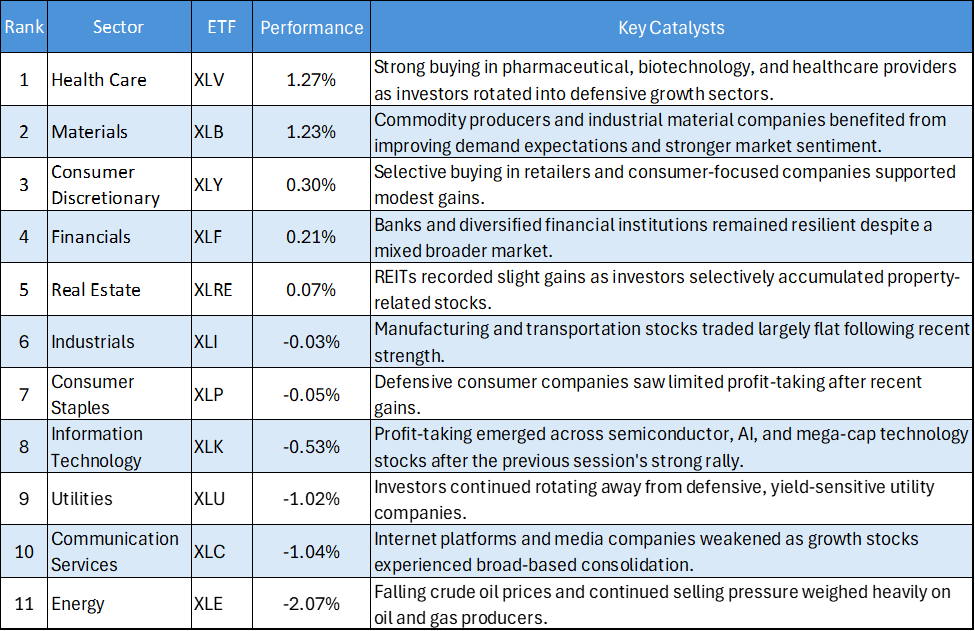
Key Market Themes
Health Care Takes Leadership
- Health Care (XLV) rose 1.27%, outperforming all other sectors as investors increased exposure to pharmaceutical, biotechnology, and medical device companies. The move suggests a rotation toward high-quality defensive growth businesses.
- Materials (XLB) climbed 1.23%, extending its recent positive momentum as improving demand expectations supported commodity-related companies.
Market Rotation Becomes More Evident
- Consumer Discretionary (XLY) gained 0.30%, indicating consumers remained a selective area of strength despite broader sector rotation.
- Financials (XLF) added 0.21%, with banks and diversified financial institutions continuing to benefit from resilient economic expectations.
- Real Estate (XLRE) finished marginally higher at 0.07%, while Industrials (XLI) and Consumer Staples (XLP) ended little changed, highlighting a relatively balanced market environment.
Technology and Energy Under Pressure
- Information Technology (XLK) declined 0.53%, reflecting profit-taking following the sector's exceptional outperformance in the previous trading session.
- Communication Services (XLC) fell 1.04%, as weakness spread across internet platforms and digital media companies.
- Utilities (XLU) lost 1.02%, extending the rotation away from defensive yield-oriented sectors.
Energy Remains the Weakest Sector
- Energy (XLE) dropped 2.07%, making it the session's poorest performer. Softer crude oil prices and continued profit-taking in exploration and production companies kept the sector under pressure despite generally stable market conditions.
Bottom Line
The US equity market delivered a mixed session on 5 August 2026, characterised by sector rotation rather than broad-based buying. Health Care and Materials emerged as the strongest performers, while Financials and Consumer Discretionary also posted modest gains. In contrast, Technology surrendered part of its previous advance, and Energy remained under heavy selling pressure.
Looking ahead, investors will closely monitor whether leadership continues rotating toward defensive growth sectors such as Health Care or whether Technology regains momentum following its recent pullback. Meanwhile, the direction of crude oil prices is likely to remain a key driver for the Energy sector, while broader market sentiment will depend on the sustainability of earnings growth and macroeconomic conditions.

 Nov 18, 2026



 Please wait processing your request...