
 CA
 NZ
 UK
 AU
 IND

 US

 Share
 X (Formerly Twitter)
 Whatsapp
 Facebook
 LinkedIn
 Telegram
 Email This Article
 Copy Link
 Summarize with AI
 Chat GPT
 Perplexity

Key Highlights
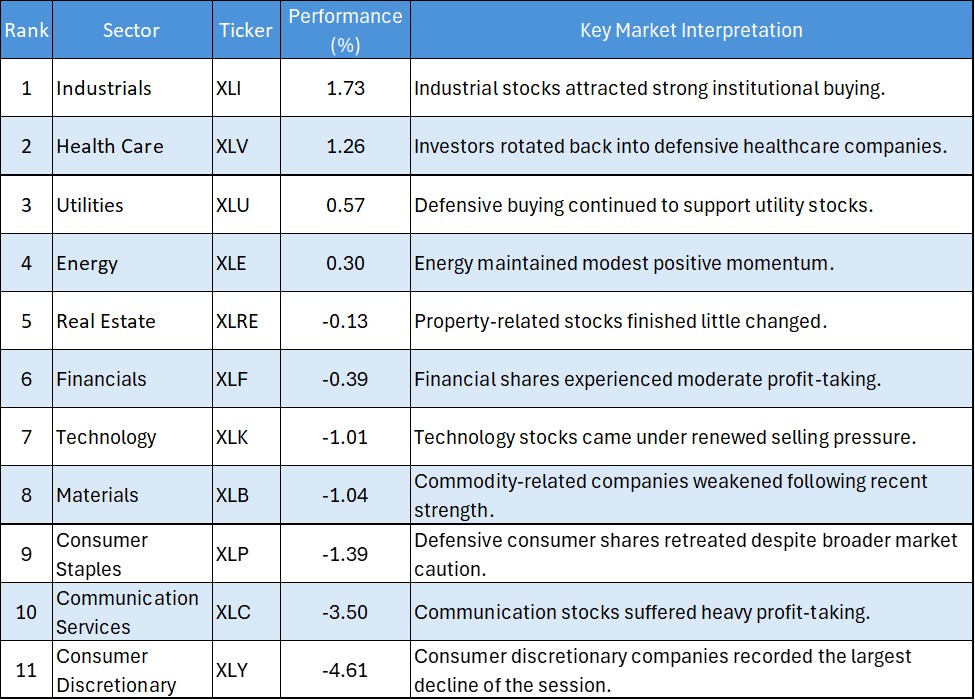
- Industrials Take the Lead: Industrials (XLI) surged 1.73%, making it the strongest-performing sector as investors rotated into economically sensitive industrial companies.
- Health Care Rebounds Strongly: Health Care (XLV) gained 1.26%, attracting renewed buying interest after recent weakness.
- Utilities Continue to Provide Defensive Support: Utilities (XLU) advanced 0.57%, extending demand for defensive sectors.
- Energy Remains Positive: Energy (XLE) edged 0.30% higher, continuing its recent period of relative resilience.
- Consumer Discretionary and Communication Services Plunge: Consumer Discretionary (XLY) tumbled 4.61%, while Communication Services (XLC) slumped 3.50%, making them the weakest-performing sectors of the session.
- Technology and Consumer Staples Also Decline: Technology (XLK), Materials (XLB), and Consumer Staples (XLP) all finished lower as investors reduced exposure to growth-oriented sectors.
- Market Breadth Turns Decisively Negative: Only four of the eleven sectors closed higher, highlighting broad-based selling pressure across much of the US equity market.
The US equity market experienced a sharp sector rotation on 23 July 2026, as investors favoured Industrials, Health Care, and Utilities while aggressively reducing exposure to Consumer Discretionary, Communication Services, and several other growth-oriented sectors. The pronounced weakness across consumer and communication stocks suggests market participants adopted a more defensive stance, while selective buying in Industrials and Health Care helped cushion broader market losses. Overall, the session reflected a significant divergence between defensive and cyclical leadership as investors reassessed risk appetite.
Daily US Sector Performance Summary
Key Market Themes
Industrials and Health Care Lead the Advance
- Industrials (XLI) delivered the strongest performance of the session, rising 1.73%. The strong advance suggests investors increased exposure to economically sensitive industrial companies, reflecting selective confidence in businesses linked to infrastructure, manufacturing, and capital investment.
- Health Care (XLV) climbed 1.26%, marking a notable rebound after recent weakness. The renewed buying interest indicates investors sought exposure to high-quality defensive companies amid growing uncertainty across broader equity markets.
Utilities and Energy Continue to Provide Stability
- Utilities (XLU) gained 0.57%, extending recent demand for defensive sectors. The continued strength suggests investors remained cautious while seeking relatively stable earnings and dividend-paying companies.
- Energy (XLE) added 0.30%, continuing to demonstrate resilience despite weakness across several other cyclical sectors. The sector remains supported by ongoing investor confidence in energy-related companies.
Consumer and Growth Sectors Come Under Heavy Pressure
- Consumer Discretionary (XLY) plunged 4.61%, making it the weakest-performing sector of the session. The sharp decline reflects broad-based selling across consumer-focused companies as investors reduced exposure to economically sensitive growth stocks.
- Communication Services (XLC) fell 3.50%, reinforcing the risk-off tone across growth-oriented industries. The sizeable decline suggests significant profit-taking following previous market strength.
- Technology (XLK) declined 1.01%, while Materials (XLB) lost 1.04%, indicating investors continued rotating away from sectors that had previously outperformed.
Defensive Rotation Becomes More Selective
- Despite the gains in Health Care and Utilities, Consumer Staples (XLP) declined 1.39%, suggesting defensive buying was concentrated in selected industries rather than spread broadly across the entire defensive sector.
- Financials (XLF) eased 0.39%, while Real Estate (XLRE) slipped only 0.13%, indicating relatively limited weakness compared with the sharp declines experienced by consumer-oriented sectors.
Bottom Line
The US equity market experienced a pronounced rotation on 23 July 2026, with investors favouring Industrials, Health Care, Utilities, and Energy while aggressively reducing exposure to Consumer Discretionary, Communication Services, and Technology. The sharp declines in consumer-related sectors suggest a more cautious market environment, while the resilience of Industrials and selected defensive sectors indicates investors remain highly selective in allocating capital.
Looking ahead, sustained leadership from Industrials and Health Care would reinforce the current market rotation. However, investors should closely monitor whether selling pressure across Consumer Discretionary, Communication Services, and Technology begins to stabilise, as renewed participation from these growth-oriented sectors would likely be necessary to support a broader market recovery.


 Nov 17, 2026





 Please wait processing your request...