
 CA
 NZ
 UK
 AU
 IND

 US

 Share
 X (Formerly Twitter)
 Whatsapp
 Facebook
 LinkedIn
 Telegram
 Email This Article
 Copy Link
 Summarize with AI
 Chat GPT
 Perplexity

Key Highlights
- Technology Reclaims Market Leadership: Information Technology (XLK) surged 1.65%, making it the strongest-performing sector as investors rotated back into growth-oriented stocks.
- Financials and Industrials Show Solid Strength: Financials (XLF) gained 0.93%, while Industrials (XLI) advanced 0.90%, reflecting broad participation in the market rally.
- Consumer Sectors Move Higher: Consumer Discretionary (XLY) rose 0.76% and Communication Services (XLC) added 0.56%, signalling improving investor confidence in economically sensitive sectors.
- Defensive Areas Underperform: Health Care (XLV), Consumer Staples (XLP), and Utilities (XLU) were among the weakest sectors, declining between 1.01% and 1.09%.
- Risk Appetite Strengthens: The sector performance profile suggests investors are favouring growth and cyclical opportunities over defensive positioning.
The US equity market displayed a clear risk-on tone on July 6, 2026, as investors shifted capital toward growth-oriented and economically sensitive sectors. Technology led the advance, supported by strong gains in Financials, Industrials, and Consumer Discretionary stocks. In contrast, traditionally defensive sectors such as Health Care, Consumer Staples, and Utilities lagged the broader market, indicating improving investor sentiment and a renewed appetite for risk assets.
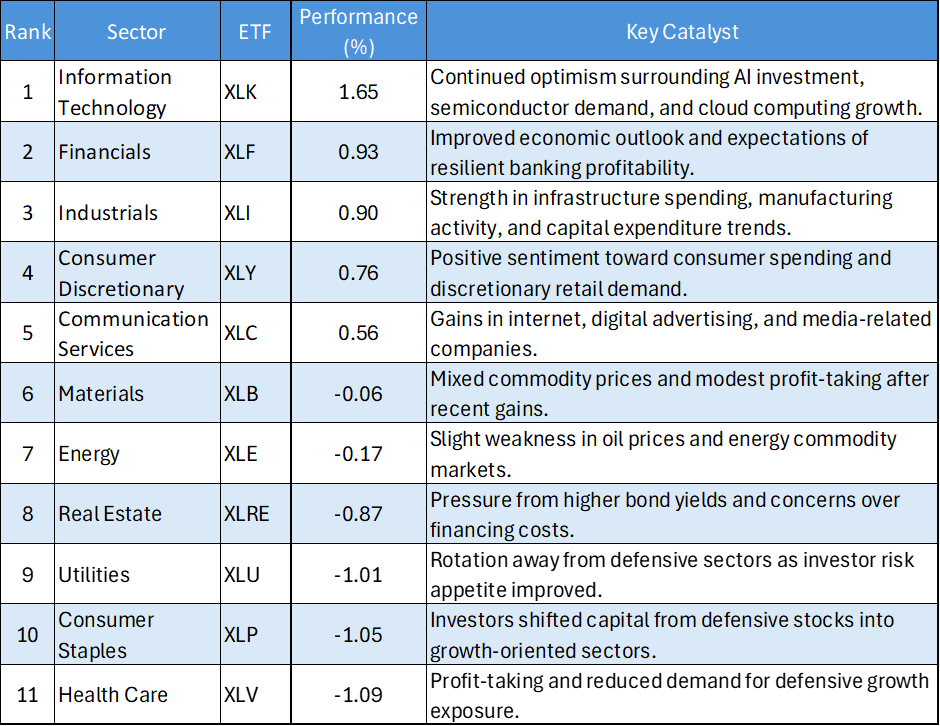
Daily US Sector Performance Summary
Technology Regains Leadership
- Information Technology (XLK) delivered the strongest performance of the session, rising 1.65%. The sector benefited from renewed buying interest in large-cap technology companies and continued optimism surrounding artificial intelligence, cloud computing, and digital infrastructure spending.
- The strong rebound suggests investors remain confident in the long-term earnings outlook for technology businesses despite periodic valuation concerns.
- Technology's return to leadership reinforces its position as one of the market's primary growth drivers in 2026.
Financials and Industrials Support the Rally
- Financials (XLF) gained 0.93%, benefiting from improving economic sentiment and continued confidence in banking, insurance, and capital markets activity.
- Industrials (XLI) advanced 0.90%, reflecting optimism regarding business investment, infrastructure spending, and industrial production trends.
- The simultaneous strength in Financials and Industrials is often viewed as a positive signal for the broader economy, as both sectors tend to perform well when growth expectations improve.
Consumer-Oriented Sectors Move Higher
- Consumer Discretionary (XLY) climbed 0.76%, indicating increasing investor confidence in household spending and consumer demand.
- Communication Services (XLC) rose 0.56%, supported by gains in media, internet, and digital communication companies.
- The positive performance across these sectors suggests investors are becoming more comfortable with cyclical exposure and are positioning for continued economic expansion.
Energy and Materials Remain Relatively Stable
- Materials (XLB) slipped just 0.06%, while Energy (XLE) declined 0.17%.
- Although both sectors finished slightly lower, the losses were modest and did not materially detract from the broader market's positive tone.
- The relatively resilient performance indicates investors remain constructive on commodity-related industries despite some near-term profit-taking.
Defensive Sectors Fall Out of Favour
- Health Care (XLV) was the weakest-performing sector, falling 1.09%, followed closely by Consumer Staples (XLP), which lost 1.05%, and Utilities (XLU), which declined 1.01%.
- Real Estate (XLRE) also underperformed, retreating 0.87%.
- The broad weakness across defensive sectors suggests investors were rotating away from safety-oriented investments and reallocating capital toward sectors with stronger growth potential.
- Such rotations are common when market participants become increasingly optimistic about economic conditions and corporate earnings prospects.
Bottom Line
The July 6 session highlighted a decisive return of growth leadership within the US equity market. Technology, Financials, Industrials, and Consumer Discretionary sectors all posted solid gains, reflecting improving risk appetite and growing confidence in the economic outlook.
Meanwhile, the underperformance of Health Care, Consumer Staples, Utilities, and Real Estate indicates that investors are reducing defensive exposure in favour of sectors offering greater earnings growth potential. While defensive sectors remain important portfolio stabilisers, current market leadership suggests investors continue to favour cyclical and growth-oriented opportunities.
If this rotation persists, Technology is likely to remain at the forefront of market performance, supported by ongoing innovation trends, while Financials and Industrials may continue benefiting from improving economic expectations and broadening market participation.

 Nov 04, 2026



 Please wait processing your request...