
 CA
 NZ
 UK
 AU
 IND

 US

 Share
 X (Formerly Twitter)
 Whatsapp
 Facebook
 LinkedIn
 Telegram
 Email This Article
 Copy Link
 Summarize with AI
 Chat GPT
 Perplexity

Key Highlights
- Technology Extends Leadership: Information Technology (XLK) surged 2.18%, making it the strongest-performing sector as investors continued to favour AI, semiconductor, and digital infrastructure themes.
- Consumer Discretionary Gains Momentum: Consumer Discretionary (XLY) advanced 1.34%, reflecting renewed confidence in consumer-related growth opportunities.
- Financials Join the Rally: Financials (XLF) climbed 1.04%, supported by improving sentiment toward banks and financial institutions.
- Defensive Sectors Underperform: Consumer Staples (XLP) and Utilities (XLU) fell 1.41% and 0.51%, respectively, as investors rotated away from defensive assets.
- Energy Records Largest Decline: Energy (XLE) dropped 1.40%, making it one of the weakest sectors as profit-taking emerged following recent outperformance.
The US equity market delivered a broad-based advance on July 9, 2026, with growth-oriented sectors leading the gains. Technology, Consumer Discretionary, Financials, and Communication Services all posted solid advances, highlighting improving investor confidence and stronger risk appetite. Meanwhile, traditional defensive sectors and Energy lagged the market, suggesting capital continued rotating toward sectors offering higher growth potential.
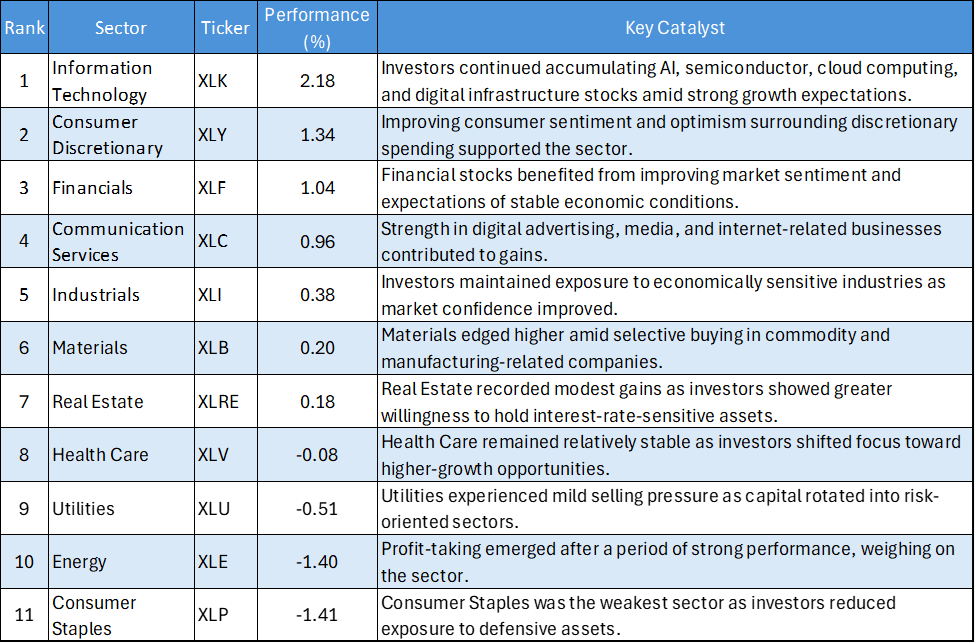
Daily US Sector Performance Summary
Technology Remains the Market Leader
- Information Technology (XLK) led all sectors with a gain of 2.18%, extending its position as the primary driver of market performance. Investor enthusiasm remained concentrated in companies exposed to artificial intelligence, semiconductors, software, and digital infrastructure. The sector's strong advance highlights continued confidence in long-term earnings growth and innovation-driven business models.
Consumer Discretionary and Financials Strengthen
- Consumer Discretionary (XLY) gained 1.34%, while Financials (XLF) rose 1.04%, making them among the market's strongest performers. The gains suggest investors became more comfortable increasing exposure to economically sensitive sectors, reflecting optimism regarding consumer activity and broader economic conditions. The participation of Financials also indicates improving confidence in credit growth and lending activity.
Communication Services Continue Higher
- Communication Services (XLC) advanced 0.96%, benefiting from strength across media, internet, and digital advertising businesses. The sector's performance demonstrates continued investor interest in growth-oriented companies beyond the technology space. Strong participation from Communication Services further reinforced the positive tone across growth sectors.
Industrials, Materials, and Real Estate Post Modest Gains
- Industrials (XLI) rose 0.38%, Materials (XLB) gained 0.20%, and Real Estate (XLRE) added 0.18%. Although gains were more modest compared with the leading sectors, the positive performance suggests investors maintained exposure to broader market opportunities rather than concentrating solely on technology stocks. This wider participation supports the view of a healthier market advance.
Defensive Sectors Lose Momentum
- Traditionally defensive sectors underperformed during the session. Utilities (XLU) fell 0.51%, while Consumer Staples (XLP) declined 1.41%, making it the weakest-performing sector. Health Care (XLV) was largely unchanged, slipping only 0.08%. The weakness across defensive areas suggests investors preferred sectors offering stronger growth prospects and higher return potential.
Energy Faces Profit-Taking
- Energy (XLE) dropped 1.40%, reversing part of its recent strength. The decline likely reflects profit-taking activity after a period of strong performance rather than a significant shift in the sector's longer-term outlook. Nevertheless, Energy's weakness contrasted sharply with the strong gains recorded across Technology and Consumer Discretionary.
Bottom Line
The July 9 session reflected a clear improvement in market risk appetite, with Technology, Consumer Discretionary, Financials, and Communication Services leading a broad-based advance. The strong performance of growth-oriented sectors suggests investors remain optimistic about earnings prospects and economic resilience.
Meanwhile, weakness in Consumer Staples, Utilities, and Energy indicates ongoing rotation away from defensive positioning and into sectors with stronger growth potential. If this trend continues, Technology and other growth sectors may remain the primary drivers of market performance in the near term, while defensive sectors could continue to lag as investor confidence improves.


 Nov 05, 2026


 Please wait processing your request...