
 CA
 NZ
 UK
 AU
 IND

 US

 Share
 X (Formerly Twitter)
 Whatsapp
 Facebook
 LinkedIn
 Telegram
 Email This Article
 Copy Link
 Summarize with AI
 Chat GPT
 Perplexity

Key Highlights
- Consumer Discretionary (XLY) led the sectors, gaining 1.78%, supported by Amazon’s rally after a Morgan Stanley endorsement and a rise in Tesla shares ahead of earnings.
- Technology (XLK) advanced 1.36% as semiconductor and AI-linked shares rebounded following a difficult week for the sector.
- Materials (XLB) was the only other sector to finish higher, edging up 0.06%, while Communication Services (XLC) slipped 0.21%.
- Consumer Staples (XLP) fell 0.47%, Healthcare (XLV) declined 0.60%, and Energy (XLE) and Industrials (XLI) each lost 0.64%.
- Financials (XLF) dropped 0.83%, Real Estate (XLRE) fell 1.16%, and Utilities (XLU) was the weakest sector, down 2.01%, as Treasury yields rose.
- The S&P 500 gained 0.41% and the Nasdaq rose 1.11%, while the Dow slipped 0.07%, reflecting a narrow, technology-led rebound.
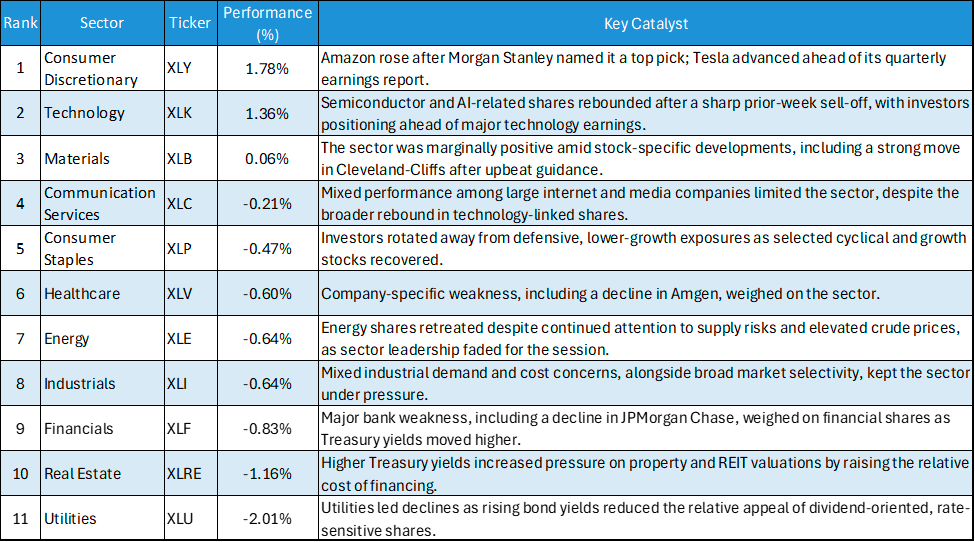
US sector performance on 19 October 2026 showed a selective rebound rather than a broad market recovery. Consumer Discretionary and Technology advanced, helping lift the S&P 500 and Nasdaq, but eight of the eleven sectors declined. Investors returned to some of the market’s largest growth-oriented names after the previous week’s technology sell-off, while higher Treasury yields weighed on rate-sensitive groups. The contrast between strong index performance and weak sector breadth suggested that gains were concentrated in a limited number of large companies.
Performance Breakdown by Sector
Consumer Discretionary and Technology Lead the Rebound
Consumer Discretionary gained 1.78%, the strongest result among the eleven sectors. Amazon rose about 5% after Morgan Stanley identified the company as a top pick, while Tesla advanced ahead of its Earnings release. These large constituents helped lift the sector, but the performance should not automatically be read as evidence of improving conditions across all consumer-facing businesses. The session’s gains were concentrated in a handful of influential stocks, and household Demand remains sensitive to borrowing costs and the cost of living.
Technology climbed 1.36% as semiconductor and AI-linked shares recovered from the previous week’s heavy selling. The Philadelphia Semiconductor Index ended an eight-session losing streak, helping restore some confidence in the technology trade. Investors were also preparing for a busy earnings calendar, with results from major technology companies expected to provide further evidence about AI demand, Capital spending and profitability. Nevertheless, concerns about the cost of AI infrastructure and the Debt used to finance data-centre expansion have not disappeared.
Materials edged up 0.06%, with company-specific developments providing support in parts of the group. Cleveland-Cliffs rallied after issuing stronger guidance, helping steel-related shares. Communication Services, by contrast, slipped 0.21%. The limited decline suggested a mixed response among internet, Advertising and media businesses, even as selected technology stocks recovered. Together, these results show that the rebound was uneven and depended heavily on individual company catalysts.
Rate-Sensitive Sectors Face Pressure
Utilities fell 2.01%, making it the weakest sector, while Real Estate declined 1.16%. Both groups are sensitive to interest rates because their income-oriented valuations can become less attractive when government bond yields rise. The 10-year Treasury Yield moved higher to around 5.14%, adding pressure to property-related shares and dividend-paying utilities. Higher yields can also increase financing costs for companies that rely on borrowing, making the direction of bond markets an important variable for these sectors.
Financials lost 0.83%, with weakness among large banks contributing to the decline. Industrials and Energy each fell 0.64%, while Healthcare declined 0.60% and Consumer Staples lost 0.47%. These losses indicate that the advance in headline indexes did not represent a market-wide upswing. The S&P 500 rose 0.41% and the Nasdaq gained 1.11%, but the Dow edged lower and broader market participation remained weak. Investors should therefore distinguish index-level gains from the underlying distribution of sector returns.
Strategic Summary
The 19 October session was characterised by a technology-led rebound alongside broad weakness in rate-sensitive and defensive sectors. Consumer Discretionary and Technology were the clear leaders, while Utilities, Real Estate and Financials were among the weakest groups. The S&P 500 and Nasdaq advanced, but the majority of sectors declined, highlighting the narrow nature of the recovery.
Investors should monitor upcoming earnings, guidance on AI-related investment, Treasury yields and developments affecting consumer demand. Strong results from major technology companies could help extend the rebound, but any renewed concern about capital-spending returns or financing costs may restore volatility. Higher yields remain a key risk for Utilities and Real Estate, while the narrow Leadership suggests that one session is insufficient to confirm a durable market rotation. Sector performance is a snapshot of daily market positioning, not a standalone forecast.

 Oct 28, 2026





 Please wait processing your request...