
 CA
 NZ
 UK
 AU
 IND

 US

 Share
 X (Formerly Twitter)
 Whatsapp
 Facebook
 LinkedIn
 Telegram
 Email This Article
 Copy Link
 Summarize with AI
 Chat GPT
 Perplexity

Key Highlights
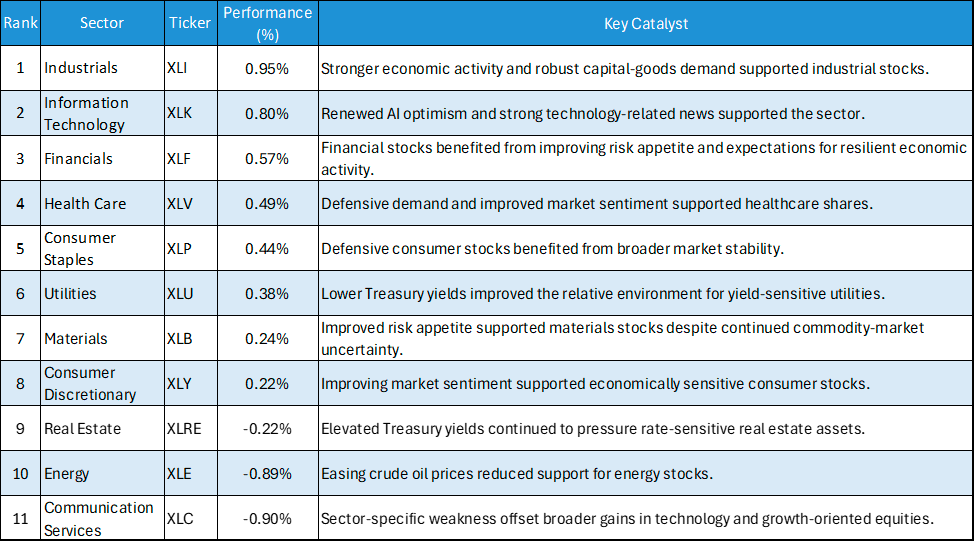
- Industrials Lead: XLI gained 0.95%, recording the strongest performance among the eleven major US sectors.
- Technology Advances: XLK increased 0.80%, supported by renewed optimism surrounding artificial intelligence and technology investment.
- Financials Strengthen: XLF rose 0.57%, while Health Care gained 0.49%.
- Defensive Sectors Rise: Consumer Staples and Utilities advanced 0.44% and 0.38%, respectively.
- Materials and Consumer Discretionary Gain: XLB increased 0.24%, while XLY added 0.22%.
- Real Estate Declines: XLRE fell 0.22%, remaining under pressure from elevated Treasury yields.
- Energy Weakens: XLE declined 0.89% as easing Crude Oil prices reduced support for energy stocks.
- Communication Services Underperform: XLC dropped 0.90%, recording the largest sector decline.
- Broad Sector Strength: Eight of the eleven major sectors advanced, indicating a substantially stronger breadth than recent risk-off sessions.
The US sector performance data for 25 September 2026 showed a broad improvement across most major sectors. Industrials led the market with a 0.95% gain, followed by Technology at 0.80% and Financials at 0.57%. Meanwhile, Communication Services and Energy were the only sectors to decline by more than 0.5%.
The session also reflected a shift in market leadership toward economically sensitive and growth-oriented sectors. AI optimism supported Technology, while easing oil prices reduced the relative strength of Energy. The broader market was also supported by softer Treasury yields and continued expectations surrounding developments in the Middle East.
Performance Breakdown by Sector
Industrials and Technology Lead the Market
Industrials (XLI) was the strongest-performing sector on 25 September, gaining 0.95%. The advance placed Industrials at the top of the daily sector ranking as investors responded positively to signs of resilient economic activity.
Technology (XLK) followed closely with a 0.80% gain. Renewed enthusiasm surrounding artificial intelligence remained an important driver for the technology complex. Microsoft was among the notable contributors after announcing additional capabilities for its Copilot platform, while AI-related companies also benefited from continued Investment expectations.
The combination of stronger technology performance and gains in Industrials indicates that market leadership was not confined to traditional defensive sectors. Instead, growth-oriented and economically sensitive areas both participated in the advance.
Financials and Defensive Sectors Advance
Financials (XLF) gained 0.57%, placing the sector third in the daily ranking. The advance came as broader market sentiment improved and investors continued to assess the implications of elevated interest rates for banks and other financial institutions.
Health Care (XLV) increased 0.49%, while Consumer Staples (XLP) gained 0.44%. The simultaneous strength of these defensive sectors and cyclical groups suggests that the session was characterised by relatively broad participation rather than a narrow rotation into a single market segment.
Utilities (XLU) also advanced 0.38%. The sector's positive performance came despite its sensitivity to interest rates, with movements in Treasury yields remaining an important Factor for dividend-oriented equities.
Materials and Consumer Discretionary Remain Positive
Materials (XLB) gained 0.24%, extending the positive tone across the majority of economically sensitive sectors. The advance came despite ongoing uncertainty surrounding Commodity prices and global trade conditions.
Consumer Discretionary (XLY) rose 0.22%. The sector remained relatively resilient as improved market sentiment supported consumer-facing equities. Its positive performance contrasted with the weakness observed in Energy and Communication Services.
The gains across Materials and Consumer Discretionary further demonstrated the breadth of the session, with eight of the eleven sectors finishing higher.
Energy and Communication Services Under Pressure
Energy (XLE) declined 0.89%, making it the second-worst-performing sector. The decline came as crude oil prices eased after remaining elevated during the earlier part of the week. Lower oil prices reduced the immediate support for energy producers, even as geopolitical developments remained an important influence on the commodity market.
Communication Services (XLC) recorded the largest decline, falling 0.90%. The sector's weakness stood in contrast to the strong performance of Technology and reflected more selective positioning within growth-oriented equities.
Real Estate (XLRE) also declined, although only modestly, falling 0.22%. Elevated Treasury yields continued to present a headwind for property-related stocks because higher yields can increase financing costs and reduce the relative attractiveness of income-oriented assets.
Broad Sector Strength Signals Improved Market Breadth
Eight of the eleven major sectors advanced on 25 September, representing a significant improvement in breadth compared with the broad declines seen in earlier sessions. Industrials, Technology and Financials provided the strongest contributions, while Health Care, Consumer Staples and Utilities also moved higher.
The 1.85-percentage-point gap between Industrials and Communication Services was considerably narrower than the extreme sector dispersion observed during more defensive sessions. This suggests that the market's performance was relatively balanced despite continued uncertainty around oil prices, Treasury yields and geopolitical developments.
Strategic Summary
The US sector performance picture on 25 September 2026 was characterised by broad gains led by Industrials and Technology. XLI gained 0.95%, while XLK increased 0.80% and Financials advanced 0.57%.
Eight of the eleven major sectors finished higher, with Health Care, Consumer Staples and Utilities also posting gains. At the weaker end of the ranking, Communication Services declined 0.90%, followed by Energy at 0.89%.
The session demonstrated a notable improvement in market breadth, with gains extending across cyclical, growth and defensive sectors. The key issue for subsequent sessions is whether Technology and Industrials can maintain their relative strength while Energy remains sensitive to changes in crude oil prices and Real Estate continues to respond to movements in Treasury yields.

 Oct 30, 2026




 Please wait processing your request...