
 CA
 NZ
 UK
 AU
 IND

 US

 Share
 X (Formerly Twitter)
 Whatsapp
 Facebook
 LinkedIn
 Telegram
 Email This Article
 Copy Link
 Summarize with AI
 Chat GPT
 Perplexity
Key Highlights
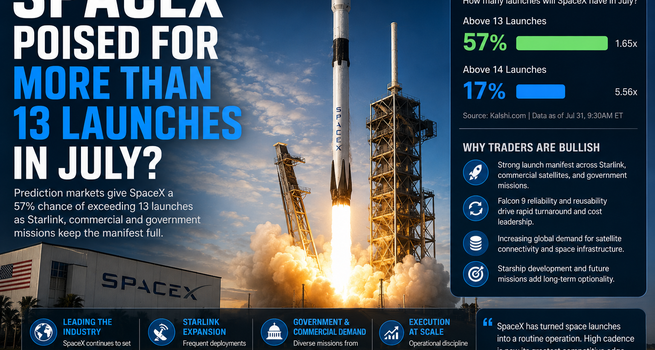
- Prediction markets assign a 57% probability that SpaceX will complete more than 13 launches in July.
- Traders see a 17% chance the company exceeds 14 launches.
- SpaceX continues to dominate the global launch market with its rapid Falcon 9 launch cadence.
- Starlink deployments, commercial missions, and government contracts remain major demand drivers.
- Launch frequency has become a key competitive advantage in the commercial space industry.
Prediction Markets Signal Another Busy Month for SpaceX
SpaceX has transformed space launches from rare engineering milestones into a routine commercial operation. That consistency is now reflected in prediction markets, where traders expect another exceptionally active month for Elon Musk's privately held aerospace company.
On Kalshi, traders currently assign a 57% probability that SpaceX will complete more than 13 launches during July. Markets also give the company a 17% chance of exceeding 14 launches, suggesting investors remain confident in the company's ability to sustain one of the highest launch rates in aerospace history.
Unlike traditional forecasts, prediction markets aggregate the expectations of participants willing to risk capital, providing a real-time measure of market sentiment rather than expert opinion alone.
Launch Cadence Has Become SpaceX's Competitive Moat
The significance of these forecasts extends beyond a simple launch count.
Over the past several years, SpaceX has fundamentally changed the economics of spaceflight through reusable Falcon 9 rockets and highly standardized launch operations. While competitors continue to increase manufacturing capacity, SpaceX's greatest advantage increasingly lies in execution.
A higher monthly launch cadence allows the company to maximize rocket utilization, shorten customer waiting times, and generate recurring revenue from both commercial and government missions.
Every successful launch also reinforces confidence among satellite operators, defense agencies, and institutional customers that rely on predictable access to orbit.
Starlink Continues to Drive Launch Demand
Much of SpaceX's launch schedule is supported by its own Starlink satellite network.
Unlike traditional launch providers that depend entirely on external customers, SpaceX benefits from a vertically integrated business model in which it serves as both launch provider and satellite operator.
Regular Starlink deployments create a steady stream of missions while expanding one of the world's largest satellite broadband networks.
Beyond Starlink, commercial satellite launches, NASA missions, and U.S. national security contracts continue to contribute to a diversified launch manifest.
This combination gives SpaceX greater flexibility than most aerospace companies, reducing dependence on any single customer or market.
Execution Matters More Than Ambition
The prediction market's confidence reflects more than technological leadership.
SpaceX has consistently demonstrated an ability to execute complex launch schedules while maintaining high reliability. That operational discipline has become one of the company's defining strengths.
For investors following the broader space economy, launch frequency serves as an important indicator of commercial activity across satellite communications, Earth observation, defense, and space infrastructure.
Higher launch rates also strengthen SpaceX's competitive position ahead of future programs involving Starship, lunar exploration, and deep-space missions.
What Investors Should Watch
Although SpaceX remains privately held, its growing influence extends across publicly traded aerospace and satellite companies.
A sustained pace of more than 13 monthly launches would reinforce the company's leadership in commercial space transportation while supporting continued expansion of Starlink services worldwide.
Investors should monitor launch execution, regulatory approvals, Starship development, and government contract awards, all of which could influence the broader space industry's growth trajectory.
Conclusion
Prediction markets suggest traders expect another exceptionally busy month for SpaceX, reflecting confidence in the company's operational execution rather than short-term optimism. A launch cadence exceeding 13 missions would further demonstrate how SpaceX has redefined the commercial space industry through reusability, scale, and disciplined execution.
As competition intensifies and global demand for satellite services continues to grow, SpaceX's ability to consistently deliver launches may remain one of its strongest competitive advantages.


 Nov 05, 2026





 Please wait processing your request...