
 CA
 NZ
 UK
 AU
 IND

 US

 Share
 X (Formerly Twitter)
 Whatsapp
 Facebook
 LinkedIn
 Telegram
 Email This Article
 Copy Link
 Summarize with AI
 Chat GPT
 Perplexity
Key Highlights
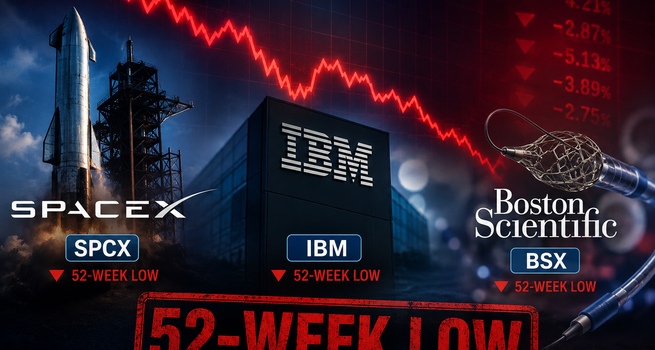
- SpaceX (SPCX) stock fell to an all-time low of $132.15, dipping below its $135 IPO price, amid profit-taking, cooling investor sentiment, and broader AI spending concerns.
- IBM (IBM) stock slumped 2.7% to an annual low of $211.03 after preliminary Q2 revenue of $17.2 billion came in well short of Wall Street expectations, triggering multiple price target cuts.
- Boston Scientific (BSX) stock touched a 52-week low of $42.20 before recovering to close up about 1%, amid Wall Street concerns over a mixed setup for the broader MedTech sector.
- All three declines reflect distinct, company-specific catalysts rather than a single shared market-wide event, spanning IPO froth cooling, an earnings miss, and sector-wide capital equipment demand caution.
Shares of SpaceX (NASDAQ: SPCX), International Business Machines Corp. (NYSE: IBM), and Boston Scientific Corp. (NYSE: BSX) all slumped to 52-week lows on Wednesday, though the underlying stories behind each decline are genuinely distinct from one another. Profit-taking after a hyped debut, a preliminary earnings miss triggering a wave of analyst downgrades, and sector-wide caution around medical technology capital spending each played out independently, converging only in the coincidental timing of hitting new lows on the same trading day.
SpaceX Dips Below Its IPO Price
SPCX stock fell to an all-time low of $132.15, dipping below its $135 IPO price, as Elon Musk's aerospace company declined for a fourth straight session following its historic Wall Street debut last month. The initial post-IPO enthusiasm that lifted the stock in its earliest trading days appears to be cooling meaningfully, with today's close representing a genuinely symbolic threshold: a stock trading below where it originally priced tends to signal that early aftermarket demand has been fully absorbed, leaving the shares to trade on more conventional valuation grounds.
The stock has experienced heavy selling tied to the company's aggressive capital-raising plans and a limited public float, a combination that has amplified volatility in both directions since the IPO. A smaller float means fewer shares are available for trading, which can produce outsized price swings on relatively modest changes in buying or selling pressure, a dynamic that appears to be compounding the broader profit-taking weighing on the stock today.
Company-specific developments provide some longer-term context for investors weighing today's decline against SpaceX's broader technology roadmap. The company is preparing for the 13th test flight of Starship, its next-generation fully reusable rocket designed to significantly reduce the cost of space travel while greatly expanding payload capacity. Unlike the partially reusable Falcon 9, which can carry about 25,000 kilograms to orbit at roughly $1,500 per kilogram, Starship is being developed to transport up to 150,000 kilograms at a fraction of that per-kilogram cost. Lower launch costs of this magnitude could unlock genuinely new opportunities, including large-scale orbital infrastructure such as AI-powered data centers in space, according to a Barron's report.
Wall Street's initial formal coverage of the newly public company reflects a measured, wait-and-see stance: Piper Sandler initiated coverage of SpaceX with a 'Neutral' rating and a $156 price target, according to TheFly. A Neutral initiation on a stock already trading below its IPO price suggests the firm sees the current valuation as roughly balanced relative to the company's near-term prospects, rather than viewing today's weakness as either a clear buying opportunity or a sign of deeper trouble. SPCX stock is now down nearly 16% since its debut, with retail sentiment on Stocktwits registering as 'bearish' at the time of writing, broader confirmation that the post-IPO enthusiasm has given way to genuine investor caution.
IBM Garners Price Target Cuts Amid Lower Q2 Expectations
IBM stock slipped to an annual low of $211.03 and is on track for its steepest weekly decline on record after the company's preliminary second-quarter results showed revenue of $17.2 billion, falling short of Wall Street expectations. Unlike SpaceX's more sentiment-driven pullback, IBM's decline is rooted directly in a concrete, quantifiable earnings shortfall.
CEO Arvind Krishna said the miss was largely due to the company's infrastructure division, where sales fell 7% as clients pulled back or delayed IT and data center spending amid rising cybersecurity concerns. This explanation matters for how investors should interpret the miss: rather than reflecting a demand-side problem unique to IBM's own products, Krishna's framing points to a broader customer-side hesitation around IT capital spending timing, a dynamic that, if accurate, could carry read-through implications for other enterprise technology and infrastructure suppliers navigating the same customer base.
Analyst Reaction
Wall Street's response to the preliminary miss has been swift and largely negative. Bank of America lowered its price target on IBM to $280 from $330 while keeping a 'Buy' rating on the shares, according to TheFly. The analyst said it was "surprised by the magnitude" of the topline miss, noting that both software and infrastructure segments significantly missed estimates — a detail suggesting the shortfall was broad-based across IBM's business rather than isolated to a single division.
Oppenheimer took a more decisive step, downgrading IBM to 'Perform' from 'Outperform' and removing its price target entirely following the Q2 results miss. The firm believes it will be difficult for IBM to meet its full-year outlook or achieve double-digit software growth for 2026 and 2027, a notably specific and multi-year skeptical view that goes beyond simply reacting to a single disappointing quarter.
IBM stock is now down more than 27% so far this year, a significant decline for a company of its size and market profile. Notably, retail sentiment on Stocktwits remains in 'extremely bullish' territory at the time of writing, creating a striking disconnect between professional analyst skepticism and retail investor enthusiasm that is worth watching as the stock's steepest weekly decline on record continues to play out.
Boston Scientific Dips on Broader MedTech Industry Weakness
BSX stock fell to a 52-week low of $42.20 on Wednesday before recovering to close higher by about 1%, a partial rebound that distinguishes its trading pattern from both SPCX and IBM today. The company has been pressured by broader weakness across the medical technology industry rather than any single company-specific disclosure.
Mizuho analyst Anthony Petrone lowered the price target on the company to $70 from $90 while maintaining an 'Outperform' rating, noting that the firm sees a "mixed setup" for the sector, according to TheFly. Earlier in the week, RBC Capital analyst Shagun Singh lowered the price target on BSX stock to $85 from $100, also keeping an 'Outperform' rating, as part of a broader Q2 preview of the MedTech industry.
A Nuanced Sector Picture
RBC's research notably offered a more nuanced picture than the price target cut alone might suggest. The firm said its extensive discussions with key opinion leaders during the quarter continue to suggest a stable procedure-volume backdrop, steady demand for medical-device capital equipment, and healthy end-market demand, with no structural deterioration in sight. This detail is important: the price target reductions across the sector do not appear to reflect a belief that underlying patient procedure volumes or device demand are collapsing.
However, for Boston Scientific specifically, sentiment remains cautious for the rest of the year, as economic headwinds are expected to persist amid a ramp-up in competition. This company-specific caution, layered on top of an otherwise stable broader sector backdrop, suggests analysts see Boston Scientific facing more idiosyncratic competitive pressure than the MedTech industry as a whole. BSX stock has declined more than 54% so far this year, a decline of striking magnitude, with sentiment on the shares registering as 'neutral' on Stocktwits — a comparatively measured retail reading relative to the more polarized sentiment seen in both SpaceX and IBM today.
Three Distinct Stories, One Coincidental Day
Taken together, today's trio of 52-week lows illustrates how a single trading day can group together stocks facing entirely unrelated pressures. SpaceX's decline reflects the natural cooling of post-IPO enthusiasm compounded by a limited float; IBM's slump stems from a concrete, quantifiable earnings miss tied to enterprise IT spending hesitation; and Boston Scientific's dip reflects broader, sector-wide MedTech caution layered with company-specific competitive concerns, even as it managed to claw back to a positive close. Investors tracking any of these three names should recognize that today's shared 52-week-low headline obscures three fundamentally different investment narratives, each likely to be resolved by entirely different future catalysts.


 Nov 19, 2026





 Please wait processing your request...