
 CA
 NZ
 UK
 AU
 IND

 US

 Share
 X (Formerly Twitter)
 Whatsapp
 Facebook
 LinkedIn
 Telegram
 Email This Article
 Copy Link
 Summarize with AI
 Chat GPT
 Perplexity
Key Highlights
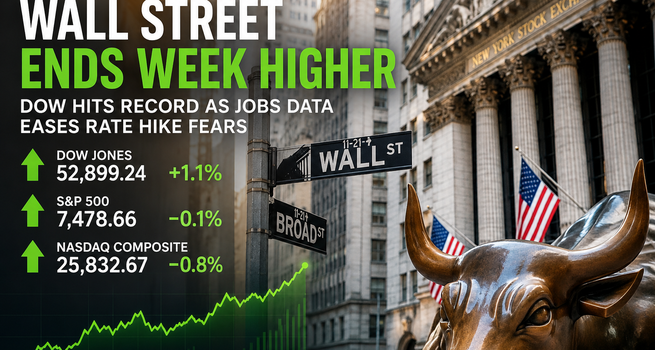
- The Dow Jones Industrial Average gained 2% for the week and closed at a record high.
- The S&P 500 and Nasdaq advanced 1.7% and 2.1%, respectively.
- Weak June payrolls reduced fears of another Federal Reserve rate hike.
- Semiconductor stocks suffered heavy profit-taking after a historic second quarter.
- Investors are increasingly debating the sustainability of AI infrastructure spending.
Wall Street Wraps Up Strong Holiday Week Despite Technology Weakness
U.S. equities finished the shortened Independence Day trading week with solid gains, extending one of the strongest quarterly rallies in years even as technology shares stumbled toward the week's end. Investors balanced encouraging signs of easing inflation pressures against growing questions surrounding the next phase of the artificial intelligence investment cycle.
The Dow Jones Industrial Average rose 2% during the week to finish at a record high above 52,800, while the S&P 500 added 1.7%. The Nasdaq Composite, despite a sharp decline on Thursday, still posted a weekly gain of more than 2%.
The week's performance followed Wall Street's strongest quarterly advance in nearly six years, underscoring continued investor confidence in the broader U.S. economy despite heightened geopolitical tensions earlier this year.
Soft Jobs Report Calms Federal Reserve Concerns
The primary macroeconomic catalyst was June's U.S. employment report, which reinforced expectations that the Federal Reserve is unlikely to tighten monetary policy further in the near term.
The U.S. economy added just 57,000 nonfarm payrolls during June, substantially below economists' expectations of roughly 114,000. The figure also represented a notable slowdown from May's revised reading.
While hiring cooled, the unemployment rate unexpectedly declined to 4.2%, suggesting that the labor market remains resilient rather than deteriorating rapidly.
The combination of slower hiring alongside stable unemployment presented markets with a relatively constructive outcome. Investors interpreted the report as evidence that labor demand is moderating without triggering a severe economic slowdown.
For policymakers, this reduces pressure to resume interest-rate increases following the inflation shock triggered by the Middle East conflict earlier this year.
Falling Oil Prices Ease Inflation Risks
Investor sentiment also benefited from improving inflation dynamics.
Crude oil prices have retreated significantly since reaching their peak during the U.S.-Iran conflict. The reopening of the Strait of Hormuz following an interim peace agreement has restored supply expectations and eased concerns about another prolonged energy-driven inflation cycle.
Lower energy prices have materially improved the inflation outlook, giving Federal Reserve Chair Kevin Warsh and policymakers greater flexibility to maintain current interest rates rather than tighten monetary policy further.
Following the employment report, Treasury yields moved lower while the U.S. dollar weakened, reflecting declining expectations for additional policy tightening.
For equity investors, a prolonged period of stable interest rates remains considerably more supportive than another round of monetary tightening.
AI Chip Stocks Finally Pause After Historic Rally
Despite the broader market's resilience, semiconductor stocks experienced one of their sharpest pullbacks of the year.
The Philadelphia Semiconductor Index, which had surged nearly 88% during the second quarter, fell more than 11% over the final two trading sessions of the week as investors locked in profits after an extraordinary rally.
Several leading semiconductor companies came under pressure, including Micron Technology (NASDAQ: MU), Advanced Micro Devices (NASDAQ: AMD), Marvell Technology (NASDAQ: MRVL), Intel (NASDAQ: INTC), Microchip Technology (NASDAQ: MCHP), Western Digital (NASDAQ: WDC) and Coherent Corp. (NYSE: COHR).
The selloff reflects less concern about deteriorating fundamentals and more about increasingly demanding valuations after months of uninterrupted gains fueled by AI enthusiasm.
Meta's AI Strategy Sparks New Questions
Another catalyst weighing on AI-related stocks was renewed scrutiny surrounding hyperscaler capital spending.
Reports suggesting Meta Platforms (NASDAQ: META) may begin monetizing portions of its excess AI computing capacity prompted investors to reconsider the pace of future infrastructure investment.
The development could indicate that major cloud and technology companies are entering a new phase of AI deployment, shifting from aggressive capacity expansion toward improving returns on already massive investments.
If hyperscalers become more disciplined with capital expenditures, suppliers throughout the semiconductor ecosystem could experience slower order growth than investors have recently anticipated.
While long-term AI demand remains intact, markets are beginning to differentiate between infrastructure build-out and monetization, creating greater volatility across AI-related stocks.
Tesla Pullback Highlights Elevated Expectations
Technology sentiment was also pressured by weakness in Tesla (NASDAQ: TSLA).
The electric vehicle manufacturer reported record quarterly deliveries that exceeded even optimistic Wall Street expectations. However, the stock declined as investors chose to realize profits following a strong rally heading into the announcement.
The reaction reinforced an increasingly common theme throughout earnings season: strong results alone are no longer sufficient to drive higher valuations after substantial price appreciation.
With many technology leaders trading near all-time highs, investors are demanding both exceptional execution and compelling forward guidance.
Markets Shift Toward a More Balanced Outlook
The week's trading illustrated an important transition taking place across financial markets.
Rather than simply rewarding every AI-related company, investors are becoming more selective, weighing valuation against future earnings potential.
Meanwhile, macroeconomic conditions continue to improve.
Inflation pressures are easing, employment remains reasonably healthy, and expectations for additional Federal Reserve tightening have diminished substantially compared with just a few weeks ago.
That combination continues to provide a constructive backdrop for equities, even if leadership rotates away from the semiconductor sector after its historic first-half performance.
Investment Outlook
Wall Street enters the second half of 2026 with considerable momentum following one of the strongest quarterly rallies in recent memory. A resilient labor market, moderating inflation, and easing concerns over additional Federal Reserve tightening continue to support investor sentiment.
However, the sharp reversal in semiconductor shares also signals that markets are becoming increasingly valuation-sensitive after months of AI-driven gains. Investors will closely monitor upcoming earnings season for evidence that corporate profits can justify elevated expectations.
The next phase of the bull market may depend less on expanding multiples and more on companies delivering sustainable earnings growth, disciplined capital allocation, and tangible returns from the unprecedented investment cycle surrounding artificial intelligence.


 Nov 17, 2026





 Please wait processing your request...