
 AU
AU
 UK
UK
 CA
CA
 NZ
NZ
 IND
IND

 US
US

 Share
Share
 X (Formerly Twitter)
 Whatsapp
 Facebook
 LinkedIn
 Telegram
 Email This Article
 Copy Link
 Summarize with AI
 Chat GPT
 Perplexity
Key Highlights:
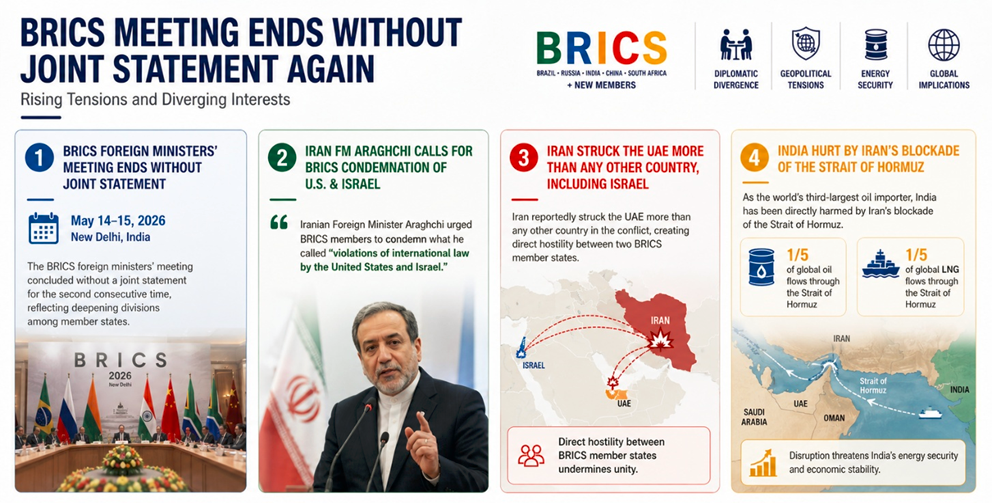
BRICS 2026 New Delhi Summit Collapses Without Consensus as Iran-UAE War Splits Bloc
The BRICS alliance, long touted as a rising counterweight to Western-led multilateral institutions, suffered a significant credibility blow on May 15, 2026, when its two-day foreign ministers' meeting in New Delhi ended without a joint statement — the second consecutive BRICS gathering in India to Fail to produce a consensus position on the Iran conflict. The breakdown exposed deep and potentially structural fractures within a bloc that now includes both Iran and the United Arab Emirates as full members — two countries actively in a state of war. India, as the 2026 chair of BRICS, was left to issue only a chair's statement, a diplomatic fallback that acknowledged "differing views among some members" without resolving them.

The confrontation at Bharat Mandapam in New Delhi on May 14 was unusually direct for the typically carefully choreographed BRICS format. Iranian Foreign Minister Abbas Araghchi urged member states to formally condemn what he described as violations of international law by the United States and Israel. He also, without naming the UAE directly, publicly accused an unnamed BRICS member of blocking portions of India's draft statement. The context was unmistakable: Iran repeatedly struck UAE territory after the outbreak of the war on February 28, reportedly hitting the UAE more than any other country in the conflict, including Israel. Araghchi attempted to defuse the bilateral tension, stating that Iran's strikes targeted American military bases and installations located on UAE soil — not the UAE itself — but the diplomatic damage was done.
India's BRICS Chairmanship Strained by Oil Price Shock and Geopolitical Crossfire
India's position as BRICS chair has been made acutely uncomfortable by the war. As the world's third-largest oil importer and consumer, India has been directly hit by Iran's effective blockade of the Strait of Hormuz, through which roughly one-fifth of global oil and liquefied Natural Gas supplies normally travel. The blockade has driven energy costs sharply higher for Indian industry and consumers. India's chair statement attempted to paper over the divisions by calling for the Global South to "stick together to tackle global challenges" and highlighting the importance of developing nations as a "driver of positive change" — language carefully chosen to avoid taking sides. But the absence of a joint statement was a visible failure for a chairmanship that had sought to strengthen BRICS cohesion at a moment of maximum geopolitical stress.
BRICS Membership Expansion Has Amplified, Not Resolved, Internal Contradictions
The crisis has thrown into sharp relief the tensions inherent in BRICS' recent expansion. The bloc's original five members — Brazil, Russia, India, China, and South Africa — were joined by Ethiopia, Egypt, Iran, Indonesia, and the UAE in the most recent expansion round. The inclusion of both Iran and the UAE, two countries that became active belligerents in a major regional war within months of both joining the bloc, has created an institutional paradox that BRICS has no mechanism to resolve. Araghchi expressed hope that positions would change by the time of the BRICS leaders' summit later in 2026, but the gap between Iran's Demand for condemnation and the UAE's alignment with U.S. and Gulf coalition positions appears too wide for near-term bridge-building. Russia's Foreign Minister Sergei Lavrov attended the New Delhi meeting but no joint position emerged even among the original five core members.
Geopolitical Stakes Rising as BRICS Credibility Faces Test
The failure to issue a joint statement is more than a procedural setback — it signals that BRICS cannot function as a coherent geopolitical actor when the interests of its own members are in direct conflict. For investors and policymakers, the breakdown has practical consequences. The Strait of Hormuz crisis, with a fifth of global energy supplies at stake, demands coordinated diplomatic engagement. Instead, BRICS' largest economies are divided between those that back Iran's framing of the conflict as a response to Western aggression — notably Russia and, implicitly, China — and those that are suffering the economic consequences of the blockade, particularly India. The al Jazeera summary of the meeting noted this was the second consecutive BRICS gathering to collapse without a consensus position on the Iran war, suggesting the impasse is not situational but structural.
Frequently Asked Questions:


 May 18, 2026




 Please wait processing your request...