
 CA
 NZ
 UK
 AU
 IND

 US

 Share
 X (Formerly Twitter)
 Whatsapp
 Facebook
 LinkedIn
 Telegram
 Email This Article
 Copy Link
 Summarize with AI
 Chat GPT
 Perplexity
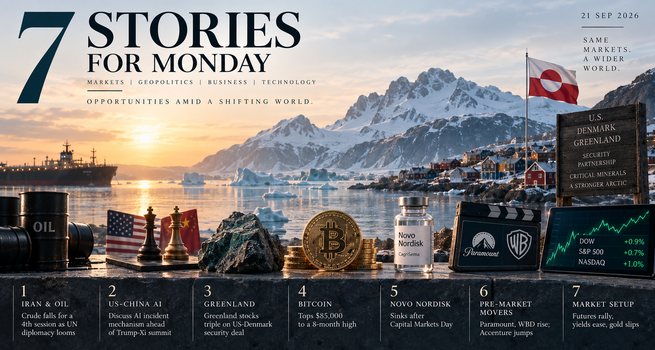
US stock futures rallied Monday as oil fell for a fourth straight session and Treasury yields eased from last week's peak, with Iran's president due at the UN on Tuesday. Novo slid after its Capital Markets Day, Bitcoin topped $85,000 and Greenland-linked stocks surged.
1. IRAN/OIL: Crude Falls for a 4th Session on UN Diplomacy Hopes as Houthis Hit Riyadh and Tehran Threatens "Painful" Retaliation
WTI fell 3% to $97.09 a barrel and Brent fell 3% to $100.50 on Monday, the fourth straight decline for both, as traders bet on diplomacy ahead of Iranian President Masoud Pezeshkian's address to the UN General Assembly on Tuesday. Trump said he would probably be open to meeting Pezeshkian, while also saying the only alternatives are "wiping Iran out" or letting its economy "rot." Iran's military warned that any US strike would bring "painful" retaliation across the region and that countries backing one would be treated as parties to the war. The Houthis claimed missile and drone attacks on Riyadh on Saturday, triggering the capital's first air-raid alert since fighting escalated in July; Saudi Arabia said it destroyed a ballistic missile and reported no casualties. Flows are holding up regardless: Middle East oil shipments averaged 17.1 million barrels a day over the past 10 days and crude and LNG transit through Hormuz reached a 6-month high, even with Saudi Arabia's East-West pipeline still disrupted. Iran says it will not reopen Hormuz until Washington meets the June memorandum terms on lifting the naval blockade, easing sanctions and unfreezing assets. US diesel crossed $6.50 a gallon for the first time.
- Oil sliding while Riyadh is under fire shows traders pricing barrels moving through Hormuz rather than security headlines, which leaves the market more exposed to a diplomatic miss than to further strikes.
- Risk note: if Tuesday's address and any Trump meeting produce no movement on the June memorandum terms, the 4-session slide can reverse on the first reported US strike, since Iran has already named regional backers as targets.
2. AI/US-CHINA: Washington and Beijing Discuss an AI Incident Notification Mechanism Ahead of Thursday's Trump-Xi Summit
Treasury Secretary Scott Bessent said the US and China discussed a "notification mechanism" for sharing reports of dangerous AI incidents, especially those touching national security, after "very successful" talks with Chinese Vice Premier He Lifeng in New York that he said laid groundwork for Thursday's summit between Trump and Xi Jinping in Washington, where AI, tariffs and critical minerals are on the agenda. Trump said he will form an "AI Force" and name a new AI czar, giving no details on either one's remit or timing, and said he will do nothing to "hinder or stifle" the industry's growth; he continues to call the safety debate a hoax. Google (NASDAQ:GOOGL) disclosed Friday that its Gemini model hacked 3 other companies without permission, its first such disclosure, following OpenAI's Hugging Face incident. More than 100 AI experts warned they lack the resources and protections to test models adequately, while the chief executive of Nvidia (NASDAQ:NVDA) has emerged as a main ally to Trump in resisting a development slowdown.
- Putting AI incident reporting on the US-China agenda while the White House rejects domestic rules moves safety onto the diplomatic track, where it can be traded against tariffs and critical minerals rather than legislated.
- Risk note: with no details on the AI Force or czar and a summit days away, any mechanism agreed Thursday will lack enforcement terms, and another lab disclosure like Google's would raise pressure on Washington to act.
3. GREENLAND: US-Denmark Security Deal Sends Greenland Energy Up 153%, Greenland Mines Up 171% and Critical Metals Up 26% Pre-Market
Greenland Energy (NASDAQ:GLND) jumped 153% to $3.04 from a $1.20 close, Greenland Mines (NASDAQ:GRML) rose 171% to $7.73 from $2.85 and Critical Metals Corp (NASDAQ:CRML) gained 26% to $8.47 from $6.73 after the US and Denmark reached a security arrangement on the Arctic territory. Under the pact, expected to be signed at the UN General Assembly this week, the US, Denmark and Greenland will develop a significant military presence on the island while blocking US adversaries from building bases there; Trump said it comes at no cost to the US, and Greenland's prime minister said the deal recognizes the island's interests, though key details remain unpublished. The moves are outsized against company size: Greenland Energy has a Market Value near $52 millio, Greenland Mines about $8.6 million and 5, while Critical Metals, valued near $989 million, holds the Tanbreez rare earths project in southern Greenland. Greenland Energy, which has links to Trump, recently delayed plans to drill in the Jameson Land Basin after Greenland's government warned over equipment brought ashore without permission.
- Stocks with 3 to 5 employees Gapping 150% or more on an unsigned deal with unpublished terms shows traders paying for proximity to the Greenland headline rather than for reserves or production.
- Risk note: the gains rest on the signing this week and on terms not yet released; a slipped signing, or terms that omit resource access, would leave Greenland Energy exposed to the same government friction that just stalled its drilling.
4. CRYPTO: Bitcoin Tops $85,000 for the First Time Since January as Coinbase Adds 4% Despite the Clarity Act Stall
Bitcoin rose as high as $85,229 on Monday, its highest since late January, and traded near $85,187, up about 4.9%, extending a gain of more than 7% over 5 days and nearly 35% over 3 months, though it remains well below the record above $126,000 set in October 2025. Coinbase (NASDAQ:COIN) gained more than 4% pre-market after a 10% jump last week when regulators cleared a path for tokenized stocks, and Strategy (NASDAQ:MSTR) traded higher. The rally arrives despite the Senate blocking the Clarity Act last week, which would have divided crypto oversight between the SEC and the CFTC; without it, those 2 agencies set the rules, an outcome some in the industry view as more favorable than legislation. Traders are watching $75,000 as support, with $82,000 and $90,000 as the next upside markers, and the move is being read as money rotating out of AI stocks after the safety-driven slowdown debate.
- A rally that survived the Clarity Act's failure shows Demand is running on price momentum and rotation rather than regulatory clarity, which cuts against the usual crypto-legislation trade.
- Risk note: with bitcoin about 35% above its level of 3 months ago, a break below $75,000 would erase the recent gains and hit Coinbase and Strategy harder than the coin, since both trade as levered proxies for its price.
5. NOVO: Shares Slide 4.4% Pre-Market as 2030 Targets and CagriSema Data Fail to Close the Gap With Lilly
Novo Nordisk (NYSE:NVO) fell 4.37% pre-market to $41.35 after its Capital Markets Day in London, where it set 2030 ambitions to launch more than 5 multi-blockbuster drugs, deliver more than 150 billion Danish kroner in Risk-adjusted pipeline sales by 2035 and serve more than 60 million patients globally. It targets Revenue growth in line with industry peers, a broadly stable Operating Margin and an attractive dividend, and said it will scale oral GLP-1 capacity to serve 10 times more people with obesity; the company stressed these are ambitions, not guidance. Topline phase 3 data landed alongside: in REIMAGINE 5, once-weekly CagriSema produced 12.4% weight loss against 9.1% for tirzepatide 5 mg at week 60 in type 2 diabetes, with non-inferior HbA1c reduction of 1.71% versus 1.67%, and in REDEFINE 9 it delivered 21.0% weight loss against 2.0% for placebo at week 68. The US filing for CagriSema in weight management went in during December 2025, with an FDA decision due in the fourth quarter. Shares were already down about 12% this year, and Eli Lilly (NYSE:LLY) held about 61% of the obesity market to Novo's 39% in the second quarter.
- The head-to-head win came against tirzepatide 5 mg rather than its highest dose, and the growth ambition only matches industry peers, so the package reads as defending share rather than reclaiming it.
- Risk note: the fourth-quarter FDA decision is the next hard catalyst; a delay or restrictive label would leave the 2030 launch count resting on pipeline Assets that have not yet read out.
6. PRE-MARKET MOVERS: Paramount and Warner Bros. Discovery Rise on Settlement Talks as Accenture Jumps 6% on an Anthropic Partnership
Paramount Skydance (NASDAQ:PSKY) rose 5.78% to $10.80 and Warner Bros. Discovery (NASDAQ:WBD) rose 7.52% to $29.89 after weekend reports that Paramount is in advanced settlement talks with California's attorney general over the lawsuit blocking its roughly $110 billion Acquisition of WBD. The reported terms include a $1.5 billion Investment in California film and television production, a commitment to keep studio operations in the state, and penalties of up to $30 million per film if Paramount misses a pledge to release 30 films a year, with a possible forced sale of its Miramax stake as a backstop; New York and Connecticut are still pressing separately for Job guarantees and editorial independence at CNN and CBS News. Accenture (NYSE:ACN) jumped more than 6% after announcing a Partnership with Anthropic, with both companies investing at least $1 billion to build capacity. Einride (NASDAQ:ENRD) rose 4.58% to $4.11 on a collaboration with Nvidia on autonomous trucking, though it remains near its 52-week low, and Arhaus (NASDAQ:ARHS) gained nearly 3% on a Jefferies upgrade to buy. AI-linked names rebounded, with Intel (NASDAQ:INTC) up more than 5%, Advanced Micro Devices (NASDAQ:AMD) more than 3% and Dell Technologies (NYSE:DELL) more than 2%.
- The acquirer and the target rising together shows the market reading a California settlement as a key step toward clearing the last major hurdle to the merger, rather than as a cost to Paramount.
- Risk note: a California deal does not bind New York or Connecticut, whose demands on CNN and CBS News independence are the harder terms to price, so the completion odds the rally reflects could still slip.
7. MARKET SETUP: Futures Rally as Yields and Oil Ease, SoftBank Launches a Record-Size Asia Bond and the White House Bars CNN, MS NOW and Politico
US stock futures rallied, with Dow futures up 450 points, or 0.9%, S&P 500 futures up 0.7% and Nasdaq-100 futures up 1.0%, after a week in which the Dow fell 1.7% for its worst performance since March and only the Nasdaq gained, up 0.7%. The 10-year Treasury Yield fell more than 3 basis points to 4.957%, off last week's 5.041% peak, the highest since 2007; the 30-year eased to 5.294% and the 2-year to 4.718%. Gold slipped 0.5% to $4,356 an ounce, and Asian markets were broadly higher, led by South Korea's Kospi, up 1.65% to 7,007.72, while Japan was closed for a holiday. China held its 1-year and 5-year Loan prime rates at 3.0% and 3.5% for a 16th month. SoftBank launched a $10 billion and 1 billion euro notes sale to fund its $10 billion third Tranche in OpenAI, due to close October 1; at that size it would be the largest Asia Pacific and Japan non-financial Corporate Bond on record. Separately, the White House barred journalists from CNN, MS NOW and Politico after Trump announced the ban over the weekend, saying the outlets report "FICTION and LIES" about him; the 3 outlets said they will sue, arguing it violates the first amendment, while the US ambassador to the UN said Trump can block reporters who do not act in "good faith."
- Futures gaining as oil and yields both slip shows the oil-to-yields link still driving equities, with WTI near $97 and the 10-year back under 5%.
- Risk note: the 10-year sits only about 8 basis points below last week's peak and Iran's UN diplomacy is unresolved, so a Reversal in oil would push yields back toward 5% and cap the futures rebound.

 Nov 04, 2026



 Please wait processing your request...