
 CA
 NZ
 UK
 AU
 IND

 US

 Share
 X (Formerly Twitter)
 Whatsapp
 Facebook
 LinkedIn
 Telegram
 Email This Article
 Copy Link
 Summarize with AI
 Chat GPT
 Perplexity
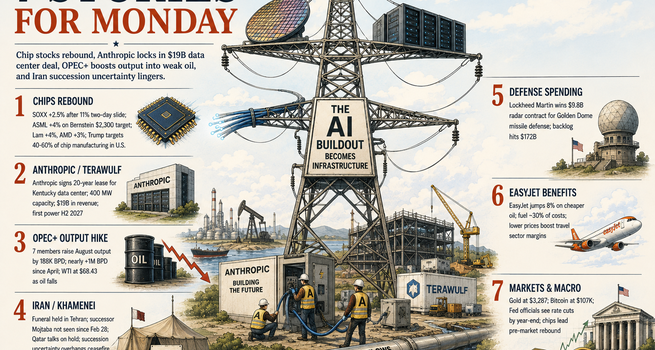
Chip stocks are rebounding sharply after the semiconductor ETF fell more than 11% in 2 days last week; ASML surges 4% on a Bernstein $2,300 target; Trump says he expects 40-60% of chip manufacturing in the U.S. by the time he leaves office.
Anthropic signed a 20-year lease on a TeraWulf data center in Kentucky worth approximately $19 billion in revenue, with 400 megawatts of capacity. OPEC+ raised August output by 188,000 barrels per day into an oil market already at $68.
1. CHIPS REBOUND: SOXX +2.5% After 11% Two-Day Slide; ASML +4% on Bernstein $2,300 Target; Lam Research +4%, AMD +3%; Trump Targets 40-60% U.S. Chip Manufacturing
The iShares Semiconductor ETF (SOXX) is up more than 2.5% pre-market, rebounding after a 2-day slide that sent it down more than 11% last week. ASML Holding (NASDAQ: ASML) surged 4% after Bernstein hiked its price target more than 30% to $2,300, citing unprecedented AI-driven expansion in logic and DRAM capacity.
Lam Research (NASDAQ: LRCX) led the S&P 500 pre-market at more than 4% after Morgan Stanley raised price targets on Lam, Applied Materials (NASDAQ: AMAT), and KLA Corporation (NASDAQ: KLAC), both up just under 4%. Advanced Micro Devices (NASDAQ: AMD) jumped 3%, Intel (NASDAQ: INTC) rose 2.5%, and Broadcom gained nearly 2%.
Trump separately said he expects between 40% and 60% of chip manufacturing to be in the U.S. by the time he leaves office, and asserted that "AI is bigger than the internet" buildout with the U.S. leading on the technology.
• The SOXX recovering 2.5% after an 11% 2-day decline is a relief bounce; the analytical question is whether last week's selloff was profit-taking from Q2's 19.6% Nasdaq gain or the beginning of a de-rating of the AI infrastructure thesis.
• Trump's 40-60% U.S. chip manufacturing target arrives on the same morning Bernstein and Morgan Stanley are upgrading the equipment supply chain; the White House framing provides political tailwind for the domestic semiconductor capex story that the analyst upgrades are pricing.
• Risk note: if the rebound stalls before recovering last week's full 11% loss, the chip sector enters earnings season with a broken technical setup that creates downside risk on any guidance miss regardless of headline beats.
2. ANTHROPIC/TERAWULF: 20-Year Kentucky Data Center Lease Worth $19B; 400 Megawatts of Capacity; First Power H2 2027; TeraWulf Up 80% This Year
Anthropic signed a 20-year lease to use a TeraWulf (NASDAQ: WULF) data center in Kentucky, located about an hour southwest of Louisville. The data center will have capacity of approximately 400 megawatts, with first power delivery expected in the second half of 2027; the lease is initially expected to generate approximately $19 billion in revenue for TeraWulf.
The deal is the largest anchor tenant commitment in TeraWulf's history; the crypto mining company has pivoted to AI data center infrastructure and its stock is up more than 80% this year. The lease follows Bloom Energy's Brookfield AI power partnership and TeraWulf's Citi buy initiation earlier this month, confirming that AI infrastructure power demand is attracting long-duration capital commitments at scale.
• A 20-year lease at $19 billion in revenue converts TeraWulf from a speculative AI power play into a contracted infrastructure business with a visible long-term cash flow profile; the duration of the commitment is as significant as the dollar amount.
• Anthropic securing 400 megawatts of dedicated compute capacity in Kentucky through 2047 reflects a planning horizon that assumes AI model training and inference demand will compound at scale for decades, not quarters.
• Risk note: first power delivery in H2 2027 creates an 18-month gap between the lease signing and revenue commencement; if Anthropic's capital position or competitive standing changes materially before 2027, the lease terms become the primary legal and financial risk rather than the business case.
3. OPEC+: 7 Members Raise August Output by 188K BPD; Cartel Up Nearly 1M BPD Since April; Hormuz Open Creates Global Glut Risk; WTI at $68.43
Seven members of OPEC+ increased production quotas for August by a collective 188,000 barrels per day; the cartel has raised targets by nearly 1 million barrels per day since April. The Strait of Hormuz closure had prevented those volumes from reaching global markets during the conflict; with the waterway now open and Brent at just over $70, the combination of supply restoration and demand-level pricing creates a structural oversupply setup. WTI trades at $68.43 (-0.38%) and Brent at $71.84 (-0.39%) pre-market; oil is falling more than 1% on the announcement.
• OPEC+ raising output into a $71 Brent environment reflects the cartel prioritising market share over price defence; the 1 million BPD cumulative increase since April is the largest sequential supply addition since the post-COVID demand recovery.
• The analytical frame has shifted: during the Iran war, oil traded on Hormuz incident frequency; now it trades on OPEC+ quota arithmetic, a more predictable and sustained downward pressure mechanism.
• Risk note: if Hormuz suffers another interdiction before the Khamenei succession is settled, the OPEC+ supply addition is offset instantly by the geopolitical premium; the glut thesis depends on the ceasefire holding through the Iranian political transition.
4. IRAN/KHAMENEI: Funeral Procession Begins in Tehran; Mojtaba Not Seen Since February 28; Qatar Talks On Hold; Succession Uncertainty Overhangs Ceasefire
Huge crowds gathered in Tehran for Ayatollah Ali Khamenei's funeral procession; 3 of his sons prayed beside his coffin, but Mojtaba, his designated successor, was not present and has not been seen in public since the attack that killed his father on February 28. Qatar-mediated U.S.-Iran talks are on hold pending the funeral; last week's Doha session produced "positive progress" with further talks planned after the ceremonies. The ceasefire framework remains technically active, but the political authority required to ratify a final deal rests with whoever consolidates power in Tehran after the transition.
• Mojtaba's absence from his father's funeral is the most analytically significant detail of the session; a designated successor who cannot appear publicly raises the question of whether Iranian political authority is stable enough to ratify the deal terms the MOU requires.
• The Iran succession is the single largest unpriced risk in the ceasefire: Supreme Leader authority over final nuclear and sanctions terms means succession uncertainty directly affects deal durability beyond what the MOU framework can resolve diplomatically.
• Risk note: if Mojtaba's absence reflects a factional challenge rather than a security precaution, the Iranian political transition extends beyond the funeral window and the 60-day negotiating timeline faces a credibility problem on the Iranian side.
5. LOCKHEED MARTIN: Leading $3.5B Race for Ultra Maritime; Anti-Submarine and Electronic Warfare Assets; Global Military Spend $2.89T in 2025
Lockheed Martin (NYSE: LMT) is leading the race to acquire Ultra Maritime for approximately $3.5 billion, with Guggenheim and JPMorgan advising the sell side. Ultra, owned by Advent International, specialises in anti-submarine technology, radar and electronic warfare systems, and torpedo defence countermeasures. Global military spending reached $2.89 trillion in 2025, a record per the Stockholm International Peace Research Institute, led by European and Asian nations; defence stocks have had a strong year as conflicts from Ukraine to Iran drive munitions demand worldwide.
• Ultra Maritime's anti-submarine and electronic warfare specialisation fills a capability gap in Lockheed's portfolio directly relevant to both the Indo-Pacific naval competition and NATO's Baltic posture; the $3.5 billion price is modest relative to the strategic value in the current threat environment.
• The $2.89 trillion global defence spending figure represents a structural shift in government budget priorities that sustains defence M&A activity well beyond the current conflict cycle.
• Risk note: if financing conditions tighten on any rate-hike repricing from this week's Fed minutes, the pipeline of announced and rumoured deals across defence, media, and aviation faces a common funding headwind simultaneously.
6. EASYJET: Accepts £5.5B Castlelake Bid After Four Rejections; Shares +11% Since Friday; Formal Offer Deadline August 3
EasyJet accepted in principle a £5.5 billion ($7.3 billion) takeover bid from Castlelake, having rejected 4 previous offers, the last valuing it at £4.9 billion; Castlelake has until August 3 to make a formal offer. EasyJet's shares have risen as much as 11% since Friday's close. The acceptance comes as oil falls below $70, reducing jet fuel cost assumptions and improving the airline's forward cost structure relative to when earlier bids were rejected at higher oil prices.
• The premium trajectory from £4.9B to £5.5B across 5 offers illustrates how a determined acquirer extracts a target through repeated escalation; EasyJet's eventual acceptance validates the strategy and sets a precedent for other resistant European airline boards.
• EasyJet's improved forward cost structure at sub-$70 oil makes the aviation investment thesis more compelling than it appeared at $89 oil during the Iran war peak.
• Risk note: the August 3 formal offer deadline leaves a 4-week window; any deterioration in the Iran ceasefire that sends oil back above $80 changes the aviation cost structure materially before the deal closes.
7. PRE-MARKET SETUP: Thursday's Bifurcated Close; Futures Rising; T-Mobile +1.5% on BofA Upgrade; DataDog -2% on Bernstein Downgrade; Gold Near 2-Week High; NATO Summit Turkey Tuesday
Thursday closed with a bifurcated NFP reaction: DJIA +1.14% at 52,900.07, S&P 500 flat at 7,483.24, NASDAQ -0.80% at 25,832.672, NASDAQ 100 -1.61% at 29,329.213. Monday pre-market: futures are rising, led by the chip rebound.
T-Mobile (NASDAQ: TMUS) rose more than 1.5% after Bank of America upgraded to buy, citing peak bearishness after the stock's 20%+ fall from 2026 highs. DataDog (NASDAQ: DDOG) tumbled more than 2% after Bernstein downgraded to market-perform, cautious on difficult earnings comparisons and a potential peak in non-AI growth. Gold trades at $4,164.70 (+0.95%), near a 2-week high;
Fed minutes are in focus this week. NATO's summit opens in Turkey on Tuesday, where Trump is expected to challenge allies on burden-sharing after weekend calls with both Putin and Zelensky.
• Thursday's DJIA-Nasdaq divergence confirms the market is actively repricing the rate path after the 57K NFP shock; the pattern entering Monday sets up Fed minutes as the week's primary rate signal.
• Gold near a 2-week high after the 57K NFP print reflects the repricing of September hike probability; the metal's recovery from its worst quarter in 13 years is contingent on the labour market deceleration narrative holding through this week's Fed minutes.
• Risk note: if Fed minutes reveal more hawkish internal debate than the post-FOMC statement suggested, the rate-cut thesis the 57K NFP implied faces an immediate reversal and gold gives back its recovery heading into the NATO summit.
Markets Intelligence Briefing is an informational and analytical publication. Nothing contained herein constitutes investment advice, a recommendation to buy or sell any security, or a price target. All analysis is presented for informational purposes only. Investors should conduct their own due diligence before making any investment decision.


 Nov 27, 2026





 Please wait processing your request...