
 CA
 NZ
 UK
 AU
 IND

 US

 Share
 X (Formerly Twitter)
 Whatsapp
 Facebook
 LinkedIn
 Telegram
 Email This Article
 Copy Link
 Summarize with AI
 Chat GPT
 Perplexity
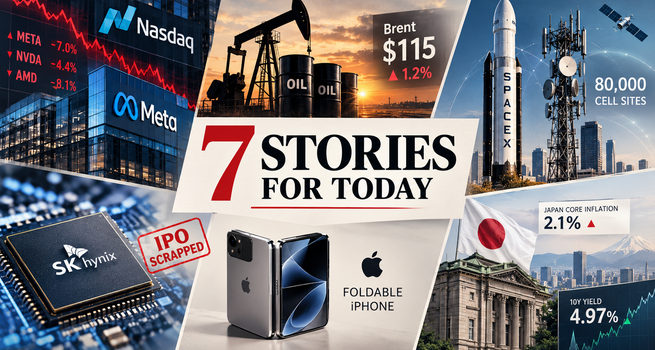
US stock futures edged lower after a sharp tech sell-off, with S&P 500 futures down 0.4% and Dow futures down 408 points, as Brent Crude touched $115 on fears of renewed fighting in the Middle East. Meta, Nvidia and AMD led Thursday's slide, SpaceX rattles telecoms and SK hynix scraps its Solidigm IPO.
1. TECH SELLOFF: Nasdaq Falls 2.6% in Its Worst Day Since June as Meta Plunges 7% and Hedge Funds Post Their Worst Day Since COVID
The Nasdaq Composite fell 2.6% on Thursday, its sharpest drop since June 5, after Meta (NASDAQ:META) slumped 7%, its largest fall since July, on heavy spending plans and a new class of shares to raise funds. Nvidia (NASDAQ:NVDA) fell 4.4% and AMD (NASDAQ:AMD) 8.1%. CoreWeave (NASDAQ:CRWV) plunged 10%, extending its monthly decline to 36%, and Australia's NextDC tumbled nearly 40% on Wednesday after cutting its Earnings forecast. All 3 hedge fund strategies tracked by Goldman Sachs lost more than 1% on Thursday, the first time since the COVID rout, as crowded AI trades were unwound. Tech-focused funds are down about 10% this month.
- One strategist said taking some air out of the AI Bubble "is a good thing" and did not expect it to burst.
- Risk note: a Tokyo Fund Manager called AI concentration "staggering" and said circular financing is a concern, echoing the dotcom era.
2. OIL: Brent Touches $115 for the First Time Since May as Aramco Evacuates Its Headquarters and Reports Point to New Iran Strikes
Brent crude rose 1.2% to $114.57 a barrel after touching $115, its highest since May 4, and is on track for a third weekly gain, of 4.2%. West Texas Intermediate gained 1.5% to $100.95. Saudi Aramco ordered the evacuation of its Dhahran headquarters on Thursday as fighting intensified with Yemen's Houthis, and reports say the US and Israel may be drawing up plans for renewed attacks on Iran. President Trump declared oil production and refining essential to national defense, invoking the Defense Production Act to allow financial incentives for oil projects. The first Russian diesel bound for the US since Trump's deal with Moscow is heading for New York.
- An analyst said the market is "concerned about a potential escalation" that "could trigger renewed Supply disruptions."
- Risk note: only 36% of Americans approve of Trump's handling of the economy before the Nov. 3 midterms, and a Libyan pipeline shutdown adds to supply strain.
3. SPACEX: Telecoms Fall 5% on a Report SpaceX Wants 80,000 Cell Sites as PhillipCapital Double-Upgrades the Stock
AT&T (NYSE:T) fell 5.23%, T-Mobile (NASDAQ:TMUS) 5.54% and Verizon (NYSE:VZ) 4.51% pre-market after a report that SpaceX is in private talks to Lease at least 80,000 cell sites, as it tries to build a fourth nationwide carrier by combining Starlink's direct-to-device network with ground infrastructure. Crown Castle (NYSE:CCI), which is in the talks, jumped 15.41% and American Tower (NYSE:AMT) 11.43%. SpaceX (NASDAQ:SPCX) rose about 1% after PhillipCapital upgraded it to buy from sell, citing stronger Revenue from its AI business. Separately, Trump said Elon Musk "put back" Ukraine's Starlink access, and Musk reportedly invested $1 billion in Skydance, which carries nearly $80 billion of debt.
- The talks would give SpaceX ground infrastructure its satellites lack, so tower owners rose while carriers fell.
- Risk note: the talks are unconfirmed, and a US senator has opened an inquiry into how Starlink was "degraded for Ukraine without notice."
4. SK HYNIX: Shares Close 4.4% Higher After the $15 Billion Solidigm IPO Is Scrapped and Nvidia's Huang Rejects a Memory Glut
SK hynix (NASDAQ:SKHY) closed 4.4% higher in Seoul, reversing early losses of more than 3%, after halting a review of a US listing of its Solidigm subsidiary, which had sought to raise $15 billion. It cited "capital-market conditions" after South Korea's financial regulator said a US listing could violate dual-listing rules. An analyst said shareholders "got the outcome they were pushing for," though the company must show a credible funding plan for a new US fab when it reports earnings next week. Its US-listed shares fell 8% overnight. Nvidia CEO Jensen Huang said he does not expect memory oversupply by 2029 and that Demand for neocloud firms is "off the charts," though "there's a Scarcity of capital."
- The pause shows how chip Volatility is closing the IPO window, with SK hynix the latest to forgo a listing.
- Risk note: Solidigm's plants have limited capacity for AI memory demand, so funding a US fab without hurting dividends and Buybacks is unsolved.
5. PRE-MARKET MOVERS: Moderna Falls 6% After a 25% Drop, Deckers Slides 7% on a Revenue Miss and Bloom Energy Dips on Cash Flow
Moderna (NASDAQ:MRNA) fell 5.7% after dropping 25% on Thursday following a leak of data on its melanoma Vaccine with Merck (NYSE:MRK), which cut the risk of death or recurrence by 42%. Both stocks faltered although the full data, released Thursday, appeared positive against expectations. Deckers (NYSE:DECK) fell 6.7% after fiscal second-quarter revenue of $1.43 billion missed the $1.51 billion expected, with HOKA and UGG short of forecasts. Bloom Energy (NYSE:BE) fell 2.5% after beating on revenue and earnings and raising its 2026 earnings guidance, as investors focused on negative free Cash Flow in the quarter.
- Selling after a strong result shows how crowded expectations had become after August's speculative frenzy.
- Risk note: misses at Deckers' top brands and Bloom's cash burn show how little shortfall investors tolerate this earnings season.
6. BONDS/JAPAN: 10-Year Yield Edges Up to 4.97% After a Safe-Haven Drop; Japan's Core Inflation Reaches 2.1%, Its Highest This Year
The 10-year Treasury Yield rose 1 to 2 basis points to about 4.97%, the 30-year to about 5.30% and the 2-year to about 4.66%, after yields fell sharply on Thursday as investors sought safe havens. Japan's core inflation reached 2.1% in September from 1.7% in August, its highest this year, with "core-core" inflation, the Bank of Japan's preferred gauge, at 2.4%. A weak yen and the indirect effects of energy costs are lifting Import prices, and the yen strengthened to 156.15 per dollar. After raising rates to 1.25% in September, a three-decade high, an economist expects another hike in December. The finance minister said Japan is "on the cusp of shifting to a period of sustained inflation driven by rising wages."
- A bill to cut the consumption tax on food to 1% from 8% for 2 years is being debated, yet the finance minister sees "no gap" between government and the BOJ.
- Risk note: the economy minister said the government must look "comprehensively" at inflation drivers before declaring Deflation over.
7. MARKET SETUP: Futures Slip, Asia Ends Mixed and Apple's Foldable iPhone Duo Launches at About $2,000
S&P 500 futures fell 0.4%, Dow futures 408 points, or nearly 0.8%, and Nasdaq-100 futures 0.2%. For the week the S&P 500 is up less than 0.1%, the Nasdaq down 0.5% and the Dow up 1.7%. In Asia, South Korea's Kospi rose 0.3% to 5,550.3, Japan's Nikkei 225 lost 0.34% to 62,693.16, Australia's ASX 200 was flat and China's CSI 300 rose 1.71% but fell for an 11th straight week. Apple (NASDAQ:AAPL) launched its first folding phone, a first test for new CEO John Ternus, with orders capped at 2 per customer. IDC expects Apple to take 44% of foldable Market Value in 2026 on 31% of units.
- Early reviews praised the hinge but flagged camera compromises, and several prominent reviewers advised many buyers against it.
- Risk note: demand is strong but supply is rationed, so the test is turning launch-day excitement into lasting adoption.


 Oct 27, 2026




 Please wait processing your request...