
 CA
 NZ
 UK
 AU
 IND

 US

 Share
 X (Formerly Twitter)
 Whatsapp
 Facebook
 LinkedIn
 Telegram
 Email This Article
 Copy Link
 Summarize with AI
 Chat GPT
 Perplexity
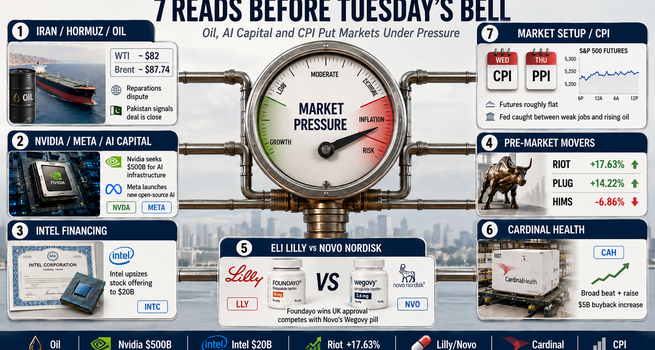
Oil jumped as much as 3% before paring gains after Pakistan signaled a US-Iran deal is close, even as Trump's new reparations Demand had deepened doubts over a Hormuz resolution. Nvidia approached six major finance firms to help raise $500 billion for AI infrastructure, while Meta launched a new open-source model and outlined plans to distribute free AI to billions. Intel upsized its stock offering to $20 billion, Cardinal Health posted a broad beat-and-raise quarter, and Riot Platforms surged 17.63% on a landmark Anthropic data centre Lease as investors await Wednesday's CPI print after last week's weak jobs report.
1. IRAN/HORMUZ: Oil Little Changed at $82 as Pakistan Signals US-Iran Deal Is Close; Trump's Reparations Demand Had Driven an Earlier 3% Spike
Oil prices were little changed Tuesday as the market weighed conflicting signals on a Hormuz deal: WTI traded around $82.32-82.49, and Brent around $87.74, both roughly flat on the day. Crude had jumped as much as 3% earlier after Trump demanded Iran pay reparations to the US, dimming prospects for an agreement, before pulling back from session highs after Pakistan's defence minister said signals indicate the US and Iran are close to some sort of arrangement, according to reports.
Trump separately claimed the US now has 100% control of the Strait of Hormuz, while a fresh sticking point has emerged over reparations now being demanded by both sides over claimed damages; Iran's foreign minister said Sunday there is no possibility of restarting direct negotiations with the US while it continues violating the June memorandum of understanding without compensation. Oil also found support from data showing US government crude stockpiles have fallen to their lowest level in more than four decades, prompting Washington to extend its Jones Act suspension, narrowed to energy-hauling vessels. Treasury yields were little changed alongside oil: the 10-year rose less than a basis point to around 4.70%, the 2-year held near 4.23%, and the 30-year, typically more sensitive to geopolitical events, added less than a basis point to 5.25%; all three finished Monday's session up 4 basis points.
Separately, reports emerged that Trump departed last month's NATO summit in Turkey via a secret military flight, quietly moved between aircraft using a catering truck after a credible Iranian assassination threat, which the White House confirmed.
- Pakistan's defence minister, rather than either party directly involved, is now the source of the most concrete near-term deal signal, an unusual channel that adds a layer of uncertainty about how reliable the "close to an arrangement" characterisation actually is.
- ING strategists noted oil remains highly headline-driven with prices whipsawing on each development, and that the latest bout of optimism is quickly fading, with current rhetoric suggesting a deal remains some way off and risks skewed to the upside.
- Risk note: a credible, specific assassination threat tied directly to this conflict is a materially different signal than the diffuse geopolitical risk markets have priced so far; further threats could intensify oil's sensitivity to headlines even as the Pakistan-relayed signal points toward progress.
2. NVIDIA/META: Nvidia Approaches Six Major Finance Firms to Raise $500 Billion for AI Infrastructure; Meta Launches Open-Source Model, Pledges Free AI for "Billions"
Nvidia (NASDAQ:NVDA) has approached six of the largest names in finance, including Apollo NYSE:APO, Blackstone (NYSE:BLK), BlackRock (NYSE:BX), Brookfield (NYSE:BAM), Goldman Sachs (NYSE:GS), and KKR (NYSE:KKR), to help raise $500 billion for AI infrastructure spending. Details remain scant, but CEO Jensen Huang said none of the firms approached have turned down the request. Investors, already concerned about the scale of AI-related Capital spending across the sector, reacted negatively; Nvidia shares closed nearly 3% lower.
Separately, Meta (NASDAQ:META) launched Muse Glimmer, a new open-source AI model, alongside an essay from CEO Mark Zuckerberg outlining plans to distribute freely available AI models to billions of people globally; Zuckerberg argued that fewer restrictions on AI access would help American companies compete more effectively against Chinese rivals, and criticised competitors that charge for access to their models rather than releasing them openly.
- Approaching six institutions simultaneously, rather than a single lead financier, suggests Nvidia is distributing both the capital commitment and the associated risk across multiple balance sheets rather than concentrating it with one partner.
- Framing open-source AI distribution explicitly as a competitive response to Chinese AI labs positions Meta's strategy as a national-competitiveness argument rather than purely a commercial one, a framing likely intended to resonate with policymakers currently shaping AI regulation.
- Risk note: Nvidia's negative stock reaction despite Huang's claim that no firm has declined shows investors increasingly treating fresh AI financing news as a warning sign on capital intensity rather than confirmation of durable demand; Meta's broader distribution of powerful open-weight models, arriving the same week OpenAI disclosed it could not rule out its own unreleased model reaching a critical cyber capability threshold, complicates the containment and monitoring efforts labs and regulators are currently trying to establish.
3. INTEL: Upsizes Stock Offering to $20 Billion From $15 Billion; Priced at $95 Per Share; Net Proceeds of $19.7 Billion for General Corporate Purposes
Intel (NASDAQ:INTC) upsized its previously announced common stock offering to $20 billion from $15 billion, at an Offer Price of $95 per share; the offering is set to close August 12 and is expected to raise net proceeds of approximately $19.7 billion after Underwriting discounts and expenses. The company said proceeds will be used for general corporate purposes, including capital expenditures and working capital, to support demand tied to physical AI, purpose-built silicon, and advanced packaging. The move follows Intel's fastest Revenue growth in nearly 15 years last month and a hike to its Capital Expenditure guidance. Mega-cap technology companies are on track to spend $765 billion on AI infrastructure this year and $1.2 trillion in 2027, according to Goldman Sachs estimates, with Amazon (NASDAQ:AMZN) giving the highest capex guidance among the group this reporting season, citing the ongoing memory cost crunch.
- Upsizing the offering by a third within days of the original announcement suggests demand was stronger than Intel initially anticipated, a signal of investor confidence in its AI growth narrative even as the raise is dilutive.
- Risk note: with mega-cap AI capex on a trajectory toward $1.2 trillion by 2027, Intel's $20 billion raise is a relatively modest contribution to a rapidly escalating industry-wide spending commitment; the company's ability to convert this capital into competitive returns will be judged against peers already spending at a far larger scale.
4. PRE-MARKET MOVERS: Riot Platforms Surges 17.63% on Anthropic Lease Disclosure; Plug Power Jumps 14.22% on Beat and Raise; Hims & Hers Falls 6.86% Despite Revenue Beat
Riot Platforms (NASDAQ:RIOT) surged 17.63% pre-market after disclosing a landmark 20-year, 191-megawatt Anthropic data centre lease at its Rockdale, Texas campus, expected to generate roughly $9.1 billion in initial contract revenue, up to $16.1 billion with extensions; combined with its existing AMD lease, Riot now has 241 megawatts contracted representing about $9.8 billion in long-term AI infrastructure revenue. Second-quarter revenue of $174.2 million beat the $154.2 million estimate, though the company posted a wider-than-expected loss; analysts at Cantor Fitzgerald and Needham raised price targets to $30, citing the scale and duration of the new AI compute contracts.
Plug Power (NASDAQ:PLUG) jumped 14.22% pre-market after second-quarter revenue of $178.3 million topped consensus estimates of roughly $169 million, up approximately 9% sequentially, while adjusted loss narrowed to $0.07 per share versus $0.08 expected; management raised full-year revenue growth guidance to 15-16% from 13-15% and reiterated a target for positive EBITDA by the fourth quarter.
Hims & Hers (NYSE:HIMS) fell 6.86% pre-market after the telehealth company reported a wider-than-expected second-quarter loss of $0.37 per share versus $0.05 expected, overshadowing revenue of $753.2 million that beat consensus; the company still raised full-year revenue guidance to $3.1-3.3 billion and reaffirmed its 2030 targets, though the profitability miss added to existing questions about the fundamentals underlying the stock's valuation.
- Riot Platforms confirming a second major hyperscale AI lease within the same disclosure that already included the AMD contract shows the company converting from a pure Bitcoin miner into a diversified AI infrastructure landlord at a pace that is now outrunning its underlying quarterly financial results.
- Risk note: Hims & Hers falling despite a Clean Revenue beat and raised full-year guidance shows the market currently weighting near-term profitability misses more heavily than forward guidance strength; if that pattern persists into future quarters, the gap between guidance credibility and near-term execution will remain the central question for the stock.
5. ELI LILLY/NOVO NORDISK: Lilly's Foundayo Wins First Approval Outside the US, Launching in UK to Compete With Novo's Wegovy Pill
Eli Lilly (NYSE:LLY) won its first approval to sell weight-loss pill Foundayo, known chemically as orforglipron, outside the US, with the UK's Medicines and Healthcare products Regulatory Agency clearing it Monday for weight management and type 2 diabetes on prescription; it becomes only the second GLP-1 weight-loss pill available in Europe, arriving roughly two months after Novo Nordisk's (NYSE:NVO) Wegovy pill launched there. The drug will still require a cost-effectiveness evaluation from the National Institute for Health and Care Excellence before becoming available through the National Health Service. Lilly has positioned Foundayo's lack of food restrictions as a key differentiator against Wegovy pill, which must be taken first thing in the morning with only water and no food or drink for at least 30 minutes afterward. Foundayo, which launched in the US in April, generated $98 million in second-quarter sales, a notably slower uptake than Wegovy pill has seen; Novo's chief executive said around 300,000 UK patients are estimated to have started taking Wegovy pill within its first three weeks of availability there, pushing back on concerns that oral GLP-1 momentum is slowing after second-quarter sales came in slightly below some analyst forecasts.
- The gap between Foundayo's $98 million in US quarterly sales and Wegovy pill's reported 300,000 UK patients in just three weeks suggests Novo's earlier market entry advantage remains substantial, even as both companies frame the oral pill category as expanding the overall market rather than simply cannibalising injectable sales.
- Risk note: Foundayo's NHS availability remains contingent on a NICE cost-effectiveness review with no confirmed timeline, meaning today's regulatory approval is a necessary but not sufficient step toward the drug generating meaningful UK revenue.
6. CARDINAL HEALTH: Q4 Revenue Up 6% to $63.7B; Non-GAAP EPS Up 40%; Raises FY27 Guidance Above Long-Term Targets, Approves $5 Billion Buyback Increase
Cardinal Health (NYSE:CAH) reported fourth-quarter revenue of $63.7 billion, up 6%, with non-GAAP diluted EPS of $2.91, up 40% as reported or 25% excluding a one-time $0.31 per share benefit from IEEPA Tariff refunds; full fiscal year 2026 non-GAAP diluted EPS rose 37% to $11.26. The company guided fiscal 2027 non-GAAP EPS growth of 13-15% to $12.40-12.60, above its long-term guidance range, and its board approved a $5 billion increase to its share repurchase authorization, bringing the total to $6.4 billion; the company's own risk disclosures specifically cite the Iran conflict as a Factor that could affect costs and supply.
- Cardinal Health's fiscal 2027 guidance being set above its own long-term target range, with all five operating segments growing profit double-digits even before recognition of one-time tariff refund benefits, is one of the cleanest broad-based beat-and-raise quarters in this series.
- Risk note: the company's explicit citation of the Iran conflict as a named risk factor in its own disclosures is a direct acknowledgment that geopolitical developments covered elsewhere in this briefing carry real operational consequences for a healthcare distributor several steps removed from energy markets.
7. MARKET SETUP: Futures Roughly Flat as CPI Looms Wednesday, PPI Thursday; Asia Mixed, Europe Marginally Lower; Fed Faces Bind Between Weak Jobs and Rising Oil
S&P 500 futures were little changed Tuesday, weighing Hormuz progress against doubts about a broader resolution; broad-index futures rose 0.1%, Nasdaq-100 futures gained 0.3%, and Dow futures added 34 points. Asian markets were mixed: Kospi closed 0.73% higher and ASX 200 added 0.19%, while Hang Seng fell 1.03% and CSI 300 dropped 0.79%; Japan was closed for a holiday. European stocks advanced only marginally, with the FTSE 100, CAC 40, and DAX all near the flatline. Existing home sales data is due later Tuesday, with July's figure expected at 4.04 million, down slightly from June's 4.09 million, ahead of the core CPI print Wednesday and PPI Thursday, both seen as important after last week's weak jobs report complicated the Fed's outlook.
- Higher oil renewing Inflation concerns just as the labour market shows genuine softening puts the Fed in a difficult position, with the two developments pointing toward opposite policy responses.
- Risk note: a hot CPI print alongside elevated oil narrows the Fed's path further, and markets currently pricing a lower September hike probability would need to reassess quickly.

 Nov 27, 2026




 Please wait processing your request...