
 CA
 NZ
 UK
 AU
 IND

 US

 Share
 X (Formerly Twitter)
 Whatsapp
 Facebook
 LinkedIn
 Telegram
 Email This Article
 Copy Link
 Summarize with AI
 Chat GPT
 Perplexity
Key Highlights
- Open Standard has launched Open USD, a dollar-pegged stablecoin backed by more than 140 companies spanning payments, banking, technology and crypto.
- The token eliminates minting and redemption fees and is designed to return most reserve income to participating businesses after a management fee.
- The launch follows the 2025 GENIUS Act, which created the first federal regulatory framework for stablecoins in the United States.
- Governance sits with an independent board drawn from partner firms, a structure BNY has called a unique combination of neutral governance and shared economics.
- Despite years of growth, stablecoins remain used mainly to facilitate crypto trading rather than everyday payments, a gap Open USD is explicitly designed to close.
What Open USD Is
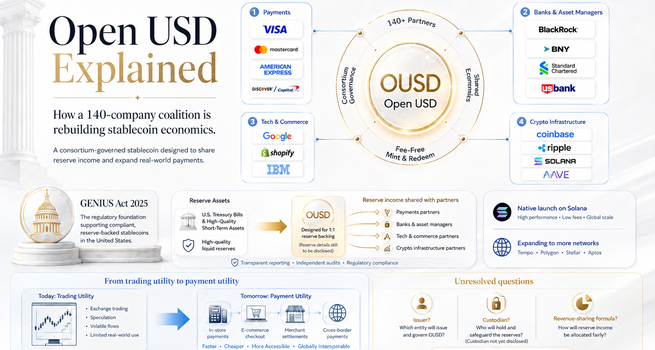
Open Standard, an independent company backed by more than 140 businesses, launched Open USD, a U.S. dollar-pegged stablecoin, aiming to broaden the adoption of digital tokens beyond their current use cases. The token, ticker OUSD, is expected to go live later this year. Founding chief executive Zach Abrams framed the rationale directly: existing stablecoins have real strengths, but scaling them requires something open, low-cost, high-throughput, broadly accessible and aligned with the interests of the businesses using them.
The partner roster spans four broad categories. Payment networks include Visa (NYSE:V), Mastercard (NYSE:MA), American Express (NYSE:AXP) and Discover (now part of Capital One, NYSE:COF). Banks and asset managers include BlackRock (NYSE:BLK), BNY (NYSE:BNY), Standard Chartered and U.S. Bank (NYSE:USB). Technology and commerce platforms include Google (NASDAQ:GOOGL), Shopify (NYSE:SHOP) and IBM (NYSE:IBM). Crypto infrastructure firms include Coinbase (NASDAQ:COIN), Ripple, Solana and Aave. Zach Abrams, who previously co-founded stablecoin infrastructure firm Bridge, is serving as founding chief executive of Open Standard.
The Regulatory Backdrop
Open USD arrives roughly a year after Washington created its first comprehensive rulebook for the asset class. The GENIUS Act, signed into law in July 2025, established the first federal regulatory framework for payment stablecoins, mandating full reserve backing and monthly public disclosures, and was widely seen as a step toward making stablecoins a mainstream tool for payments rather than a niche crypto instrument. That regulatory clarity is part of what makes a 140-company coalition of this scale plausible now, where it would have carried far more legal ambiguity even two years ago.
How the Economic Model Works
The core innovation is structural rather than technological. Businesses can mint and redeem Open USD without cost and without volume limits, letting partners build at scale. Earnings from the reserves backing the token are shared among Open Standard's partners, minus a management fee to cover operational costs, a direct inversion of the model in which a single issuer retains reserve income.
The precise allocation formula has not been disclosed. Comparable consortium models, such as Paxos-backed USDG, tie reserve-sharing to factors including minting activity, custody and merchant acceptance. Analysts expect some combination of balance-weighted and activity-weighted distribution for Open USD, though the exact mechanics await confirmation.
Governance and the Adoption Gap
Open USD's governance model is built around a board composed of partner firms rather than a single controlling company. BNY chief product and innovation officer Carolyn Weinberg described the approach as combining neutral governance with shared economics, a pairing she said has the potential to unlock the next phase of digital asset growth.
That framing points to a gap Open Standard is explicitly trying to close. Stablecoins are digital tokens designed to hold a constant value, typically pegged to a currency such as the U.S. dollar or euro, and their circulation has grown substantially in recent years. Yet despite that growth and the regulatory clarity the GENIUS Act was expected to bring, stablecoins remain used mostly to facilitate trading between other crypto tokens rather than as an everyday means of sending or receiving payments. Open USD's fee-free, high-throughput design is aimed squarely at that unresolved gap between stablecoin volume and stablecoin utility.
Consortium governance is not new. USDC originally launched under the Centre Consortium, a joint venture between Circle and Coinbase that was dissolved in 2023 when governance was consolidated under a single issuer. A separate coalition of fintech and crypto firms launched Global Dollar Network in 2024 using a similar shared-economics model. Both precedents suggest that consortium structures can attract partners, but that durability depends on whether governance holds once real revenue is at stake and firms that cooperate on infrastructure keep competing for customers.
Chain Rollout and Technical Details
Solana has confirmed native day-one issuance, and Tempo's chief executive has separately confirmed the token will be natively issued on its network from launch, with support for payments, liquidity, exchanges and decentralized finance. Reporting also points to a broader rollout across Polygon, Stellar and Aptos later this year, though a fully confirmed chain-by-chain sequence has not been published. Reserves are expected to be held at established financial institutions in compliance with applicable U.S. regulatory requirements, though the specific custodian and reserve manager have not been named.
Open Questions Facing the Coalition
Several structural elements remain unresolved. Open Standard has not disclosed the legal issuing entity, the reserve custodian, or the full revenue-sharing formula. The strength of commitment also varies across the 140-plus participant list, with some firms committing to default usage and others listed as ecosystem participants exploring potential use cases.
History adds a further caution. Visa, Mastercard and Stripe each previously backed Facebook's Libra project in 2019 before withdrawing amid regulatory pressure, and that effort did not proceed. Whether Open USD converts a large partner list into functioning liquidity, redemption depth and, crucially, real payment volume rather than trading volume, remains an open question that will only be answered after launch.
Conclusion
Open USD represents an attempt to rebuild stablecoin economics around shared distribution rather than centralized issuance, launched into a regulatory environment the GENIUS Act helped create. Its scale of corporate backing is unusual, and its stated ambition, closing the gap between stablecoins' trading-driven growth and their still-limited use in payments, is more specific than most consortium launches attempt. Whether that alignment translates into durable governance, transparent reserve management and genuine payment volume will determine if Open USD becomes a structural shift in stablecoin economics or another ambitious coalition that failed to move beyond its announcement.
Disclaimer: This article is for informational purposes only and does not constitute investment advice. Readers should conduct independent research before making financial decisions.


 Nov 04, 2026





 Please wait processing your request...