
 CA
 NZ
 UK
 AU
 IND

 US

 Share
 X (Formerly Twitter)
 Whatsapp
 Facebook
 LinkedIn
 Telegram
 Email This Article
 Copy Link
 Summarize with AI
 Chat GPT
 Perplexity
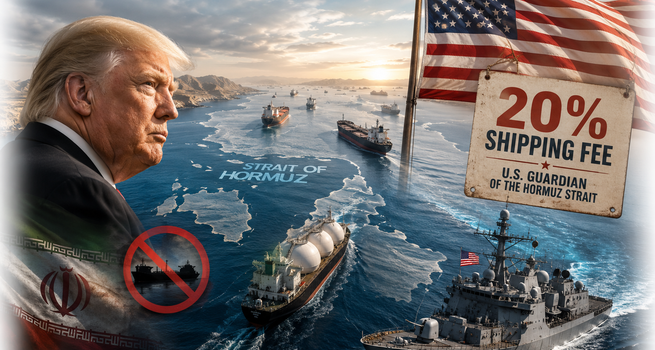
A presidential social-media post declares the Strait of Hormuz "open," Iran blockaded, and a 20% fee due on the world's cargo
Key Highlights
- "Guardian" Declaration: President Trump announced the US will act as "the Guardian of the Hormuz Strait," declaring the waterway open to all shipping except Iranian vessels and their customers.
- 20% Reimbursement Fee: A 20% fee would be charged on all cargo transiting the strait, intended to cover the cost of US security operations, with implementation to begin "immediately."
- No Operational Detail Provided: The announcement offered no detail on how the fee would be assessed, billed, or enforced.
- Uncertain Legal Standing: The move has no clear precedent in international maritime law, given the strait's status as an international waterway rather than a US-operated chokepoint like the Suez or Panama canals.
- Volatile Timing: The policy arrives amid an already tense week of US-Iran strikes and counter-strikes, with oil and gas markets on edge over potential supply disruption.
- Allied and Industry Response Expected: Allied governments and shipping industry stakeholders are likely to seek clarification through diplomatic and legal channels rather than accept the announcement at face value.
There is a certain American genius for turning a crisis into a business model. On July 13th, President Donald Trump announced, via a post on Truth Social, that the United States would henceforth act as "THE GUARDIAN OF THE HORMUZ STRAIT," a title nobody asked it to hold, now attached to a fee nobody agreed to pay. The strait, Mr Trump declared, "is OPEN, and will remain OPEN, with or without Iran." America would simultaneously reinstate what he called "the Iranian blockade," intended to stop Iranian vessels and their customers from using the waterway, while all other shipping would enjoy "fair and open use." In exchange for providing this security, Washington would collect a 20% reimbursement fee on "all cargo shipped" through the strait, a charge the president said would begin "immediately."
It is worth pausing on the sheer novelty of the arrangement being proposed. The Strait of Hormuz, through which around a fifth of the world's seaborne oil and a substantial share of its liquefied natural gas normally passes, is not American territory, nor is it under any single nation's sovereign control. It is an international strait governed, however imperfectly, by customary maritime law and multilateral practice. That a single country might declare itself both gatekeeper and tax collector for a waterway shared by dozens of trading nations represents a significant, if characteristically blunt, assertion of unilateral authority over what has always been treated as a global commons.
A Fee With Few Precedents in Maritime Law
Commentators searching for a template will struggle to find one. Ships transiting other strategic chokepoints, the Suez and Panama canals, for instance, do pay tolls, but those are levied by the sovereign or treaty authority actually operating the canal, based on decades of engineering investment and a body of international agreement governing the charge. The Strait of Hormuz has no canal, no locks, and no comparable owner-operator. A unilateral security surcharge imposed by a foreign navy on commercial traffic transiting international waters would be, if implemented as described, a substantial departure from existing maritime and trade law, and one likely to invite swift objection from shipping nations, insurers, and the flag states whose vessels would be asked to pay it.
The announcement arrives against the backdrop of an already volatile week. Fresh American strikes on Iranian targets, described in the president's own post as a response to attacks on shipping in the strait, have kept oil and gas markets on edge, with crude prices already elevated on fears of supply disruption. Framing an American military and fiscal role explicitly around that volatility, "this very volatile section of the World," as the post puts it, suggests the administration sees the current tension less as a problem to be resolved than as a rationale to be capitalised upon.
Command of the Seas, Invoice Attached
The economic logic Mr Trump offered is straightforward, even if the legal and diplomatic mechanics are not: America, in his telling, has spent "billions" protecting global trade routes without compensation, and intends to stop doing so for free. It is an argument with a long pedigree in Trumpian foreign policy, echoing past demands that allies pay more for the American security umbrella, whether in NATO or over Gulf shipping lanes during earlier tanker-escort operations. What is new here is the mechanism: not a request that allied governments contribute more to burden-sharing, but a direct levy on commercial cargo itself, collected, presumably, by the same naval forces conducting the patrols.
Quite how such a fee would be assessed, collected, or enforced remains entirely unclear from the post itself, which offered no operational detail. Would it apply per vessel, per tonne, or per cargo value? Would compliance be voluntary, or would non-paying ships risk being treated as unprotected, or worse, obstructed? Markets and shipowners, who tend to prefer certainty over rhetoric, are likely to withhold judgment until, or unless, the administration publishes something resembling a formal policy rather than a social-media post.
What Markets and Allies Will Be Watching
For all its bluster, the announcement touches a genuinely important nerve. Roughly a fifth of global oil supply and a meaningful share of global LNG exports rely on safe passage through Hormuz. Any credible threat to that passage, whether from Iranian mines and gunboats or from an American toll booth of uncertain legal standing, tends to move prices. Energy traders, already jumpy after a week of strikes and counter-strikes, now have one more variable to price: not just whether the strait stays open, but on whose terms, and at what cost.
Allied governments, meanwhile, face an awkward choice. Publicly rejecting an American security guarantee looks ungrateful; publicly accepting a 20% surcharge on their national cargo looks like capitulation to an arrangement several may regard as legally dubious. Expect diplomatic channels, rather than Truth Social, to carry the more consequential parts of this story in the days ahead, assuming, that is, the policy survives contact with the practicalities of implementation, international law, and the shipping industry's considerable capacity for quiet, expensive litigation.
Disclaimer: This article is for informational purposes only and does not constitute financial, investment, or trading advice. Readers should conduct their own research or consult a licensed financial advisor before making investment decisions. Past performance is not indicative of future results.

 Nov 27, 2026





 Please wait processing your request...