
 CA
 NZ
 UK
 AU
 IND

 US

 Share
 X (Formerly Twitter)
 Whatsapp
 Facebook
 LinkedIn
 Telegram
 Email This Article
 Copy Link
 Summarize with AI
 Chat GPT
 Perplexity

Key Momentum Shifts
- Energy (XLE) remains among the strongest sectors, occupying a far-right position within Leading and maintaining a prominent relative-momentum profile.
- Consumer Staples (XLP), Utilities (XLU), Healthcare (XLV) and Consumer Discretionary (XLY) also remain in Leading, although their plotted positions and trajectories differ.
- Materials (XLB) and Financials (XLF) have entered Leading, expanding the Leadership group and indicating broader positive relative momentum.
- Real Estate (XLRE) is positioned at the boundary between Improving and Leading, making it a potential candidate to join the leadership group.
- Communication Services (XLC) and Industrials (XLI) remain close to the centre-left area, indicating weaker relative positioning than the established leaders.
- Technology (XLK) remains the only sector in Lagging, despite an upward trajectory from a substantially negative position.
The latest Relative Performance Visualization for 22 October 2026 shows a broad concentration of sectors in the Leading quadrant. Energy, Consumer Staples, Utilities, Healthcare, Consumer Discretionary, Materials and Financials occupy Leading, while Real Estate sits at the boundary between Improving and Leading. Communication Services and Industrials remain close to the central dividing area, while Technology continues to occupy the Lagging quadrant.
This configuration indicates that relative momentum leadership has broadened, with Materials and Financials joining the established leaders. Real Estate is approaching a potential transition into Leading, although its boundary position means further movement is needed to confirm that classification. Technology remains the principal outlier, with its position substantially below the horizontal midpoint despite an upward trajectory.
Momentum Breakdown by Sector
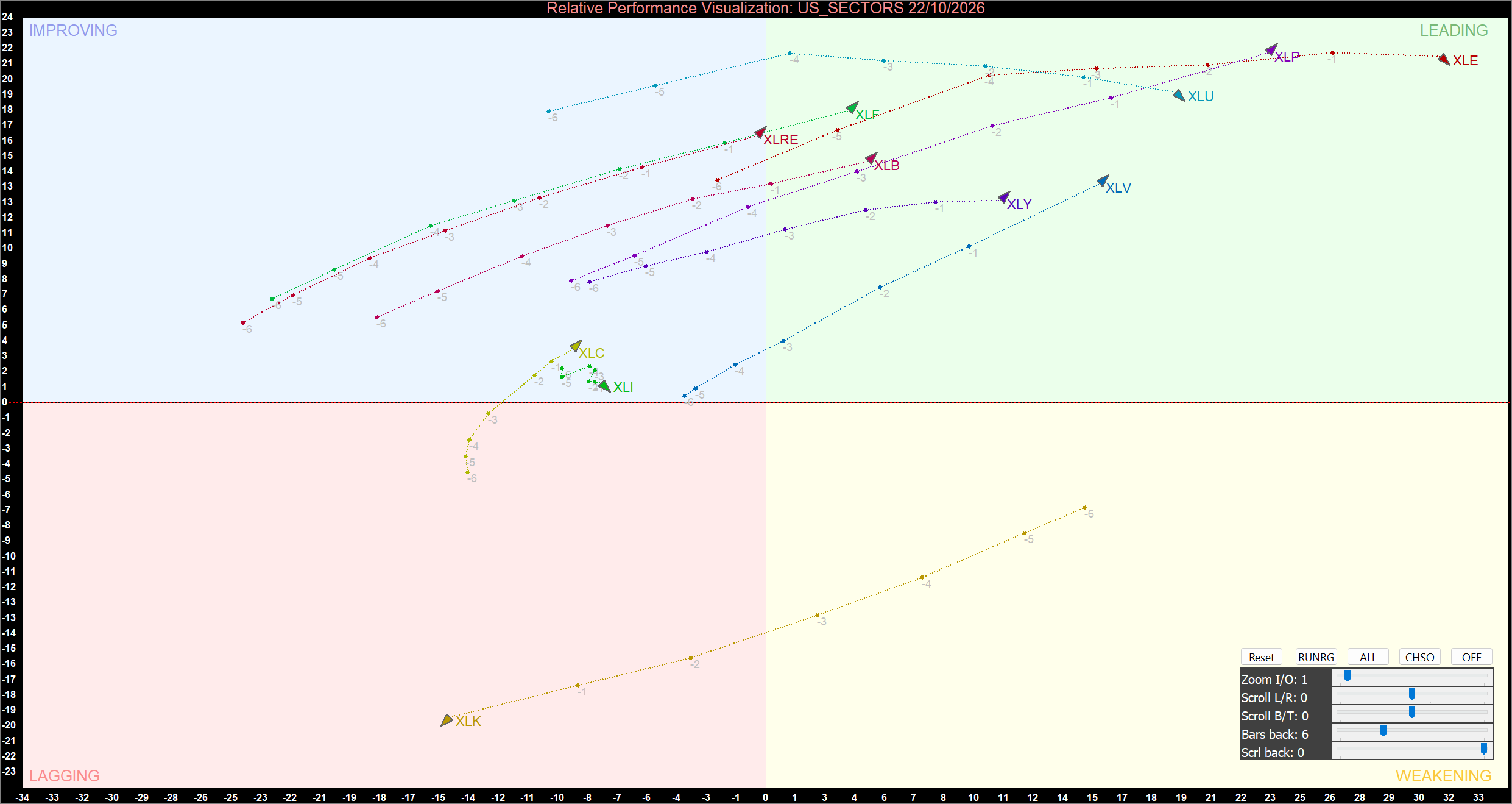
US Sector Relative Momentum Chart (at the closing price of 22/10/2026). Powered by: amibroker.com.
Leading Quadrant
Energy (XLE), Consumer Staples (XLP), Utilities (XLU), Healthcare (XLV), Consumer Discretionary (XLY), Materials (XLB) and Financials (XLF) occupy the Leading quadrant. Their positions to the right of the vertical midpoint and above the horizontal axis indicate relatively strong momentum and relative strength. Energy remains one of the most prominent leaders by its far-right position, while Consumer Staples and Utilities also maintain established positions within the upper-right quadrant.
The addition of Materials and Financials is an important development in the current rotation. Both sectors have entered Leading, expanding the group and suggesting that positive relative momentum is no longer confined to the sectors that previously dominated the quadrant. However, entry into Leading does not guarantee continued momentum improvement. Their subsequent trajectories will help determine whether they establish more durable leadership or move back toward the central boundary.
Healthcare and Consumer Discretionary also remain in Leading, although their positions differ from those of Energy, Consumer Staples and Utilities. These differences highlight that sectors can share the same quadrant while displaying different degrees of relative strength and different momentum trajectories. Monitoring their direction of movement remains important when assessing whether leadership is strengthening or beginning to moderate.
Improving Quadrant
Communication Services (XLC) and Industrials (XLI) remain close to the boundary between Improving and Lagging, around the central area of the chart. Their positions suggest that their relative-momentum profiles are less established than those of sectors already positioned firmly in Leading. Continued upward and rightward movement would provide stronger evidence of improving relative strength.
Real Estate (XLRE) is positioned at the boundary between Improving and Leading. This location places the sector close to a potential transition into the leadership group. A sustained move into the upper-right quadrant would strengthen the case that its relative momentum has improved sufficiently to join the leaders. Conversely, movement back into Improving would indicate that the transition has not been sustained.
The distinction between a sector sitting near a quadrant boundary and one positioned well inside it is important. Boundary positions can signal a developing transition, but subsequent movement is needed to establish whether the change in momentum is becoming more durable.
Technology Remains in Lagging
Technology (XLK) remains the only sector in Lagging and is positioned substantially below the horizontal axis and to the left of the vertical midpoint. Its location contrasts sharply with the broad leadership group and identifies it as the clearest relative-momentum outlier on the chart.
XLK's trajectory extends upward from a more negative position, suggesting an attempted recovery in relative momentum. However, the sector remains deeply within Lagging and has not crossed into Improving. A sustained upward movement toward the horizontal midpoint, followed by a move above that boundary, would be needed to signal a meaningful change in quadrant status. Until then, Technology remains the weakest relative-momentum sector in the current configuration.
Strategic Summary
The 22 October 2026 chart presents a broadly constructive relative-momentum structure, with seven sectors in Leading and leadership extending into Materials and Financials. Energy remains a prominent leader, while Consumer Staples, Utilities, Healthcare and Consumer Discretionary retain positive relative positioning. Real Estate is close to entering Leading, creating another potential expansion of the leadership group.
The main areas to monitor are whether Materials and Financials sustain their new positions, whether Real Estate crosses decisively into Leading, and whether Communication Services and Industrials can strengthen their relative-momentum profiles. Technology remains the principal exception, with its attempted recovery yet to produce a change in quadrant status. Overall, leadership breadth has improved, but the substantial divergence between the leading sectors and Technology continues to define the current momentum landscape.


 Oct 27, 2026





 Please wait processing your request...