
 CA
 NZ
 UK
 AU
 IND

 US

 Share
 X (Formerly Twitter)
 Whatsapp
 Facebook
 LinkedIn
 Telegram
 Email This Article
 Copy Link
 Summarize with AI
 Chat GPT
 Perplexity

Key Highlights
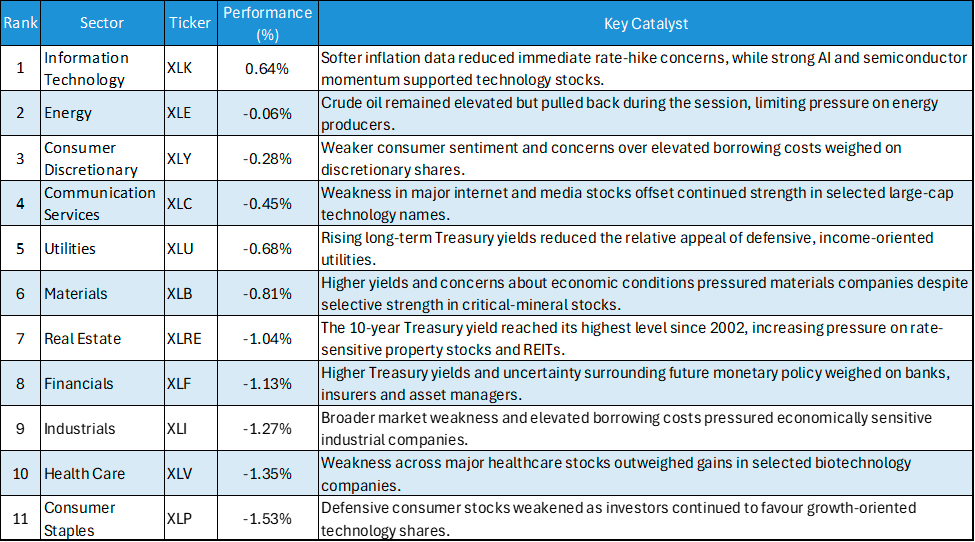
- Information Technology (XLK) gained 0.64%, recording the strongest performance among the eleven major US sectors.
- Energy (XLE) declined only 0.06%, making it the second-best-performing sector despite fluctuations in Crude Oil prices.
- Consumer Discretionary (XLY) fell 0.28%, while Communication Services (XLC) declined 0.45%.
- Utilities (XLU) dropped 0.68%, while Materials (XLB) declined 0.81%.
- Real Estate (XLRE) fell 1.04% as elevated long-term Treasury yields continued to pressure rate-sensitive assets.
- Financials (XLF) declined 1.13%, while Industrials (XLI) fell 1.27%.
- Health Care (XLV) dropped 1.35%, despite strength in selected biotechnology companies.
- Consumer Staples (XLP) was the weakest sector, falling 1.53%.
- Only one of the eleven sectors advanced, while ten declined, indicating significantly negative market breadth.
The US sector performance data for 30 September 2026 showed a clear divergence between Technology and the rest of the market. Information Technology gained 0.64% and was the only sector to finish higher, while Energy was almost unchanged with a 0.06% decline. The remaining nine sectors recorded losses of at least 0.28%.
The broader market also finished mixed. The Nasdaq Composite rose 0.24%, while the S&P 500 declined 0.25% and the Dow Jones Industrial Average fell 0.86%. Softer-than-expected Inflation data initially supported equities, but the subsequent rise in long-term Treasury yields limited broader market gains and reinforced the rotation toward selected technology stocks.
Performance Breakdown by Sector
Technology Leads the Market
Information Technology (XLK) was the strongest-performing sector, rising 0.64%. The advance made technology the only sector to record a gain during the session and reinforced its relative strength as investors continued to focus on artificial intelligence, semiconductors and software.
The sector benefited from a softer-than-expected inflation reading, which reduced immediate concerns about another Federal Reserve rate increase. Technology shares also received support from continued optimism surrounding AI-related Investment and strong semiconductor demand. The Nasdaq Composite gained 0.24%, highlighting the influence of technology within the broader market.
Energy Remains Relatively Resilient
Energy (XLE) declined only 0.06%, making it the second-best-performing sector despite ending slightly lower. Crude oil prices remained elevated following a strong September, although oil prices pulled back during the session.
The relatively small decline indicated that energy stocks remained supported by a higher commodity-price environment. However, geopolitical uncertainty and elevated oil prices continued to contribute to inflation concerns, creating an important counterweight to the positive effect of stronger energy revenues.
Consumer and Communication Sectors Decline
Consumer Discretionary (XLY) declined 0.28%, while Communication Services (XLC) fell 0.45%. Consumer-related stocks remained sensitive to weaker consumer confidence and elevated financing costs.
Communication Services also experienced selling pressure despite continued strength in selected large-cap internet companies. The decline suggested that the market’s preference for technology was relatively concentrated rather than extending broadly across growth-oriented sectors.
Rate-Sensitive Sectors Under Pressure
Real Estate (XLRE) declined 1.04%, while Utilities (XLU) fell 0.68%. Both sectors remained vulnerable to rising long-term Treasury yields. The 10-year Treasury Yield moved above 5.3%, reaching its highest level since 2002, increasing competition for income-oriented Assets and raising financing costs.
Financials (XLF) also declined 1.13%. Although higher yields can support certain banking margins, the rapid rise in longer-term borrowing costs and uncertainty over future Monetary Policy created broader pressure across financial stocks.
Industrials, Health Care and Consumer Staples Weaken
Industrials (XLI) fell 1.27%, reflecting the broader risk-off tone across economically sensitive companies. Higher borrowing costs and concerns about future economic conditions remained important considerations for the sector.
Health Care (XLV) declined 1.35%, despite positive developments among selected biotechnology companies. The weakness was therefore relatively broad across the sector rather than concentrated entirely in one industry group.
Consumer Staples (XLP) recorded the largest decline, falling 1.53%. The result was notable because Consumer Staples are traditionally regarded as defensive investments. The sector's weakness suggested that investors were prioritising growth exposure, particularly technology, despite the broader market decline.
Market Breadth Becomes Significantly Negative
The latest session represented a sharp deterioration in Market Breadth compared with 29 September, when four of the eleven major sectors advanced. On 30 September, only Information Technology finished higher, while ten sectors declined.
The 2.17-percentage-point difference between Technology, the strongest sector at 0.64%, and Consumer Staples, the weakest at -1.53%, demonstrated substantial sector dispersion. The concentration of gains in Technology also indicated that the broader market remained dependent on a relatively narrow group of growth-oriented companies.
Strategic Summary
US sector performance on 30 September 2026 was characterised by concentrated technology strength and widespread weakness elsewhere. Information Technology led with a 0.64% gain, followed by Energy at -0.06% and Consumer Discretionary at -0.28%. Communication Services declined 0.45%, while Utilities and Materials fell 0.68% and 0.81%, respectively.
At the weaker end of the ranking, Consumer Staples declined 1.53%, followed by Health Care at 1.35% and Industrials at 1.27%. Financials and Real Estate also remained under pressure as Treasury yields moved to multi-year highs.
The session highlighted the competing influence of softer inflation data, resilient economic growth, elevated Treasury yields and continued AI-related investment. The key issue for subsequent sessions is whether Technology can maintain its relative strength while the remaining sectors continue to face pressure from high long-term yields and tighter financial conditions.


 Oct 28, 2026




 Please wait processing your request...