
 CA
 NZ
 UK
 AU
 IND

 US

 Share
 X (Formerly Twitter)
 Whatsapp
 Facebook
 LinkedIn
 Telegram
 Email This Article
 Copy Link
 Summarize with AI
 Chat GPT
 Perplexity

Key Highlights
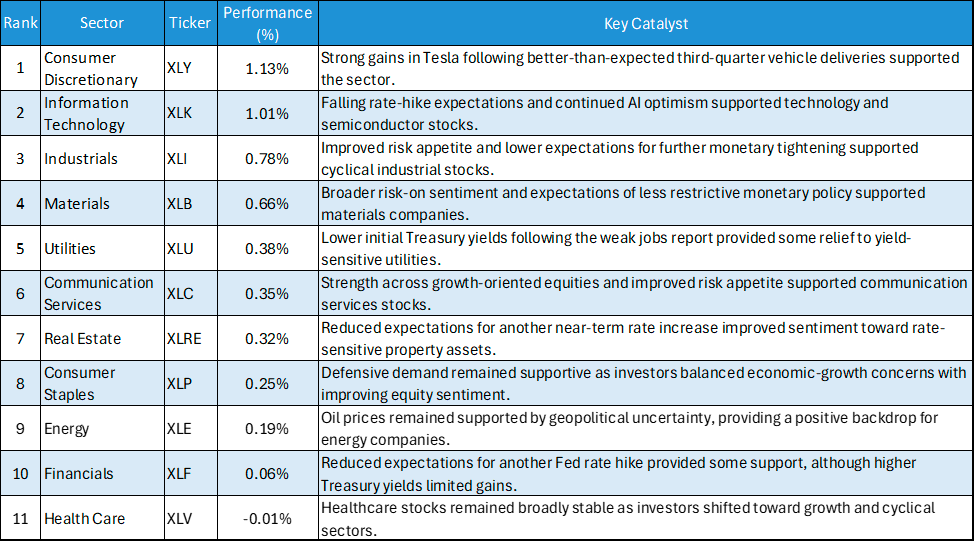
- Consumer Discretionary (XLY) gained 1.13%, recording the strongest performance among the eleven major US sectors.
- Information Technology (XLK) advanced 1.01%, supported by renewed strength in technology and artificial intelligence-related stocks.
- Industrials (XLI) rose 0.78%, while Materials (XLB) gained 0.66%.
- Utilities, Communication Services and Real Estate also finished higher, indicating broad participation in the market rebound.
- Consumer Staples (XLP) and Energy (XLE) recorded more modest gains of 0.25% and 0.19%, respectively.
- Financials (XLF) edged higher by only 0.06%, remaining the weakest-performing positive sector.
- Health Care (XLV) was virtually unchanged, declining just 0.01%.
- All eleven sectors remained above or close to flat, highlighting a broad-based recovery following recent market pressure.
- A weaker-than-expected September employment report reduced expectations for another Federal Reserve rate increase in October and supported risk appetite across US equities.
US equities staged a broad rebound on 2 October 2026, with all but one of the eleven major sectors advancing. Consumer Discretionary and Information Technology led the recovery, while Industrials and Materials also recorded strong gains. The market responded positively to a much weaker-than-expected September employment report, which reduced expectations for another Federal Reserve rate increase and helped rate-sensitive Growth Stocks recover.
Performance Breakdown by Sector
Consumer Discretionary Leads the Rebound
Consumer Discretionary was the strongest-performing sector on 2 October, gaining 1.13%. The sector benefited from a significant improvement in investor risk appetite after the release of weaker-than-expected US employment data.
Tesla was a major contributor to the sector's performance after reporting third-quarter vehicle deliveries above analyst expectations. The stronger delivery result reinforced expectations that the company's automotive Business could return to annual growth, providing an additional catalyst for consumer discretionary stocks.
The sector's Leadership was particularly significant because Consumer Discretionary is highly sensitive to household spending, financing conditions and economic expectations. The prospect of a less restrictive Federal Reserve policy therefore provided a supportive backdrop.
Technology Benefits from Lower Rate-Hike Expectations
Information Technology gained 1.01%, ranking second among the eleven sectors. Technology stocks benefited from the sharp repricing of Federal Reserve expectations following the weak employment report.
September payrolls increased by only 29,000, substantially below the market expectation of approximately 90,000. The weaker labour-market data reduced expectations of an October rate increase, providing relief for growth-oriented companies whose valuations are particularly sensitive to interest rates.
Artificial intelligence optimism also remained an important underlying catalyst. Nvidia and other technology companies benefited from continued investor enthusiasm surrounding AI infrastructure and semiconductor demand. The Nasdaq Composite subsequently gained around 1.2%, reinforcing the strength of the technology-led rebound.
Industrials and Materials Move Higher
Industrials advanced 0.78%, while Materials rose 0.66%. The gains indicated that the recovery extended beyond technology and consumer-related stocks into cyclical areas.
Improved expectations for Monetary Policy helped support economically sensitive companies, while broader risk appetite encouraged investors to increase exposure to cyclical assets. Materials also benefited from the improvement in overall market sentiment, although Commodity markets remained sensitive to movements in Treasury yields and the US dollar.
The performance of these sectors suggests that the session represented a relatively broad risk-on move rather than a narrow technology rally.
Rate-Sensitive Sectors Recover
Utilities gained 0.38%, Real Estate increased 0.32% and Financials edged higher by 0.06%. These sectors were influenced by the changing interest-rate outlook following the employment report.
Treasury yields initially declined after the weak employment data, improving the relative attractiveness of rate-sensitive assets. However, Treasury yields later recovered and finished higher, limiting the gains in several interest-rate-sensitive sectors.
Financials were particularly subdued. Although reduced expectations for another rate increase provided some support, higher long-term yields and uncertainty surrounding future monetary policy continued to create a mixed environment for banks and other financial companies.
Energy and Defensive Sectors Remain Resilient
Energy advanced 0.19%, supported by continued uncertainty surrounding global energy supplies and elevated oil prices. Geopolitical developments remained an important influence on crude markets, helping prevent the sector from falling despite fluctuations in broader risk sentiment.
Consumer Staples gained 0.25%, reflecting continued Demand for relatively defensive companies. However, the sector lagged the stronger cyclical and growth-oriented areas of the market as investors increased exposure to higher-beta segments following the employment report.
Health Care was the only sector to finish lower, although its decline was negligible at just 0.01%. The near-flat performance indicates that investors did not aggressively reduce exposure to defensive healthcare stocks despite the broader rotation toward growth and cyclical sectors.
Broad Market Recovery Signals Improved Risk Appetite
The performance of all eleven sectors around or above the zero line represents a significant improvement in market breadth. Consumer Discretionary and Information Technology led the advance, while Industrials and Materials also delivered substantial gains.
The 1.14-percentage-point gap between Consumer Discretionary and Health Care was relatively narrow compared with previous sessions of greater sector dispersion. This indicates that the rebound was broadly distributed across the market rather than being concentrated in a small number of sectors.
Strategic Summary
The US sector performance picture on 2 October 2026 was characterised by a broad-based recovery led by Consumer Discretionary and Information Technology. XLY gained 1.13%, while XLK advanced 1.01%. Industrials and Materials also performed strongly, rising 0.78% and 0.66%, respectively.
The key catalyst was the much weaker-than-expected September employment report, which reduced expectations for another Federal Reserve rate increase in October. This supported growth and cyclical equities and helped the Nasdaq outperform the broader market.
Although Treasury yields later recovered from their initial decline, the overall sector performance remained positive. With ten sectors gaining and Health Care virtually unchanged, the session showed a clear improvement in Market Breadth and risk appetite. The key question for subsequent sessions is whether the technology-led recovery can broaden further while changing Federal Reserve expectations continue to support Equity valuations.


 Oct 28, 2026




 Please wait processing your request...