
 CA
 NZ
 UK
 AU
 IND

 US

 Share
 X (Formerly Twitter)
 Whatsapp
 Facebook
 LinkedIn
 Telegram
 Email This Article
 Copy Link
 Summarize with AI
 Chat GPT
 Perplexity

Key Highlights
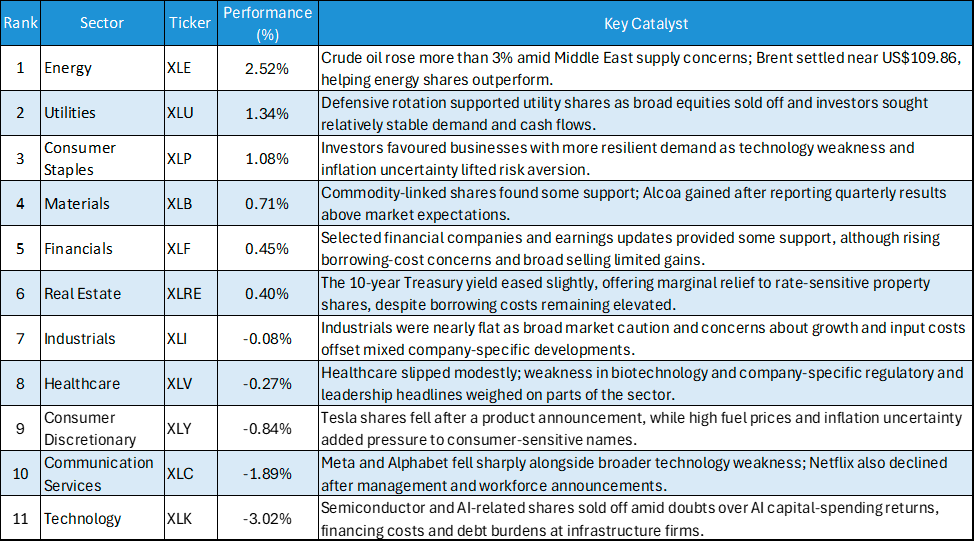
- Energy (XLE) was the strongest sector, gaining 2.52% as Crude Oil prices climbed amid renewed Middle East Supply concerns.
- Utilities (XLU) advanced 1.34% and Consumer Staples (XLP) rose 1.08%, signalling Demand for more defensive exposures during a risk-off session.
- Materials (XLB) gained 0.71%, followed by Financials (XLF) at 0.45% and Real Estate (XLRE) at 0.40%.
- Industrials (XLI) edged down 0.08%, while Healthcare (XLV) lost 0.27% and Consumer Discretionary (XLY) fell 0.84%.
- Communication Services (XLC) declined 1.89%, while Technology (XLK) was the weakest sector, dropping 3.02% amid renewed pressure on semiconductor and AI-related stocks.
- The S&P 500 fell about 1.1%, the Nasdaq lost around 2.1% and the Dow declined roughly 0.3%, reflecting a technology-led retreat.
US sector performance on 16 October 2026 reflected a defensive rotation as investors weighed higher oil prices, Inflation and doubts about the returns from artificial-intelligence spending. Energy led with a 2.52% gain, while Utilities and Consumer Staples also advanced. Technology and Communication Services fell sharply, contributing to a steeper Nasdaq decline than in the broader market. The ranking points to investors favouring Commodity exposure and resilient demand while cutting risk in high-valuation growth shares.
Performance Breakdown by Sector
Energy Leads as Defensive Sectors Advance
Energy rose 2.52% as crude prices advanced on concerns about supply disruptions in the Middle East. Brent Crude settled near US$109.86 per barrel after rising more than 3%, while major producers including Exxon and Chevron gained. Energy’s outperformance showed how stronger commodity prices can support the sector during a broader sell-off. However, expensive oil can also lift inflation expectations and pressure valuations elsewhere in the market.
Utilities climbed 1.34% and Consumer Staples advanced 1.08%, reflecting demand for defensive areas during the technology-led sell-off. These sectors are often viewed as having more resilient demand than cyclical businesses. Their relative strength was consistent with investors reducing risk after a difficult week for technology shares. Still, one session cannot confirm a lasting rotation, particularly while inflation and bond yields remain important market variables.
Materials gained 0.71%, supported in part by commodity-linked shares and quarterly Earnings news, including Alcoa’s better-than-expected result. Financials added 0.45%, while Real Estate rose 0.40%. Property shares received limited support as the 10-year Treasury Yield edged lower, although borrowing costs remained elevated. Performance in these mid-ranking sectors was mixed rather than evidence of a broad-based rally.
Technology and Communication Services Lead the Declines
Technology dropped 3.02%, the weakest sector. Selling spread across semiconductor, software and large technology companies as investors questioned whether AI-related Capital spending would generate adequate returns. Micron, AMD, Broadcom and Intel recorded sizeable declines. Concern about debt-heavy AI infrastructure businesses also contributed to the risk-off tone, while high oil prices and inflation readings added uncertainty about financing costs.
Communication Services fell 1.89%, with major constituents Meta Platforms and Alphabet under pressure. Although classified in this sector, these companies are often grouped with large technology and AI-linked shares, leaving them exposed to changes in sentiment around digital advertising, cloud services and valuations. Netflix also declined following executive changes and workforce-reduction news. Consumer Discretionary lost 0.84%, with Tesla lower after its Roadster announcement and inflation uncertainty weighing on consumer-facing shares.
Healthcare declined 0.27%, while Industrials slipped just 0.08%. The relatively small moves suggest more mixed performance than in Technology and Communication Services. Healthcare weakness included soft biotechnology trading and individual company headlines, while Industrials faced market caution and cost concerns. Sector ETFs aggregate companies with different drivers, so a sector-level return does not mean every constituent moved in the same direction.
Strategic Summary
The 16 October session featured strong Energy performance and gains in Utilities and Consumer Staples, set against notable losses in Technology and Communication Services. The S&P 500 fell about 1.1%, the Nasdaq declined around 2.1% and the Dow lost roughly 0.3%, highlighting the effect of technology weakness on the growth-heavy Nasdaq. Energy benefited from higher oil prices, while defensive sectors attracted cautious investors.
Investors should monitor oil supply developments, inflation readings, Treasury yields, Federal Reserve expectations and upcoming earnings. Technology and Communication Services remain sensitive to confidence in AI monetisation and the ability to convert capital spending into sustainable returns. Defensive Leadership could persist if uncertainty remains elevated, but subsequent sessions are needed to confirm the rotation. The daily sector ranking is a snapshot of capital flows, not a standalone forecast.


 Oct 28, 2026




 Please wait processing your request...