
 CA
 NZ
 UK
 AU
 IND

 US

 Share
 X (Formerly Twitter)
 Whatsapp
 Facebook
 LinkedIn
 Telegram
 Email This Article
 Copy Link
 Summarize with AI
 Chat GPT
 Perplexity
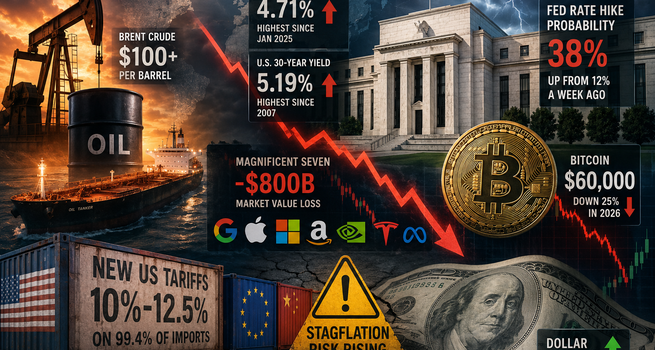
A single week brings surging crude, multi-year high bond yields, a tech-led equity selloff, a deepening Bitcoin slide, sweeping new tariffs, and rising stagflation risk
Key Highlights
- Oil Above $100, Yields at Multi-Year Highs: Brent topped $100 a barrel while 10-year and 30-year Treasury yields hit their highest levels since 2025 and 2007 respectively.
- $800 Billion Tech Selloff, Bitcoin Near $60,000: The Magnificent Seven lost nearly $800 billion in value on AI overbuild fears, while Bitcoin extended its 25% 2026 decline.
- Sweeping Tariffs and Stagflation Risk: New US tariffs cover 99.4% of imports as rising energy costs revive global stagflation concerns.
Global markets are navigating one of the more turbulent weeks of the year, as escalating Middle East conflict, a hawkish repricing of Federal Reserve policy, a sharp tech-led equity selloff, and sweeping new US tariffs converge into a single, mutually reinforcing risk-off narrative spanning oil, bonds, equities, crypto, and currency markets alike.
Oil and Rates Lead the Move
Brent crude surged above $100 a barrel for the first time since May after Houthi attacks on Saudi tankers in the Red Sea raised fears of a second shipping chokepoint closing alongside the Strait of Hormuz. Prices retreated slightly Friday, with WTI near $89 to $91, though oil remains up roughly 11% to 13% on the week as Trump weighs a "massive attack" on Iran. That surge fed directly into bond markets, where 10-year Treasury yields hit their highest since January 2025 at 4.71%, and 30-year yields neared 5.19%, a level not seen since 2007, as oil-driven inflation fears fueled hawkish Fed bets under new Chairman Kevin Warsh. Fed funds futures now price 38% odds of a rate hike at next week's meeting, up sharply from 12% a week earlier.
Equities and Crypto Feel the Pressure
The 'Magnificent Seven' stocks shed nearly $800 billion in market value on Thursday, led by Alphabet and Tesla, on concerns over ballooning AI capex from Microsoft, Amazon, and others. US futures attempted to stabilize Friday, but Asian equities sold off heavily, with Korea's KOSPI and KOSDAQ triggering circuit-breaker curbs and Japan's Nikkei falling around 2.5%. Bitcoin extended its 2026 slide, down about 25% for the year and briefly testing $60,000, as US spot crypto ETFs saw $2.7 billion in outflows over six weeks and hopes for the CLARITY Act faded after Senate Majority Leader Thune signaled no vote before the August recess, with Polymarket odds of passage falling to 37% from over 80% this spring.
Currencies, Trade Policy, and the Stagflation Question
The dollar strengthened on safe-haven demand as the euro slid, a typical pattern during episodes of escalating geopolitical risk and rising rate-hike expectations in the United States. Adding to the uncertainty, the Trump administration imposed fresh 10% to 12.5% tariffs on goods from the EU, China, and dozens of other partners, citing forced-labor enforcement failures and covering 99.4% of US imports, with notable exemptions for oil, gas, and autos; analysts say the near-term FX impact is limited since the tariffs largely replace an expiring 10% global levy, though they warn of further policy surprises ahead.
Taken together, these developments have revived stagflation concerns, with European gas prices set for their biggest monthly jump since March and government borrowing costs at multi-year highs. India's stock benchmarks are on track for their worst week in four months as crude's rise above $100 threatens to widen its trade deficit and stoke inflation, underscoring how directly this week's oil-driven turmoil is spreading across global growth and inflation expectations alike.
Frequently Asked Questions
Q: What is driving this week's global market turmoil?
A: Escalating Middle East conflict pushing oil above $100, a hawkish repricing of Fed rate expectations, a tech-led equity selloff on AI overbuild fears, and sweeping new US tariffs are all converging into a single risk-off narrative.
Q: How are bond markets reacting to the oil price surge?
A: 10-year Treasury yields hit 4.71%, their highest since January 2025, while 30-year yields neared 5.19%, a level not seen since 2007, as rate hike odds for next week's Fed meeting jumped to 38% from 12% a week earlier.
Q: How is Bitcoin performing amid this turmoil?
A: Bitcoin is down about 25% in 2026 and briefly tested $60,000, pressured by $2.7 billion in US spot ETF outflows over six weeks and fading hopes for the CLARITY Act's passage.
Q: What is happening with new US tariffs and what is their market impact?
A: The Trump administration imposed fresh 10% to 12.5% tariffs covering 99.4% of US imports, though analysts say the near-term FX impact is limited since the tariffs largely replace an expiring 10% global levy.
Disclaimer: This article is for informational purposes only and does not constitute financial, investment, or trading advice. Readers should conduct their own research or consult a licensed financial advisor before making investment decisions. Past performance is not indicative of future results.

 Nov 19, 2026
 Please wait processing your request...