
 CA
 NZ
 UK
 AU
 IND

 US

 Share
 X (Formerly Twitter)
 Whatsapp
 Facebook
 LinkedIn
 Telegram
 Email This Article
 Copy Link
 Summarize with AI
 Chat GPT
 Perplexity
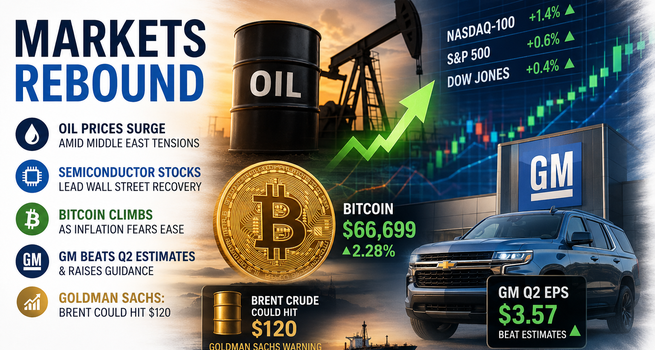
Key Highlights
- Crude oil climbed nearly 3% as geopolitical tensions in the Middle East intensified and supply risks increased.
- Semiconductor stocks fueled a rebound in U.S. equities after three consecutive sessions of declines.
- Bitcoin recovered above $66,600 following softer U.S. inflation data that boosted risk sentiment.
- General Motors exceeded quarterly expectations and raised its full-year earnings guidance.
- Goldman Sachs warned Brent crude could reach $120 per barrel if disruptions in the Strait of Hormuz worsen.
Global Markets Find Their Footing as Investors Balance Geopolitical Risks and Corporate Earnings
Global financial markets entered Tuesday with a cautiously optimistic tone despite escalating geopolitical tensions in the Middle East. Investors are simultaneously navigating rising oil prices, renewed strength in semiconductor stocks, improving cryptocurrency sentiment, and the beginning of another important corporate earnings season.
While concerns surrounding Iran, Yemen's Houthi movement, and shipping disruptions in the Strait of Hormuz continue to push energy markets higher, equity investors found relief in technology shares following several volatile trading sessions. At the same time, softer U.S. inflation data has improved expectations that the Federal Reserve may be approaching the end of its tightening cycle, encouraging renewed buying in risk assets including Bitcoin.
Against this complex macroeconomic backdrop, markets are increasingly shifting their focus toward corporate earnings, where companies' guidance will likely determine whether recent market gains can continue through the remainder of the quarter.
Oil Prices Surge as Middle East Conflict Raises Supply Concerns
Energy markets remain at the center of investor attention.
WTI crude oil rose approximately 2.8%, briefly extending gains as military tensions between the United States and Iran continued to escalate. The latest developments include another round of U.S. military strikes on Iranian targets alongside reports of attacks on commercial shipping in the Strait of Hormuz.
Further complicating the outlook, Yemen's Iran-backed Houthi movement expanded its threats toward Saudi Arabia, raising concerns over nearly 2.5 million barrels per day of Saudi oil production. The combination of military conflict and potential supply disruptions pushed Brent crude above $91 per barrel during trading.
The Strait of Hormuz remains one of the world's most strategically important shipping lanes, transporting roughly one-fifth of global oil supplies. Any prolonged disruption could significantly tighten global energy markets and place additional upward pressure on inflation.
Higher oil prices also present a challenge for central banks that have only recently begun seeing evidence of moderating inflation. If energy costs remain elevated, policymakers may find it difficult to justify aggressive interest-rate cuts later this year.
Semiconductor Stocks Lead Wall Street's Recovery
Despite higher energy prices, technology stocks provided a welcome source of optimism.
U.S. stock futures moved sharply higher before the opening bell, with Nasdaq-100 futures rising roughly 1.4%, while S&P 500 and Dow Jones futures also posted solid gains.
The recovery follows three consecutive sessions of weakness driven largely by profit-taking in artificial intelligence-related companies.
Semiconductor shares led Tuesday's advance as investors returned to the sector ahead of upcoming earnings reports from several major technology companies. South Korea's KOSPI Index also climbed around 2%, reflecting renewed confidence across the global semiconductor supply chain.
The rebound suggests investors remain constructive on the long-term AI investment theme despite recent volatility.
Chip manufacturers continue to benefit from strong demand for AI accelerators, advanced memory, networking infrastructure, and cloud-computing hardware. However, valuations remain elevated, meaning upcoming earnings reports will likely play a critical role in determining whether the rally can extend further.
Markets are particularly focused on management commentary regarding AI spending, enterprise demand, and capital expenditure plans from major hyperscale cloud providers.
Bitcoin Rebounds Above $66,600 as Inflation Fears Ease
Cryptocurrency markets also benefited from improving macroeconomic sentiment.
Bitcoin climbed approximately 2.3%, trading above $66,600 after recovering from Monday's weakness.
The move followed softer-than-expected U.S. inflation data, which reduced concerns that the Federal Reserve may need to maintain restrictive monetary policy for longer than previously anticipated.
Lower inflation expectations typically support risk assets by improving liquidity conditions and lowering discount rates for future growth.
Ethereum also advanced toward $1,850, while Solana outperformed many large-cap digital assets during the session.
Although cryptocurrencies remain significantly below previous cycle highs, the recent rebound demonstrates that macroeconomic data continues to be one of the primary drivers of digital asset prices.
Institutional investors also remain focused on potential ETF inflows and broader adoption of digital assets as regulatory clarity gradually improves.
Currency Markets Stay Cautious Ahead of ECB Decision
Foreign exchange markets were comparatively subdued.
The euro traded near 1.1400 against the U.S. dollar, reflecting competing macroeconomic forces.
On one hand, higher oil prices raise inflation risks across Europe, potentially supporting expectations for tighter monetary policy.
On the other, softer U.S. inflation data has limited further gains for the dollar by reducing expectations of additional Federal Reserve tightening.
Investors are now assigning roughly a 75% probability that the European Central Bank could deliver another interest-rate increase in September.
Attention now turns to the ECB policy announcement and President Christine Lagarde's press conference, both of which could significantly influence currency markets over the coming weeks.
General Motors Delivers Strong Earnings Surprise
Corporate earnings also provided encouraging news for investors.
General Motors reported second-quarter revenue of $48.03 billion, comfortably exceeding analyst expectations of approximately $46.61 billion.
Adjusted earnings per share reached $3.57, well ahead of consensus forecasts of $3.19.
Importantly, management also raised its full-year financial guidance, citing easing production costs and continued operational discipline despite mixed vehicle demand.
The strong report offers reassurance that large industrial companies continue to manage inflationary pressures effectively while maintaining profitability.
Automakers remain closely watched as investors assess consumer spending trends, electric vehicle adoption, and the broader health of the U.S. economy.
Goldman Sachs Warns Brent Could Reach $120
While equity markets recovered, commodity analysts remain increasingly cautious.
Goldman Sachs warned that Brent crude oil prices could rise above $120 per barrel during the fourth quarter if disruptions in the Strait of Hormuz continue.
Although the bank's base-case forecast still assumes geopolitical tensions gradually ease, analysts note that several market fundamentals have become increasingly supportive of higher prices.
Global oil inventories have declined throughout the second quarter, leaving less buffer against unexpected supply disruptions.
Meanwhile, shipping activity through the Persian Gulf remains below historical averages, making energy markets particularly vulnerable to further geopolitical shocks.
If supply interruptions persist, energy inflation could become a significant headwind for both global growth and monetary policy.
What Investors Should Watch Next
Financial markets are entering a period where macroeconomic developments and corporate earnings carry equal importance.
Investors will continue monitoring military developments in the Middle East, particularly any escalation affecting the Strait of Hormuz and regional oil production.
At the same time, upcoming earnings from major technology companies will offer critical insights into artificial intelligence spending, cloud infrastructure investment, and enterprise software demand.
Inflation data and central bank decisions remain equally important, as markets continue searching for confirmation that interest rates have peaked.
For cryptocurrency investors, improving inflation dynamics and institutional participation remain the key variables supporting Bitcoin's medium-term outlook.
Conclusion
Tuesday's market action reflects the increasingly complex environment facing global investors. On one side, escalating geopolitical tensions have reignited concerns over energy security, driving oil prices higher and creating new inflation risks. On the other, resilient corporate earnings, recovering semiconductor stocks, and improving cryptocurrency sentiment suggest investors remain willing to embrace risk when economic data cooperates.
The coming weeks will likely determine whether markets can sustain this recovery. Corporate earnings, central bank decisions, inflation trends, and developments in the Middle East will collectively shape investor sentiment as markets move into the second half of the year.
While volatility is expected to remain elevated, today's market action demonstrates that investors continue to differentiate between short-term geopolitical uncertainty and the longer-term earnings power of global businesses.
Q. Why are oil prices rising today?
A. Oil prices are climbing due to escalating tensions between the U.S. and Iran, attacks on shipping in the Strait of Hormuz, and renewed threats against Saudi oil infrastructure.
Q. Why did semiconductor stocks rebound?
A. Chip stocks recovered after three sessions of declines as investors positioned ahead of major technology earnings and remained optimistic about long-term AI demand.
Q. Why is Bitcoin moving higher?
A. Bitcoin gained after softer U.S. inflation data reduced expectations for additional Federal Reserve rate hikes, improving sentiment toward risk assets.
Q. What did General Motors report?
A. General Motors exceeded Wall Street's revenue and earnings expectations while raising its full-year guidance, reflecting stronger operational performance.
Q. Why is Goldman Sachs forecasting $120 Brent crude?
A. Goldman Sachs believes Brent could exceed $120 per barrel if supply disruptions in the Strait of Hormuz continue and global oil inventories remain tight.
Q. What are the biggest risks for markets now?
A. The primary risks include escalating geopolitical conflict, higher oil prices, inflation persistence, central bank policy decisions, and upcoming Big Tech earnings.
This article is for informational purposes only and should not be considered investment advice.


 Nov 13, 2026





 Please wait processing your request...