
 CA
 NZ
 UK
 AU
 IND

 US

 Share
 X (Formerly Twitter)
 Whatsapp
 Facebook
 LinkedIn
 Telegram
 Email This Article
 Copy Link
 Summarize with AI
 Chat GPT
 Perplexity
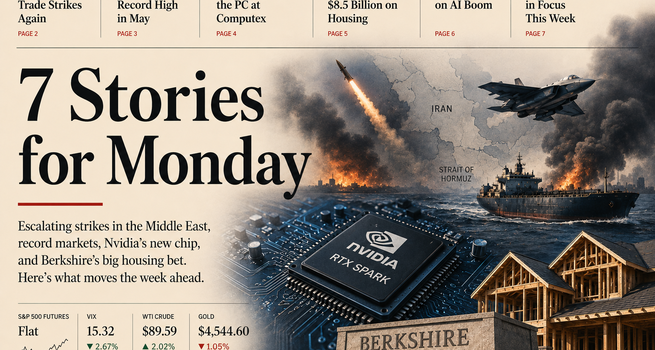
Geopolitics and Energy: U.S. and Iran Trade Strikes Again; Israel Moves Deeper into Lebanon; Hormuz Mines Confirmed; Oil +2%
The U.S. conducted self-defence strikes on Iranian radar and drone control sites in Goruk and Qeshm Island over the weekend in response to the shootdown of a U.S. MQ-1 drone over international waters. U.S. fighter aircraft eliminated Iranian air defences, a ground control station, and two one-way attack drones. Iran's IRGC said Monday its aerospace force targeted a U.S. airbase in response. Kuwait air defences were intercepting missile and drone attacks as sirens sounded across the country.
Netanyahu ordered troops further into Lebanon on Sunday; Rubio proposed a "gradual de-escalation" plan under which Hezbollah would first stop attacks on Israel in exchange for Israel refraining from escalation in Beirut. Iran dropped fresh mines in Hormuz last week shortly after Hegseth warned it would be a ceasefire violation. Brent rose to $93.00 and WTI to $89.65.
- The U.S. and Iran have sporadically exchanged strikes since the April ceasefire; the latest exchange follows the same pattern as last Thursday's and was described in similar terms by both sides.
- Even if a deal is signed, fresh Hormuz mines mean oil Supply relief will arrive slowly as the de-Mining process could take weeks.
- Risk note: Israel's Lebanon offensive directly complicates the Iran ceasefire timeline, Iran has said Hezbollah must be included in any deal, and Netanyahu's weekend escalation removes that possibility near term.
- Markets: S&P 500 and Dow Close at All-Time Highs Friday; June Opens Flat as Iran Escalation Weighs
The S&P 500 gained 0.22% to 7,580.06 on Friday, a record close. The Dow gained 0.72% to 51,032.46, also a record. The Nasdaq gained 0.20% to 26,972.62. The Russell 2000 fell 0.59%. The VIX fell 2.67% to 15.32. Monday futures are flat. Gold at $4,544.60, down 1.05%. June is historically the worst month for stocks in midterm election years. The S&P 500 enters June up more than 12% year to date.
- Oil's 10% weekly drop last week was the biggest since the war began; Monday's 2% rebound on fresh strikes illustrates the fragility of that decline.
- The S&P 500 is trading at elevated multiples with 50% rate hike probability, making any Iran deal breakdown or Earnings miss disproportionately impactful.
- Risk note: the VIX at 15.32 is near its lowest since before the Iran war began, a level of complacency that Monday's mutual strikes could rapidly reprice.
- Technology: Nvidia Unveils RTX Spark PC Chip at Computex; Vera CPU in Full Production; $200 Billion CPU Market
Jensen Huang unveiled the N1X processor made alongside Microsoft at Taiwan's Computex Monday, incorporated into a new RTX Spark superchip debuting in the fall on Windows PCs from Microsoft, Dell, HP (NYSE:HPQ), ASUS, Lenovo, and MSI. Huang said: "Microsoft and Nvidia (NASDAQ:NVDA) are going to reinvent the PC. This is the first completely re-engineered, reinvented line of PCs that has happened in 40 years." More than 30 laptops and 10 desktops will launch with the new chip. RTX Spark pairs a Blackwell GPU with the Arm-based N1X CPU custom designed by MediaTek, with 128 gigabytes of unified memory, made on TSMC's (NYSE:TSM) 3-nanometer process. Vera CPU for data centres is now in full production; early customers include Anthropic, OpenAI, SpaceX's xAI, Dell, Oracle (NYSE:ORCL), and CoreWeave. Vera produces tokens 1.8 times faster than x86.
- RTX Spark enters a PC market long dominated by Intel (NASDAQ:INTC) and Advanced Micro Devices (NASDAQ:AMD), continuing the Arm-based architecture shift that Apple began with the iPhone in 2007.
- Vera CPU full production and the RTX Spark launch position Nvidia to capture both the data centre and consumer PC upgrade cycles driven by agentic AI in the same product generation.
- Risk note: RTX Spark is currently targeted at premium price points for creators, AI developers, and gamers; mass market impact on Intel and AMD Revenue depends on how quickly Nvidia expands to lower tiers.
- Capital Markets: Berkshire Acquires Taylor Morrison for $8.5 Billion; Greg Abel's First Major Deal
Berkshire Hathaway (NYSE:BRK.B) agreed Sunday to acquire Taylor Morrison Home (NASDAQ:TMHC) for $72.50 per share in cash, a 24% premium to the May 29 closing price, valuing the company at approximately $8.5 billion including Debt and $6.8 billion in Equity. The deal is the first major strategic Acquisition under Greg Abel, who took over as CEO at the start of 2026. Berkshire is sitting on a cash hoard nearing $400 billion. Abel said: "Berkshire is acquiring a best-in-class national homebuilder, led by an exceptional team and backed by a trusted reputation for customer experience." Berkshire already owns Clayton Homes, building product companies, and Berkshire Hathaway HomeServices.
- The $8.5 billion deal is modest relative to Berkshire's $400 billion cash position; investors will watch for whether Abel pursues larger acquisitions to deploy the hoard.
- The acquisition contrasts with last week's FHFA and Case-Shiller data showing real home prices falling for the seventh consecutive month, Berkshire is betting on a cycle turn.
- Risk note: the deal is expected to close in the second half of 2026; elevated Mortgage rates and Iran war Inflation could delay the housing recovery underpinning the thesis.
- Friday Stock Movers: Dell +33%, Okta +30%, PagerDuty +33%, NetApp +22%, IBM +13%, ServiceNow +14%, Workday +12%, Replimune +86%
Dell Technologies (NYSE:DELL) surged 32.88% to $421.30 after Q1 FY2027 revenue of $43.8 billion beat the $35.5 billion estimate, up 88% year over year, with AI-optimized server revenue of $16.1 billion up 757% year over year, a record $51.3 billion AI server Backlog, $24.4 billion in new AI orders, and a $9.7 billion Pentagon software contract.
NetApp (NASDAQ:NTAP) surged 22.39% to $174.29 after fiscal year 2026 beat with strong FY2027 guidance and a $1 billion buyback.
Okta (NASDAQ:OKTA) jumped 30.14% to $124.79 after Q1 FY2027 beat and raised full-year guidance; management described the agentic AI identity pipeline as "bigger than anything we've ever seen."
PagerDuty (NYSE: PD) surged 33.74% after non-GAAP EPS of $0.32 beat $0.25 and raised full-year guidance to $1.27-$1.32.
IBM (NYSE:IBM) gained 12.71% to $297.80 after a $15 billion strategic Investment package including $10 billion in Quantum Computing and $5 billion in AI security with Red Hat.
ServiceNow (NYSE: NOW) rose 14.38%. Workday (NASDAQ: WDAY) gained 12.45%. Replimune (NASDAQ: REPL) exploded 85.68% after an FDA agreement to resubmit its BLA for RP1 in advanced melanoma as an "urgent matter."
- Dell's $51.3 billion AI server backlog confirms enterprise AI infrastructure Demand has a multi-quarter runway that has not yet peaked.
- May is shaping up as the best month for software stocks since 2001 as SaaSpocalypse fears fade, with Okta, PagerDuty, ServiceNow, and Workday all posting double-digit gains.
- Risk note: Ambarella (NASDAQ:AMBA) fell 21.41% despite beating estimates after flagging elevated DRAM costs and H2 supply constraints, not all AI infrastructure companies are navigating the memory shortage equally.
- Earnings Preview: HPE and Credo Technology Report After the Close Tonight
Hewlett Packard Enterprise (NYSE:HPE) reports fiscal Q2 2026 results after the close tonight; consensus EPS of $0.38 on revenue of $7.9 billion. HPE's ProLiant and GreenLake platforms compete directly in the same enterprise data centre market that drove Dell's record results Friday.
Credo Technology (NASDAQ:CRDO) also reports after the close. Credo makes high-speed SerDes and active electrical cable products that connect AI chips inside data centres, up more than 100% year to date. Together the two prints will confirm or challenge Friday's AI infrastructure euphoria heading into Tuesday's open.
- HPE's GreenLake guidance will be read as confirmation or contradiction of Dell's record $51.3 billion backlog commentary.
- Credo's connectivity chips sit between Nvidia GPUs and the rest of the data centre; rising AI chip density directly expands its addressable market.
- Risk note: both stocks have rallied significantly year to date; any guidance miss would disproportionately punish both given elevated valuations and post-Dell euphoria.
- Economic Data: ISM Manufacturing PMI and Construction Spending at 10:00 AM ET; Week Ahead in Focus
The ISM Manufacturing PMI for May releases today at 10:00 AM ET alongside April Construction Spending. The prior PMI reading was 48.7, in contraction. A reading above 50 would be the first manufacturing expansion since January. China's factory activity also stalled in May with exports falling and cost pressures mounting. The Deutsche Bank Data Center Summit and Raymond James Internet, AI and Autonomous Tour both begin in New York today. The week ahead is the most consequential of the summer: JOLTS Tuesday, ADP Wednesday, ISM Services Wednesday, Nonfarm Payrolls Friday June 5, Palo Alto Networks (NASDAQ:PANW) and Broadcom (NASDAQ:AVGO) earnings Wednesday, SpaceX roadshow Thursday June 4.
- Nonfarm Payrolls on Friday June 5 will be the single most important data point of the week, directly determining whether the labour market is cooling enough to change the Fed's rate hike calculus under Warsh.
- Risk note: a PMI below 48 would add a recessionary signal to last week's PCE 3.8% and GDP 1.6% revision, creating the most bearish macro combination of the year.

 Nov 17, 2026




 Please wait processing your request...