
 CA
 NZ
 UK
 AU
 IND

 US

 Share
 X (Formerly Twitter)
 Whatsapp
 Facebook
 LinkedIn
 Telegram
 Email This Article
 Copy Link
 Summarize with AI
 Chat GPT
 Perplexity
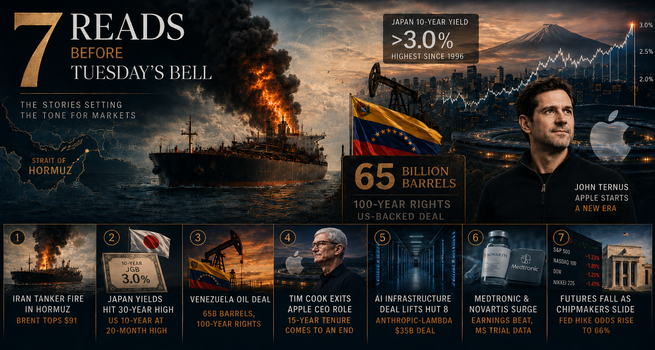
A supertanker caught fire in the Strait of Hormuz after Iranian media reported it struck naval mines, even as US Central Command said no vessels had hit mines, sending Brent above $91 a barrel. Global Bond yields surged in tandem, with Japan's 10-year topping 3% for the first time since 1996, while Venezuela granted a US-backed firm 100-year rights to 65 billion barrels of oil and Tim Cook stepped down as Apple's CEO after fifteen years.
1. IRAN/HORMUZ: Supertanker Hits Mines and Catches Fire in Strait of Hormuz as CENTCOM Disputes the Claim; Brent Tops $91
A supertanker caught fire in the southern Strait of Hormuz after striking two naval mines, according to Iranian state media, though US Central Command said no vessels had hit mines in the waterway. The UK Maritime Trade Operations agency separately reported a tanker was struck by three unknown projectiles in the strait's southern shipping lane Monday, with no casualties reported. The flare-up follows Sunday's US strike on two Iranian rocket launchers on Larak Island, which an American official said were being prepared to fire mines into Hormuz, and Iran's retaliatory attacks on US bases in Jordan and the UAE. President Trump extended military threats to Kharg Island, Iran's key oil export hub. Iranian President Masoud Pezeshkian told the Shanghai Cooperation Organisation Summit that Tehran would reciprocate if Washington returns to the June interim deal's commitments. Brent Crude climbed above $91 a barrel and WTI rose 2.43% to $87.84, with the war now in its seventh month.
- Analysts characterized the Larak Island strike as an attempt to enforce the Hormuz blockade rather than a broadening of US war aims.
- Brent's 50-day Moving Average had been closing in on a bearish "death cross" below its 200-day average before this week's rebound, and the benchmark is now instead flirting with a bullish "golden cross" as its 10-day average nears its 100-day average, though that momentum is already fading; resistance sits at $94.83 and $102, with support at $85.41, $78.11, and $70.14.
- Risk note: conflicting accounts from Iranian state media and CENTCOM over whether a vessel struck a mine could drive further Volatility once either version is confirmed.
2. GLOBAL BONDS: Japan's 10-Year Yield Tops 3% for First Time Since 1996 as US 10-Year Hits 20-Month High; Gold Falls on Rate Pressure
Global bond yields surged across major markets as renewed Middle East hostilities reignited Inflation concerns. The US 10-year Treasury Yield rose 3 basis points to a 20-month high of 4.788%, while the 30-year climbed to 5.279%. Japan's benchmark 10-year yield jumped more than 6 basis points to move above 3% for the first time since 1996, and the 2-year Japanese government bond touched a 31-year high of 1.81% as investors weighed fiscal pressures ahead of Japan's 2027 budget. UK 10-year Gilts rose 10 basis points to 5.2501%, their highest since June 2008, while UK 30-year Gilts climbed to 5.8909%, a level last seen in March 1998. Treasury Secretary Scott Bessent said he expects Tokyo and the Bank of Japan to act to support the yen, which traded near 160.1 per dollar for a third straight session. Gold fell more than 1% to around $4,375 an ounce, its lowest since August 19, as elevated yields weighed on the metal. The CME FedWatch tool now prices a 66% probability of a September rate hike, up from 59.9% Monday.
- Japan's 2-year yield hitting a 31-year high alongside the 10-year's first move above 3% since 1996 shows fiscal and currency pressures in Tokyo are now translating directly into borrowing costs.
- Risk note: if Japan intervenes to support the yen by selling US Treasurys, given its status as the largest foreign holder of US debt, that could compound the pressure already pushing American yields higher.
3. VENEZUELA: NABEP Wins 100-Year Rights to 65 Billion Barrels as US Takes 35% Equity Stake in Landmark Oil Deal
Venezuelan interim authorities granted North American Blue Energy Partners 100-year concessions covering 17 oil fields with proven reserves of about 65 billion barrels, the White House confirmed. NABEP, Venezuela's second-largest private oil producer, granted the US Department of War's Office of Strategic Capital a 35% equity stake in its corporate parent, representing what the White House called up to hundreds of billions in value and dividends for the United States. The arrangement guarantees Washington the right to buy 20% of all current and future field output at production cost, plus right of first refusal on the remaining 80%, aiding efforts to refill the US strategic petroleum reserve. NABEP has committed to invest up to $100 billion in new infrastructure and will pay $200 billion in royalties and taxes over the first 25 years. Analysts remained skeptical the deal could meaningfully boost near-term US output or lower gas prices, citing the Investment needed to revive production that has languished for decades under mismanagement and sanctions.
- The equity stake structured through the Department of War's Office of Strategic Capital signals Washington is treating Venezuelan crude access as a strategic reserve question rather than a purely commercial transaction.
- Risk note: with decades of underinvestment in Venezuelan infrastructure, the 65 billion barrels represents a reserve estimate rather than near-term deliverable supply, so oil price relief investors might expect is unlikely soon.
4. APPLE: Tim Cook Steps Down as CEO After 15 Years, Becomes Executive Chairman as John Ternus Takes Over Amid AI Pressure
Tim Cook transitioned to executive chairman at Apple (NASDAQ:AAPL) on September 1, ending a fifteen year run as CEO during which the company grew from a $350 billion Business to one valued at more than $4.5 trillion, with hardware chief John Ternus taking over as CEO. Under Cook, annual sales rose from $108 billion to $416 billion in the last fiscal year while profit grew more than fourfold to $112 billion, driven substantially by services Revenue built on Apple's 2.5 billion installed device base. Cook will continue guiding Apple's dealings with policymakers amid tense US-China relations, an area critical to a company shifting iPhone assembly toward India and Vietnam. Critics have pointed to Cook era setbacks including the abandoned electric vehicle project, the botched 2012 Apple Maps launch, weak Vision Pro sales, and delays overhauling Siri as evidence Apple has lagged rivals on AI. Ternus inherits the task of proving AI will be more than an app on the iPhone as Apple enters what analysts describe as its most ambitious product cycle in years.
- Cook's operations first approach, turning Apple's Supply chain into a durable advantage and its installed base into a recurring services engine, is a different value creation model than the product design Leadership of the company's prior era.
- Risk note: with AI cited as Ternus's biggest challenge and Siri's overhaul already delayed, further slippage could pressure Apple's premium valuation relative to peers already shipping generative AI products.
5. AI INFRASTRUCTURE/AMAZON: Hut 8 Jumps on Reported $35 Billion Anthropic-Lambda Data Center Deal as Amazon Faces FTC Antitrust Suit
Hut 8 (NASDAQ:HUT) shares rose as much as 1.73% pre-market after reports the company will develop a Texas data center site tied to a newly disclosed $35 billion Cloud Computing agreement between Anthropic and Nvidia backed Lambda, with Nvidia itself holding the underlying lease. The deal follows Hut 8's July disclosure of 15 year leases across its entire 700 megawatt Texas campus and adds to a pipeline that already includes work for Anthropic using Google TPUs and roughly $19.6 billion in contracted capacity across 949 megawatts. Separately, the Federal Trade Commission and 22 states sued Amazon (NASDAQ:AMZN), alleging the company has systematically overcharged advertisers on its platform since 2019 by secretly manipulating minimum Advertising prices. The FTC called it the agency's third case against Amazon, which denied wrongdoing. The two stories underscore how AI infrastructure buildout and legacy platform practices are both drawing intensifying capital and regulatory scrutiny simultaneously.
- Hut 8's transition from a pure play Bitcoin miner to an AI infrastructure provider is being validated by a third major hyperscaler-adjacent contract in as many months.
- Risk note: a third FTC case against Amazon in relatively quick succession raises the prospect of cumulative regulatory exposure across multiple business lines at once.
6. MEDTRONIC/NOVARTIS: Both Surge More Than 4% Pre-Market on Distinct Catalysts as Healthcare Leads Early Gains
Medtronic (NYSE:MDT) shares rose as much as 5.12% pre-market after a fiscal first quarter 2027 beat, with revenue of $9.76 billion topping a $9.55 billion estimate, up 13.7% year over year, and adjusted Earnings Per Share of $1.45 beating a $1.39 consensus, driven by 18.9% growth in the cardiovascular segment including 88% growth in cardiac ablation solutions. Management raised full year 2027 guidance to 7.25% to 7.75% organic revenue growth and $5.94 to $6.00 non-GAAP earnings per share, while announcing an investment of up to $80 million in Pi-Cardia and a $700 million Partnership with Stereotaxis. Novartis (NYSE:NVS) shares rose as much as 5.16% after its drug remibrutinib met primary endpoints in two Phase 3 multiple sclerosis studies, REMODEL-1 and REMODEL-2, showing superiority over teriflunomide in reducing relapse rates with a favorable safety profile. The gain was partly offset by reports Novartis paused eight trials of its experimental CAR-T cell therapy after three patient deaths from severe immune reactions, prompting regulator and safety monitoring board scrutiny.
- Medtronic's raised guidance alongside two new structural investments signals management views the current growth rate as durable rather than a one quarter anomaly.
- Risk note: Novartis investors are weighting the strong MS data more heavily than the CAR-T safety setback for now, but an extended clinical hold could weigh on sentiment once the data's novelty fades.
7. MARKET SETUP: Futures Fall as Chipmakers Slide on Rising Yields; Robinhood and Duolingo Rally on Upgrades, Army Secretary Resigns
US stock futures fell Tuesday, with Dow futures down 240 points, S&P 500 futures off 0.5%, and Nasdaq 100 futures down nearly 1%, as rising bond yields pressured technology shares. Chipmakers fell broadly, with the VanEck Semiconductor ETF down more than 1% and Nvidia, AMD, and Micron all lower by a similar margin, while Microsoft fell 1% and Alphabet slipped 0.6%. Energy stocks moved higher alongside oil, with the Energy Select Sector SPDR ETF up more than 1% and EOG Resources, Diamondback Energy, and Targa Resources each gaining more than 1%. Robinhood Markets (NASDAQ:HOOD) rose more than 2% after a Morgan Stanley upgrade to overweight, while Duolingo (NASDAQ:DUOL) climbed 6% after an Evercore ISI upgrade to outperform.
Dan Driscoll, the US Army Secretary, resigned following repeated clashes with Defense Secretary Pete Hegseth, who has dismissed at least 24 generals including the country's most senior army officer, leaving the largest branch of the US armed forces without a civilian leader. In Asia, Japan's Nikkei 225 closed 0.15% lower and China's CSI 300 fell 0.30%, while South Korea's Kospi rose 0.23%; the Stoxx 600 fell 0.6% in Europe, with oil and gas shares up 1.3%. This week brings the ADP employment report Wednesday and August nonfarm payrolls Friday.
- Chipmakers falling in tandem with rising yields while energy rallies on the same Iran headlines shows a single geopolitical catalyst producing opposite sector reactions depending on rate sensitivity.
- Risk note: the Army Secretary's resignation leaving the military's largest branch without civilian leadership arrives during active US engagement with Iran, a vacuum that could complicate policy coordination if hostilities escalate further this week.

 Nov 27, 2026





 Please wait processing your request...