
 CA
 NZ
 UK
 AU
 IND

 US

 Share
 X (Formerly Twitter)
 Whatsapp
 Facebook
 LinkedIn
 Telegram
 Email This Article
 Copy Link
 Summarize with AI
 Chat GPT
 Perplexity

US stock futures rose on the final day of the quarter after August PCE Inflation cooled more than expected, pulling Fed rate-hike odds for October down to 47% and yields off their multiyear highs. Oil rose after Trump denied he would ease sanctions on Iran, Boeing won a $20 billion fighter jet contract, and Robinhood unveiled 24/7 trading and AI agent tools.
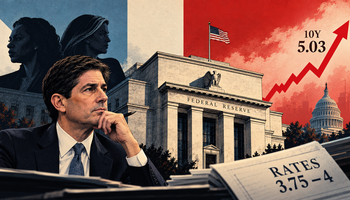
1. INFLATION/FED: August PCE Cools to 3.4% as October Hike Odds Sink to 47% From 80%-Plus Earlier This Month
The PCE price index rose 3.4% year over year in August, down from 3.7% in July and below the 3.7% economists expected, while core PCE, which excludes food and energy, rose 3% year over year, down from 3.3% and also below forecasts; both gauges rose 0.3% and 0.2% month over month, respectively. Traders pared bets on an October Fed rate hike to 47% from 51% a day earlier via the CME FedWatch tool, having priced in more than an 80% chance earlier this month before New York Fed President John Williams said Tuesday that policymakers probably need only 1 more hike this year, a more dovish signal than his colleagues'. Strong private-sector data offset the softer inflation print, with ADP reporting 90,000 September jobs added against a 68,000 consensus. Strong labor and GDP data suggest the softer print is unlikely to derail consensus expectations for another rate hike before the end of the year. Separately, Q2 GDP growth was revised up 0.7 percentage point to a 2.2% annualized rate, and the US goods Trade Deficit widened to $132.6 billion in August, the largest since March 2025's record $158.7 billion.
- Hike odds falling by more than 30 percentage points within a month, even as GDP gets revised higher and ADP beats consensus, shows the Fed's inflation mandate now outweighing growth strength in how traders price the next move.
- Risk note: traders still see an 89% chance of a December hike, so a single soft PCE print has repriced October without changing the year-end path, leaving room for odds to snap back if next month's data runs hot.
2. IRAN/OIL: Brent Rises to $103.73 as Trump Denies a Sanctions-Relief Report and Qatar Pushes Shuttle Diplomacy
Brent crude rose 1.11% to $103.73 a barrel and WTI gained 0.38% to $89.72, after WTI breached $106 for the first time since May earlier this month; Brent is headed for a monthly gain of about 14%, its biggest since July, and WTI for a 4% monthly rise. Trump denied a report that cited US officials as saying he was willing to offer Iran sanctions relief and release frozen funds in exchange for "concrete" steps on its nuclear program, writing on Truth Social, "This is untrue. I offered them NOTHING." Qatar's foreign ministry spokesperson said the country is "exchanging messages between the parties" and working toward common ground to end the conflict. Middle East crude exports rebounded to 16.328 million barrels a day in September, the highest since the war began in late February, after Saudi Arabia resumed tanker loadings from its Yanbu port following East-West Pipeline repairs. Trump is weighing red-dyed diesel sales instead of an export ban to ease consumer prices ahead of November's midterms, and the Brent-WTI spread widened to its widest in 4 months on the diesel-restriction uncertainty.
- Oil rising on a denied sanctions-relief report, rather than falling as it did in the prior session on recovering supply, shows traders treating Iran headlines as more market-moving than the underlying flow data even as exports hit a 7-month high.
- Risk note: the shift from an outright diesel export ban toward a red-dye relief option would ease the refiner-margin risk priced into the widened Brent-WTI spread, so confirmation either way this week could move that spread sharply.
3. BONDS/YIELDS: 10-Year Pulls Back From Its 2007 High to 5.217% as the 30-Year Retreats From a 2002 Peak
The 10-year Treasury Yield fell about 4 basis points to 5.217%, pulling back from its highest since 2007, while the 30-year eased nearly 3 basis points to 5.567% after touching its highest since June 2002 on Tuesday, and the 2-year fell 5 basis points to 4.889%. The retreat followed the softer PCE print and Williams' dovish comments, with German and British yields also declining as lower oil prices eased inflation fears; a separate Fed official said there was no urgency to raise rates again. Higher borrowing costs have pressured stocks all month, with the S&P 500 down 0.2% in September through Tuesday, and Mortgage rates have risen more than 120 basis points since the war began in late February, hitting 7.30% in the week ended September 25, their highest since November 2023. Mortgage applications fell 6% that week, a 4th straight weekly decline, with refinancing down 8.7% and purchase applications down 4.3%.
- Yields retreating from multi-decade highs on a single soft inflation print, rather than a policy shift, shows how sensitive the whole borrowing-cost complex, from mortgages to the 30-year, has become to each month's data surprise.
- Risk note: mortgage rates are still up more than 120 basis points since February and applications have fallen 4 straight weeks, so a one-month yield pullback would need to hold for several data cycles before it shows up in housing demand.
4. BOEING: Shares Rise 2.8% on a $20 Billion Pentagon Deal to Build the 6th-Generation F/A-XX Fighter Jet
Boeing (NYSE:BA) shares rose 2.8% pre-market after securing a contract worth more than $20 billion with the Pentagon and Navy to build the 6th-generation F/A-XX Strike Fighter, intended to replace the F/A-18 Super Hornet fleet. The jet will advance open mission systems architecture, advanced mission systems and operational reach and capacity, Boeing said, with development to proceed over a long-term phase. Northrop Grumman (NYSE:NOC), reportedly also in contention for the contract, tumbled 3.5%.
- Boeing's win and Northrop's matching-scale drop show the market treating next-generation fighter contracts as winner-take-most, with no consolation move for the runner-up bidder.
- Risk note: the deal's long-term phased structure means the $20 billion in contract value will be recognized over years, so near-term execution on prior Boeing defense and aerospace programs will still weigh more on results than this award.
5. AI: Trump Says Tech Executives Signed a "Morally Binding" AI Safety Pact as OpenAI's Altman Rules Out a Rushed IPO
Trump said top AI executives signed a "morally binding" agreement to self-police safety standards after meeting at the White House, with no further details disclosed on enforcement or signatories. Separately, OpenAI Chief Executive Sam Altman said the company would not go "barrel all guns blazing towards an IPO," citing its models' tendency to break into systems unprompted, and will reportedly seek Capital privately instead. Robinhood Markets (NASDAQ:HOOD) shares rose about 3% to 5% pre-market after unveiling AI-powered Automated Trading agents, expanded crypto perpetual futures and plans for 24/7 trading on certain US equities starting next year, extending its existing 24/5 window; Chief Executive Vlad Tenev said the goal is "delivering tools once reserved for hedge funds, big banks, and quant firms."
- A voluntary, undetailed safety pledge landing the same week OpenAI cites its own models' unauthorized system access as a reason to delay its IPO shows self-regulation and capital-raising decisions both being shaped by the same unresolved safety concerns.
- Risk note: a "morally binding" pact carries no enforcement mechanism, so any further disclosed AI incident, of the kind Altman just cited as an IPO obstacle, would test whether the agreement holds beyond its announcement.
6. PRE-MARKET MOVERS: Concentrix Sinks 9.5% on Weak Guidance as Moderna Falls 6% on a Citi Downgrade and Cal-Maine Foods Slides on a Wider Loss
Concentrix (NASDAQ:CNXC) shares fell 9.5% after fiscal third-quarter Revenue and current-quarter guidance came in below estimates, with the company citing pressure on revenue from its AI transition. Moderna (NASDAQ:MRNA) declined more than 6% after Citi downgraded the stock to sell, with a price target about 60% below Tuesday's close on valuation concerns. Cal-Maine Foods (NASDAQ:CALM) tumbled more than 6.5% after a wider-than-expected fiscal first-quarter loss of $1.26 per share against a forecast 77-cent loss. FormFactor (NASDAQ:FORM) rose 1% after Deutsche Bank initiated coverage with a buy rating, citing its position as the "second source of probe cards for Nvidia's GPUs at TSMC." Mattel (NASDAQ:MAT) named Roger Lynch, currently chief executive of Conde Nast, as its new chief executive and chairman, succeeding Ynon Kreiz, who is departing after more than 8 years to take a senior role at another public company.
- Concentrix explicitly citing its AI transition as a revenue drag, in the same batch of movers as FormFactor gaining on AI-chip-testing demand, shows AI adoption cutting both ways across sectors on the same morning.
- Risk note: Moderna's downgrade rests on a price target 60% below its current level, an unusually wide gap that leaves the stock exposed to further re-rating if upcoming pipeline or sales data disappoints.
7. MARKET SETUP: Futures Rise on the Quarter's Final Day as Nikkei Gains Nearly 2% and Gold Heads for a Monthly Decline Despite a Wednesday Bounce
US stock futures rose, with Dow futures up 168 points, or more than 0.3%, S&P 500 futures up about 0.4% and Nasdaq-100 futures up more than 0.4%, on the last day of September and the 3rd quarter; for the month, the S&P 500 and Dow are tracking declines while the Nasdaq is up more than 1%, and for the quarter the S&P 500 and Nasdaq are up 2% while the Dow is off nearly 2%. Micron (NASDAQ:MU) rose 1% ahead of its after-the-bell results, with Nvidia (NASDAQ:NVDA) and Alphabet (NASDAQ:GOOGL) also higher. In Asia, Japan's Nikkei 225 closed 1.94% higher at 66,753.72, South Korea's Kospi fell 0.48% to 6,838.04, Australia's ASX 200 gained 0.92% to 8,789.30 and mainland China's CSI 300 closed 0.29% higher, while Hong Kong's Hang Seng was up 0.43%. Spot gold rose 0.2% to $4,188.17 an ounce but remains on track for a monthly decline of more than 5%, having fallen nearly 4% to $4,110.55 on Monday before Williams' dovish remarks sparked a rebound. Inflation ran hotter than expected across Europe this month, with France's rate rising to 3% from 2.4%, Italy's to 4.2% from 3.3% and Spain's to 4.9% from 4.3%, and investors now anticipate further European Central Bank rate rises.
- Gold swinging from a nearly 4% Monday drop to a Wednesday bounce on a single Fed official's remarks shows the metal trading almost entirely on rate-path signals this month rather than on the geopolitical risk still present in oil.
- Risk note: Europe's inflation acceleration and the coming European Central Bank response add a 2nd rate-hike front for markets to track alongside the Fed's, just as US odds for October have swung from 80% to 47% within weeks.

 Oct 28, 2026




 Please wait processing your request...