
 CA
 NZ
 UK
 AU
 IND

 US

 Share
 X (Formerly Twitter)
 Whatsapp
 Facebook
 LinkedIn
 Telegram
 Email This Article
 Copy Link
 Summarize with AI
 Chat GPT
 Perplexity
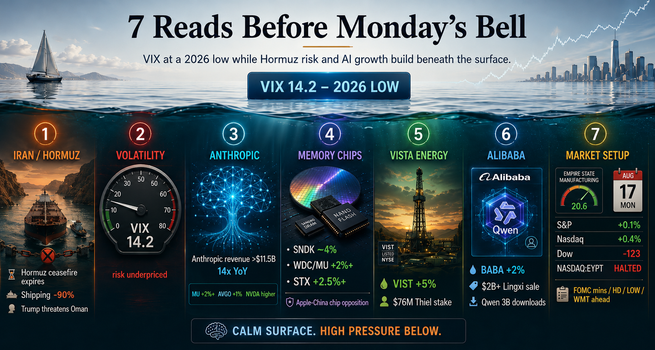
The 60-day US-Iran ceasefire expired Monday with no deal in sight, as Iran claimed full control of the Strait of Hormuz and Trump threatened to bomb Oman if it "gets in the way." Anthropic's second-quarter Revenue rocketed more than 14-fold to above $11.5 billion, lifting chip stocks, while the VIX sits at a 2026 low even as strategists warn markets are underpricing risk heading into a historically volatile stretch.
1. IRAN/HORMUZ: Ceasefire Expires With No Deal as Iran Claims Full Control of the Strait; Trump Threatens to Bomb Oman if It "Gets in the Way"
The 60-day ceasefire between the United States and Iran expired Monday with no official negotiations or deal in sight, as Iran claimed full control of the Strait of Hormuz a day earlier despite ongoing US attempts at backchannel talks with the Islamic Revolutionary Guard Corps. President Trump said the US would bomb Oman if the Gulf nation "gets in the way," even as Oman continues separate talks with Tehran aimed at reopening the strait to commercial transit. Trump described informal talks with Iran's Revolutionary Guard as ongoing but said the US is in no rush, adding that Iran must agree to never possess a nuclear weapon in any form. Shipping traffic through Hormuz has ground to a near-halt: only five cargo ships passed through the strait Saturday and none on Sunday, compared with 31 vessels the prior weekend, extending a decline that has left transit down roughly 90% since the war began on February 28. Iran's foreign minister said Saturday the two sides do not have anything resembling a ceasefire. Oil prices eased slightly Monday, with Brent down 0.15% to $88.45 and WTI down 0.74% to $81.79.
- Trump's explicit threat against Oman, the primary intermediary in Hormuz negotiations, risks collapsing the one diplomatic channel that has kept talks alive even as direct US-Iran engagement remains stalled.
- Risk note: with shipping already at roughly 10% of pre-war levels and both sides publicly disputing whether any ceasefire framework still exists, the practical difference between the expired ceasefire and open conflict may now be narrower than the diplomatic language suggests.
2. VOLATILITY: VIX Hits a 2026 Low of 14.2 as Strategists Warn Markets Are Underpricing Risk Heading Into a Historically Volatile Stretch
The CBOE Volatility index fell to 14.2 on Friday, its lowest level of 2026, even as the S&P 500 sits roughly 16% higher year to date and near record highs. One market technician noted that the VIX's retreat points to growing complacency heading into the mid-August to mid-October window, historically a choppier period for markets, particularly during mid-term election years, observing that the equal-weight S&P has pulled back at least 7% from its August peak through mid-October in every mid-term year since 1990.
The volatility reset was described elsewhere as substantial, with two-month implied volatility edging back toward pre-Iran-war levels near 13.5%, even as cross-asset and geopolitical risks remain active. Another analyst pointed to July's surprise 0.6% retail sales decline as a signal that US consumers are beginning to feel strain, adding that elevated long-end Treasury yields point to a very different picture than the one implied by the recent Equity rally.
- A 12-week consecutive run of equity fund inflows continuing alongside falling volatility, even as the Hormuz standoff and weak retail sales both point to building risk, suggests investor positioning has not caught up to the deteriorating fundamentals sitting beneath the market's calm surface.
- Risk note: record equity highs, near-zero volatility, and elevated long-term yields together form a historically unstable configuration; strategists specifically flagged this setup as one where a single piece of bad news could trigger an outsized repricing precisely because so little risk is currently priced in.
3. ANTHROPIC: Second-Quarter Revenue Surges More Than 14-Fold to Above $11.5 Billion, Lifting Chip Stocks Ahead of a Potential Record IPO
Anthropic's second-quarter revenue jumped at least 14-fold from a year earlier to more than $11.5 billion, up from $787 million in the same period last year and $4.73 billion in the first quarter of 2026, according to a Bloomberg News report citing internal documents. The quarter also marked the company's first period of positive adjusted operating income. The company is meeting with banks about a potential initial public offering that could rank among the largest on record. Chip stocks advanced broadly on the news: Micron Technology (NASDAQ:MU) rose more than 2%, Broadcom (NASDAQ:AVGO) gained around 1%, and Nvidia (NASDAQ:NVDA) traded higher as investors read the results as confirmation that AI Capital spending will remain sustained in the medium term.
- Revenue climbing more than fourteenfold year over year while also turning adjusted Operating Income positive for the first time signals a scale inflection point rather than simply continued high growth, a distinction that matters for how any IPO would ultimately be priced.
- Risk note: markets are now pricing chip Demand partly on the assumption that Anthropic-scale revenue growth is broadly representative of AI lab economics; if the next major lab to disclose financials shows a materially different trajectory, the read-through currently supporting semiconductor names could reverse quickly.
4. MEMORY CHIPS: Sandisk, Western Digital, Micron Rise as Commerce Secretary Says Administration Opposes Apple Buying Chinese Memory Chips
Domestic memory chipmakers rallied premarket Monday after Commerce Secretary Howard Lutnick told the Wall Street Journal the Trump administration opposes Apple (NASDAQ:AAPL) purchasing memory chips from Chinese suppliers. Sandisk (NASDAQ:SNDK) jumped nearly 4%, extending sharp gains from the prior week, while Western Digital (NASDAQ:WDC) and Micron each rose more than 2%; Seagate Technology (NASDAQ:STX) gained more than 2.5%. The move builds on a broader rally that began with Sandisk's Investor Day guidance last week and continued Monday alongside the separate boost from Anthropic's revenue disclosure.
- A policy signal steering a major US buyer like Apple away from Chinese memory suppliers functions as a direct demand transfer toward domestic and allied producers, reinforcing rather than competing with the AI-driven demand story already lifting the same names.
- Risk note: Lutnick's comments were characterized as opposition rather than a formal restriction, leaving open whether this becomes binding policy or remains informal pressure; the scale of today's rally implies markets are pricing in the more restrictive outcome before any formal action has been confirmed.
5. VISTA ENERGY: Shares Jump 5% After Peter Thiel's Hedge Fund Discloses $76 Million Stake in the Argentine Shale Producer
Vista Energy (NYSE:VIST) shares rose as much as 5% premarket after a regulatory filing showed Peter Thiel's Thiel Macro LLC held nearly 1.2 million American Depositary Shares worth about $76 million as of June 30, roughly a 1% stake in the company. The position was Thiel Macro's second-largest disclosed holding after Amazon, and one of seven new positions the fund reported, six of which were in energy or Utility companies including American Electric Power, DTE Energy, and Vistra. Vista Energy operates in Argentina's Vaca Muerta shale formation and has invested more than $6.5 billion in the country; Thiel relocated to Buenos Aires earlier this year and has since met with senior officials in President Javier Milei's government.
- Thiel Macro's heavy weighting toward energy and utility names in its newly disclosed positions suggests a broader fund-level bet on the sector rather than a stock-specific view of Vista alone, which explains the sympathetic tailwind but also means Vista's rally is partly borrowed from a sector-wide thesis.
- Risk note: Thiel's direct relationships with Argentina's economic policymaking team raise the question of whether his Vista position reflects an access advantage tied to Milei's reform agenda, a dynamic worth monitoring given the stock's exposure to Argentine regulatory and currency policy.
6. ALIBABA: Shares Rise on Report of $2 Billion-Plus Lingxi Games Sale to Trustar Capital, Part of a Pivot Toward AI and Core Commerce
Alibaba Group (NYSE:BABA) shares rose as much as 2% premarket after Reuters reported the company has reached a formal agreement to sell its Lingxi Games unit to Private Equity firm Trustar Capital for more than $2 billion, citing a person familiar with the matter. The divestiture is described as part of a broader strategic pivot toward artificial intelligence and core E-commerce operations. The news follows data showing Alibaba's open-source Qwen AI models have surpassed 3 billion global downloads over six months, overtaking Meta and Google's Gemini and Llama models to become the world's most-downloaded AI model family, reinforcing investor optimism around the company's AI monetization strategy following a difficult year marked by weak Earnings and an Anthropic intellectual property dispute that triggered a securities class action lawsuit.
- Divesting a gaming unit to fund AI and commerce Investment signals Alibaba is actively reallocating capital away from non-core businesses at the same time its open-source AI models are gaining real distribution scale, strengthening the narrative shift the stock has needed after a difficult year.
- Risk note: Qwen's download lead does not by itself confirm monetization, and Alibaba's ongoing legal dispute with Anthropic over intellectual property remains unresolved, meaning the AI optimism currently supporting the stock could face a setback if that litigation produces an unfavorable outcome.
7. MARKET SETUP: Empire State Manufacturing Hits a Four-Year High as Futures Are Flat; EyePoint Halted on a Trial Miss, Week Ahead Brings FOMC Minutes and Walmart Earnings
The Empire State Manufacturing Survey's general Business conditions index rose five points to 20.6 in August, its highest reading in more than four years, with new orders and shipments both posting solid gains even as Supply availability continued to worsen and delivery times lengthened substantially. S&P 500 futures were roughly flat Monday, up 0.1%, while Nasdaq 100 futures gained 0.4% and Dow futures slipped 123 points, coming off a third consecutive weekly gain for the S&P 500. EyePoint Pharmaceuticals (NASDAQ:EYPT) was halted premarket after its experimental eye drug Duravyu missed the primary endpoint in a late-stage trial against standard treatment aflibercept for wet age-related macular degeneration, with the company attributing the miss to a small patient cohort skewing results; shares had fallen more than 64% before the halt. Intel (NASDAQ:INTC) rose about 1.5% after a regulatory filing showed CEO Lip-Bu Tan purchased more than 105,000 shares at $95 each last week. Semiconductor names broadly advanced, with Marvell Technology (NASDAQ:MRVL) and Arm (NASDAQ:ARM) both up 2%, Applied Materials up 1.5%, and Broadcom and AMD (NASDAQ:AMD) both higher by 1%. The week ahead brings FOMC minutes Wednesday, Home Depot (NYSE:HD) and Lowe's (NYSE:LOW) earnings Tuesday and Wednesday, and Walmart (NASDAQ:WMT) earnings Thursday.
- The Empire State index's four-year high alongside worsening supply availability and lengthening delivery times suggests demand strength is currently outpacing the manufacturing sector's capacity to fulfill it, a combination that historically feeds through to higher input costs.
- Risk note: EyePoint's binary trial outcome is a reminder that this week's broader market calm, discussed in story two, coexists with genuine single-stock volatility; a cluster of similar surprises during an otherwise catalyst-light week could disproportionately move sentiment given how little volatility is currently priced in.


 Nov 27, 2026





 Please wait processing your request...