
 CA
 NZ
 UK
 AU
 IND

 US

 Share
 X (Formerly Twitter)
 Whatsapp
 Facebook
 LinkedIn
 Telegram
 Email This Article
 Copy Link
 Summarize with AI
 Chat GPT
 Perplexity

Key Highlights
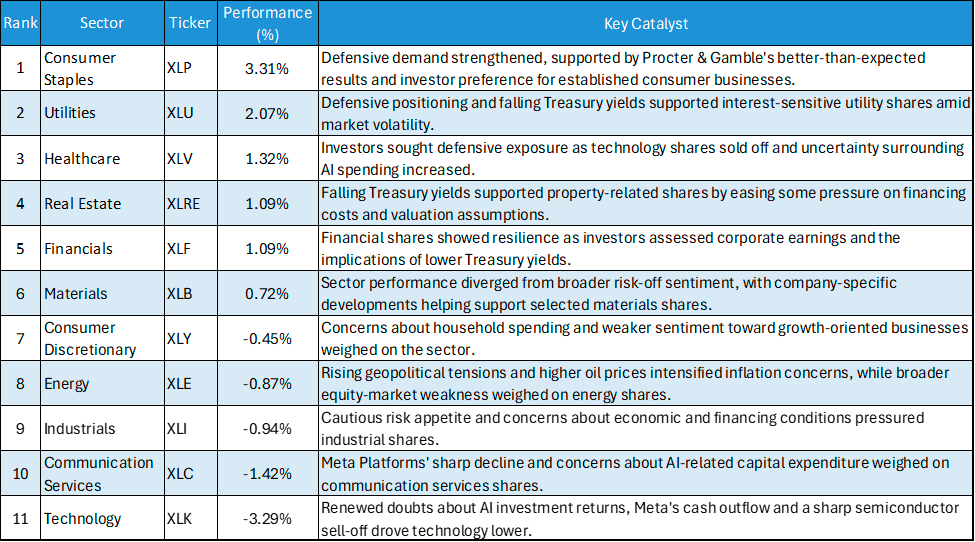
- Consumer Staples (XLP) led all eleven sectors, rising 3.31%, as investors rotated toward defensive businesses amid heightened market uncertainty.
- Utilities (XLU) gained 2.07%, while Healthcare (XLV) advanced 1.32%, reflecting Demand for defensive exposure during the technology-led sell-off.
- Real Estate (XLRE) and Financials (XLF) each rose 1.09%, while Materials (XLB) gained 0.72%, demonstrating that gains extended beyond traditional defensive sectors.
- Consumer Discretionary (XLY) declined 0.45%, while Energy (XLE) and Industrials (XLI) fell 0.87% and 0.94%, respectively.
- Communication Services (XLC) dropped 1.42%, while Technology (XLK) was the weakest sector, plunging 3.29% amid renewed concerns about the sustainability of artificial intelligence investment.
- The 6.60-percentage-point gap between Consumer Staples and Technology highlighted a pronounced shift in sector Leadership and investor risk appetite.
US sector performance on 22 October 2026 reflected a decisive rotation away from technology-oriented investments and toward defensive sectors. Consumer Staples delivered the strongest gain, followed by Utilities and Healthcare, while Real Estate and Financials also advanced. In contrast, Technology suffered the largest decline as corporate Earnings renewed concerns about the cost and financial returns of artificial intelligence investment. The broader market faced additional pressure from geopolitical tensions in the Middle East and rising oil prices, which heightened Inflation concerns. The session highlighted a substantial divergence between defensive sectors and businesses more exposed to growth expectations and technology spending.
Performance Breakdown by Sector
Consumer Staples Leads as Investors Seek Defensive Exposure
Consumer Staples surged 3.31%, making it the strongest sector in the supplied data. The advance reflected a shift toward businesses with relatively resilient demand during periods of market uncertainty. Procter & Gamble's better-than-expected results provided an additional positive catalyst, reinforcing interest in established consumer products companies.
Utilities gained 2.07%, while Healthcare advanced 1.32%. Both sectors benefited from their defensive characteristics as investors reassessed risk following the technology sell-off. Falling Treasury yields also supported interest-sensitive assets, helping Real Estate rise 1.09%. Financials recorded an identical gain, indicating that the rotation was not limited to traditional defensive sectors.
However, defensive outperformance does not necessarily establish a lasting market trend. Sustained leadership will depend on earnings resilience, financing conditions and whether investor concerns about technology spending persist.
Technology and Communication Services Face AI Spending Concerns
Technology plunged 3.29%, the weakest performance among the eleven sectors. Renewed concerns about the financial sustainability of AI Investment intensified following corporate earnings announcements. Meta Platforms fell sharply despite beating earnings expectations, as investors focused on substantial AI-related expenditure, negative free Cash Flow and plans to raise additional capital. Semiconductor shares also suffered heavy losses, amplifying pressure on the technology sector.
Communication Services declined 1.42%, reflecting weakness in major companies with substantial AI investment requirements. The sell-off demonstrated that investors were increasingly scrutinising the relationship between Capital expenditure, cash generation and expected future returns. Strong Revenue growth alone was insufficient to reassure markets when spending requirements and profitability remained uncertain.
Consumer Discretionary slipped 0.45%, while Industrials fell 0.94%. These declines suggested that risk aversion extended beyond technology, although the relatively modest losses compared with XLK indicated different levels of exposure to the market's immediate concerns.
Mixed Performance Across Materials and Energy
Materials gained 0.72%, contrasting with weakness across several economically sensitive sectors. Financials also advanced 1.09%, while Energy declined 0.87% despite rising oil prices associated with geopolitical tensions. This divergence illustrated that sector returns reflected broader equity-market positioning, company-specific developments and changing risk perceptions, rather than movements in Commodity prices alone.
The rise in oil prices also increased concerns about inflation and the potential implications for Federal Reserve policy. Investors will need to assess whether higher energy costs place additional pressure on consumers and businesses, particularly if elevated prices persist.
Strategic Summary
The 22 October session showed a pronounced rotation toward defensive sectors, led by Consumer Staples, Utilities and Healthcare. Technology and Communication Services were the principal areas of weakness as investors questioned the financial returns from large-scale AI investment. The 6.60-percentage-point performance gap between XLP and XLK underscored the scale of the divergence.
Investors should monitor upcoming earnings, AI Capital Expenditure plans, semiconductor performance, Treasury yields and geopolitical developments. The session provides evidence of defensive leadership, but one day's returns cannot confirm a durable sector rotation. Sustained leadership will depend on whether defensive earnings remain resilient and whether technology companies can demonstrate that their substantial AI investments will generate adequate future returns.


 Oct 26, 2026




 Please wait processing your request...